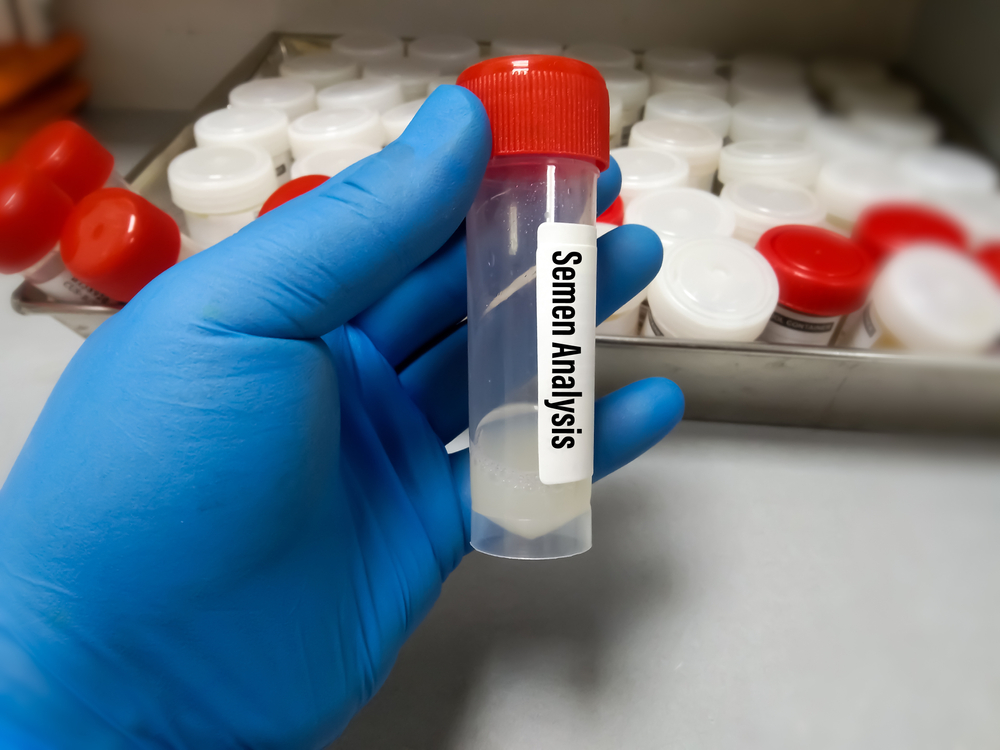
A semen analysis test is a laboratory test that examines an ejaculated semen sample to measure sperm count, movement (motility), shape (morphology), and volume. It is also called an HSA test, a seminogram, a sperm test, or a sperm count test, and each name refers to the same investigation. It is the first test in a male fertility assessment and, for most couples, the only test needed to determine whether a male factor is present
What is an HSA test?
HSA stands for Human Semen Analysis, and an HSA test is the same test as a semen analysis. Indian laboratories and requisition slips use HSA, semen analysis, seminogram, sperm test and sperm count test interchangeably, which is why one investigation turns up under several names on different forms. If your doctor has written HSA on your request slip, you are being asked for a standard semen analysis and nothing more specialised. There is no separate preparation and no separate sample attached to the abbreviation.
What does a semen analysis test measure?
A standard semen analysis measures six things in a single sample.
Semen parameter
What it measures
Volume
How much fluid the ejaculate contains, which affects how the sperm are carried
Sperm concentration
How many sperm are present in each millilitre of semen
Total sperm count
How many sperm the whole sample contains, not just each millilitre
Motility
How many sperm are moving, and how many are moving forward rather than in place
Morphology
How many sperm have a normally formed head, midpiece and tail
Vitality
How many sperm are alive, checked when the proportion of moving sperm is low
None of these is pass-or-fail figures on their own. Each is compared against a reference value, and the meaning comes from the pattern across all six rather than any single number. For what each value means once your report is in front of you, see how to read your semen analysis report. Two measures have their own details worth reading separately: sperm motility and sperm morphology.
Who needs a semen analysis and when?
A semen analysis is requested in five situations, and in four of them, before anything has gone wrong.
After twelve months of trying, or after six months if the female partner is over 35, when conception has not happened with regular unprotected intercourse.
Before IUI, IVF or ICSI: because the treatment chosen depends on how much usable sperm is available.
After a vasectomy: to confirm that no sperm remain in the ejaculate before contraception is stopped.
Before sperm freezing, or where there is a known varicocele or a history of cancer treatment: to record a baseline while one can still be recorded.
In India, evaluation of the male partner is often delayed until after the female partner has already undergone months of testing. That order is worth questioning: a semen analysis is faster and far less invasive than most of the female workup, and it answers roughly half the question on its own.
How many days should you abstain before a semen analysis?
No, a longer gap does not improve the result. The usual instruction is to abstain from ejaculation for two to five days, which sits inside the wider window of two to seven days that the World Health Organisation laboratory manual specifies. Less than two days lowers both volume and total count. Beyond about seven days, the count keeps climbing, but motility begins to fall, so a very long gap makes the sample less representative of you, not more. Keep the same gap for any repeat test; otherwise, the two reports are not comparable.
In the few days before the test:
Keep the scrotum cool. Hot baths, saunas, steam rooms and a laptop resting on the lap all raise local temperature, and sperm production is sensitive to heat.
Go easy on alcohol. Heavy drinking in the preceding weeks can lower the result.
Tell the team what you are taking. Prescription medicines, supplements, and Ayurvedic or other traditional preparations are all worth disclosing, because several drug classes affect sperm production or ejaculation.
Mention any fever in the last three months. Sperm take roughly 72 to 90 days to develop, so an illness with fever in that window can materially change the sample. Better to record it than to have the result read as your baseline.
How is a semen analysis sample given, step by step?
The whole visit usually takes 15 to 30 minutes, and most of that is waiting.
Arrive at the laboratory and confirm how many days it has been since you last ejaculated. This is written on the request form, so give the real figure.
A staff member will show you to a private collection room. Nobody is present, and there is no time pressure.
Wash and dry your hands. Do not use soap residue, saliva, or any lubricant, including anything you have brought with you.
Collect the full ejaculate into the sterile container provided. The first portion matters most, so aim the start of the ejaculate into the container rather than catching the end of it.
Write the collection time and your name on the container. The laboratory needs the exact time because the clock on the sample starts then.
Hand the container to the laboratory staff directly rather than leaving it at a counter. At this point, tell them if any part of the sample was spilt.
No needles, instruments, or physical examination are involved at any stage. If you are dreading the appointment, that is the part worth knowing in advance.
What invalidates a semen sample?
No, a sample collected in an ordinary condom, by withdrawal, or with lubricant cannot be analysed. These are not laboratory preferences. Each one changes the sample enough that the results would be wrong, and a wrong number on a fertility report is worse than none.
Ordinary condoms. Standard condoms are treated with agents that damage sperm and interfere with movement, so a sample collected in one cannot be read for motility.
Withdrawal. The first fraction of the ejaculate carries most of the sperm and is almost always lost this way. The sample is also exposed to vaginal fluid, which is acidic enough to affect sperm survival.
Lubricants and saliva. Both impair sperm movement on contact, so motility may be underreported even when everything else about the sample is fine.
A partial sample. If part of the ejaculate is spilt, volume and total count cannot be measured, and concentration is misleading. Report a spill rather than quietly submitting the remainder. It saves a repeat test.
A sample past its transport window. Motility falls steadily from the moment of collection, so a sample that has been sitting for hours no longer describes the sperm that were in it.
There is one accepted alternative. Where masturbation is not possible, for personal or religious reasons or because of a physical difficulty, laboratories can supply a special non-spermicidal collection condom designed for the purpose. It is not the same product as a contraceptive condom, and it has to be arranged in advance.
Can a semen analysis be done at home?
No, not unless you can meet three conditions. Home collection is genuinely offered, and it suits plenty of people, but it is not equivalent to collecting in the clinic. It has three failure points, and all three sit with you rather than the laboratory.
The container. It must be the sterile container the laboratory supplied. Household containers carry detergent residue, and detergent kills sperm.
The temperature. Keep the container close to body temperature and away from cold. The World Health Organisation manual specifies a transport range of roughly 20 to 37 degrees Celsius, narrowed in the sixth edition to about 20 to 27 degrees. An inside pocket meets this comfortably.
The clock. The sample must reach the laboratory within about 60 minutes of collection, and 30 minutes gives a materially better motility reading. Traffic counts against you here.
The explicit negatives. Do not refrigerate it. Do not courier or post it. Do not decant it into anything else. Each of these invalidates the sample outright rather than degrading it.
Collecting at the clinic removes all three failure points, which is why it remains the default. If the journey from your home to the centre is longer than 30 minutes in normal traffic, collect at the clinic.
What happens if you cannot produce a sample at the clinic?
No, this is not a fertility finding. Difficulty producing a sample in a clinical room is common; it has nothing to do with fertility, and it is not recorded as a result of any kind. A hospital collection room is an unfamiliar setting with a task attached and an appointment slot running, which is close to the definition of a situation that makes performance harder. Tell the team. The appointment is rescheduled, or home collection is arranged instead, and nothing goes on your file. It is a scheduling problem, not a clinical one.
What does a healthy semen sample look like?
No, appearance tells you nothing about sperm count. A normal sample and a severely abnormal one look identical to the eye.
Colour. Greyish white to slightly yellow is normal, and the shade varies between samples from the same person.
Consistency. Thick at first, then liquefying to a watery consistency within about 30 minutes. This liquefaction is normal, not a sign of anything.
Volume. Roughly one and a half to five millilitres, which is less than most people expect and is not related to the number of sperm in it.
A normal-looking sample can contain almost no sperm, and an odd-looking sample is very often entirely normal. Sperm are microscopic; there are no visible cues to count, movement, or shape. Two changes are worth mentioning to the team rather than interpreting alone: pink or red colouring, which can indicate blood, and a persistent strong yellow across repeated samples.
What happens to the sample in the laboratory?
Five things, in this order, and the timing of the first one is why transport time matters.
Liquefaction. The sample is left for 20 to 30 minutes to change from thick to watery, usually at 37 degrees Celsius. Nothing can be measured accurately until this has happened.
Macroscopic assessment. Volume, appearance, viscosity and pH are recorded, all properties of the fluid rather than the sperm.
Microscopic assessment. Concentration, motility and morphology are counted under the microscope. Motility is assessed first because it decays fastest.
Vitality staining. Where the proportion of moving sperm is low, a stain distinguishes sperm that are alive but immobile from sperm that are dead. That distinction changes what happens next clinically.
Computer-assisted analysis, where used. Some laboratories add automated tracking of sperm movement alongside the manual count, rather than replacing it.
Motility is measured at the start of this sequence, not the end. That is the reason a sample sitting in a car for 90 minutes produces a lower motility figure than the same sample would have produced in the clinic.
How long does a semen analysis report take?
A basic semen analysis is typically reported within 24 to 48 hours of the sample reaching the laboratory, and morphology can take longer, as it is prepared and read separately. A specialist reviews the report rather than handing over a number, because a single parameter read on its own is easy to overinterpret in both directions. We confirm turnaround at your centre when you book.
Does one abnormal semen analysis mean you are infertile?
No, a single abnormal result does not mean you are infertile. Sperm take roughly 72 to 90 days to develop, so the sample you gave this morning reflects the previous three months, not today. A fever, a viral illness, sustained heat exposure or a period of heavy drinking anywhere in that window can lower the result temporarily and then reverse. One report is a data point, not a diagnosis.
When a repeat test is appropriate:
A borderline result: repeat at two to four weeks, with the abstinence period standardised to the same number of days as the first test.
A clearly abnormal result: repeat in four to eight weeks, allowing time for a temporary cause to clear.
After a significant lifestyle change: repeat at 90 days or more, because anything less than a full production cycle will not show the effect.
At the same laboratory: different laboratories use different methods and different technicians, and the variation between them can be larger than the change you are trying to detect.
What is an advanced semen analysis or a DFI test?
A standard semen analysis counts and describes sperm, but it does not assess the DNA carried inside them. Sperm that look normal and move normally can still carry fragmented DNA, and that is what a sperm DNA fragmentation index test measures. It is an additional test for specific questions rather than part of the routine workup, and most men having a first semen analysis do not need it. If it has been suggested to you, or you have seen the term advanced semen analysis, read our guide to sperm DNA fragmentation testing, or see DFI testing at Cloudnine Fertility.
There are three broad outcomes, and each has a different next step.
Within the reference range: this test identifies no male factor, and the assessment continues with the female partner. Read how to read your semen analysis report to understand what your own figures describe.
Clearly abnormal: the next step is to find the cause rather than move straight to treatment. Where assisted conception is the route, the options usually discussed are IUI and ICSI, depending on the parameters.
Counselling is available at every Cloudnine Fertility centre and is worth using now, not later. A semen analysis result lands differently from most test results, and talking it through is a normal part of the process.
Want to consult the Best Fertility in india? Please find the links below.
Find clear, trusted answers to the most common questions about IVF—designed to guide and support you every step of the way.
What is a semen analysis test?
A semen analysis test is a laboratory test that examines an ejaculated semen sample to measure sperm count, movement, shape, volume, and a few other markers. It is the first investigation in a male fertility assessment and is usually the only test needed to establish whether a male factor is present. At Cloudnine Fertility, our andrology laboratory analyses the sample, and a specialist reviews the report with you rather than handing over a set of numbers.
What is an HSA test?
HSA stands for Human Semen Analysis, and it is the same test as a semen analysis. Indian laboratories and requisition slips use HSA, semen analysis, seminogram, sperm test, and sperm count test interchangeably, which is why the same investigation appears under several names. If your doctor has written HSA on your form, you are being asked for a standard semen analysis.
How many days should you abstain before a semen analysis?
Two to five days is the usual instruction, within the wider window of two to seven days specified in the World Health Organisation laboratory manual. No, a longer gap does not improve results. Under two days lowers the volume and the total count, and beyond about seven days sperm motility begins to fall, so a very long abstinence period makes the sample less representative rather than more. Keep the same abstinence period for any repeat test so you can compare the results properly.
Can a semen analysis be done at home?
Only if three conditions are met. The sample must be collected in the sterile container the laboratory provides, kept close to body temperature during transport and away from cold, and delivered within about 60 minutes, with 30 minutes better for an accurate motility reading. Do not refrigerate it, do not courier or post it, and do not use a household container. Collecting in the clinic removes all three failure points.
Can a semen sample be collected in a condom or by withdrawal?
No. An ordinary condom cannot be used because condoms are treated with agents that damage sperm, and withdrawal cannot be used because the first part of the ejaculate carries most of the sperm and is usually lost. Lubricants and saliva also damage sperm movement. The sample must be collected by masturbation directly into the sterile container provided. Where masturbation is not possible, a special non-spermicidal collection condom supplied by the laboratory is the only accepted alternative, and it must be arranged in advance.
What does a healthy semen sample look like?
No, appearance tells you nothing about sperm count. A normal sample is greyish white to slightly yellow, thick at first and liquefying to a watery consistency within about 30 minutes, at a volume of roughly one and a half to five millilitres. A normal-looking sample can contain almost no sperm, and an unusual-looking one is frequently normal. Pink, red or persistently strong yellow colouring is worth mentioning to the team, but it is not something to interpret on your own.
How long does a semen analysis report take?
A basic semen analysis is usually reported within 24 to 48 hours of the sample reaching the laboratory. A specialist reviews the result rather than issuing it as a standalone number, because a single parameter read in isolation is easy to overinterpret. We confirm turnaround at your centre at booking.
What happens if you cannot produce a sample at the clinic?
No, this is not a fertility finding, and it is not recorded as a result. Difficulty producing a sample in a clinical setting is common and has nothing to do with fertility. Tell the team, and they will reschedule the appointment, or arrange home collection instead. It is a scheduling issue, not a clinical one.