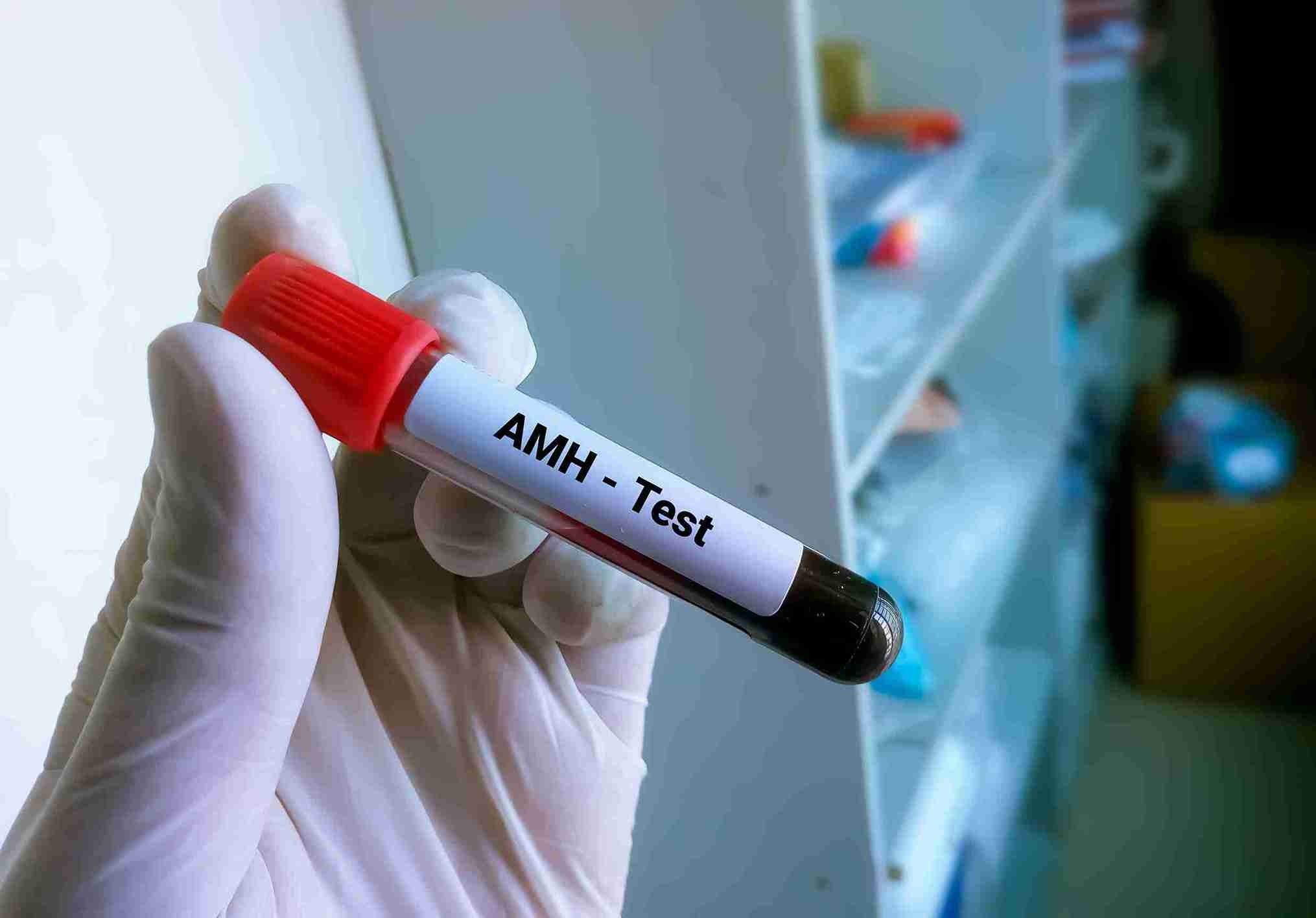
AMH (Anti-Müllerian Hormone) is a blood test that estimates your ovarian reserve - roughly how many eggs you have left. As a guide, AMH is often around 2.0-6.8 ng/mL under 30, 1.5-4.0 ng/mL at 30-35, 1.0-3.0 ng/mL at 35-40, and below 1.0 ng/mL is common after 40. A low AMH means fewer eggs, not infertility - egg quality, driven by age, matters more.
What is the AMH Test, and What’s a Good Level by Age?
AMH (Anti-Müllerian Hormone) is produced by the small, developing follicles in your ovaries, so the level reflects how many eggs remain - your “ovarian reserve.” It is a simple blood test that can be taken on any day of your cycle, since AMH stays fairly steady month to month. The chart below gives general AMH ranges by age for Indian women; treat them as orientation, not a pass-or-fail score, because labs, assays and individuals vary.
Age Group
General AMH Range (ng/mL)
What It Usually Suggests
Under 30
2.0 - 6.8
Good to high ovarian reserve for age.
30 - 35
1.5 - 4.0
Healthy reserve, beginning a slow decline.
35 - 40
1.0 - 3.0
Reduced reserve; age starts to matter more.
40 - 45
0.3 - 1.5
Lower reserve is common and expected.
Over 45
Often below 0.5
Reserve is naturally very low as you approach menopause.
One practical caveat: AMH is reported in different units. Indian labs usually use ng/mL, but some use pmol/L (1 ng/mL ≈ 7.14 pmol/L). Always check which unit your report uses before comparing it to any chart, and read it against an age-matched range rather than a single “normal” figure.
AMH Testing in India: What to Know
AMH testing is widely available and affordable across India, and for couples in Gurgaon and Delhi NCR, it is usually one of the first tests offered during a fertility assessment. A single AMH blood test typically costs a modest amount and can be done on any day of the cycle, often with same-day or next-day results. Some Indian studies suggest women here may reach lower ovarian-reserve values at slightly younger ages than older Western reference charts assume, which is one reason to interpret your result against an India-relevant, age-matched range and alongside other tests rather than in isolation. It is also worth knowing that a single AMH value is a snapshot - your specialist will combine it with your age, cycle history and an ultrasound (antral follicle count) to build the full picture. Because reference ranges and pricing differ between centres, confirm both with the clinic when you test.
What Does Your AMH Result Actually Mean?
AMH is a useful number, but it answers a narrower question than most people assume. It estimates quantity (how many eggs) rather than quality (whether those eggs can support a healthy pregnancy). Understanding that distinction prevents a lot of unnecessary worry.
AMH vs FSH vs AFC: how they differ
Three tests are commonly used together to assess ovarian reserve, and they measure slightly different things:
Test
What It Measures
How It Is Done
AMH
Egg quantity (ovarian reserve); predicts response to IVF stimulation.
Blood test, any day of the menstrual cycle.
FSH (Follicle-Stimulating Hormone)
How hard the body is working to recruit eggs; typically rises as ovarian reserve declines.
Blood test, usually performed on day 2–3 of the menstrual cycle.
AFC (Antral Follicle Count)
Number of small follicles visible on ultrasound; a visual estimate of ovarian reserve.
Transvaginal ultrasound performed during the early part of the menstrual cycle.
No single test is the full story. AMH and AFC tend to agree and are best at predicting how the ovaries will respond to IVF medication; FSH adds another angle. None of them reliably predicts whether you will conceive naturally.
Can you get pregnant with low AMH?
Yes - and this is the most important and most misunderstood point. Large studies have found that women with low AMH (even below 1.0 ng/mL) do not have a lower chance of conceiving naturally, or a lower future live-birth rate, than women with normal AMH - provided their cycles are regular. The reason is simple: for natural conception, you only need one good egg, and a low reserve does mean no good eggs. Where low AMH genuinely matters is in IVF, because fewer eggs can be collected in a stimulation cycle. So a low result is a reason to seek timely advice, not a verdict on your fertility. A fertility specialist consultation can interpret your AMH in the context of your age and cycles.
Why age beats AMH for predicting a healthy pregnancy
Egg quality - the chance an egg is genetically normal - is driven mainly by age, not by AMH. This is why a 30-year-old with a slightly low AMH often has better odds in a given month than a 42-year-old with a higher AMH: the younger woman has fewer eggs, but they are statistically more likely to be healthy. When you read your AMH, read your age alongside it.
A low AMH for your age can have several explanations. The most common is simply age, but other factors contribute:
Age: the leading factor - reserve declines naturally over time, faster after the mid-30s.
Genetics and family history: early menopause or low reserve can run in families.
Previous ovarian surgery: operations on the ovaries (for example, for cysts or endometriosis) can reduce reserve.
Medical treatments, such as chemotherapy or radiotherapy, can reduce egg numbers.
Certain conditions, such as endometriosis and some autoimmune or genetic conditions, are associated with reduced reserve.
Smoking is linked to lower ovarian reserve and earlier menopause.
Can AMH Be Improved - and How Does It Guide IVF?
Two practical questions follow almost every low result: can I raise my AMH, and what does it mean for treatment? Here, honesty matters more than hope marketing.
Can you improve your AMH naturally?
Not in the way many websites imply. You are born with all the eggs you will ever have, and no diet, supplement or lifestyle change can create new ones or meaningfully raise your true ovarian reserve. There is no reliable evidence that AMH can be significantly increased. What you can do is protect the eggs you have and support overall reproductive health - not smoking, maintaining a healthy weight, eating well, managing stress, and treating underlying conditions. Some supplements are discussed in fertility care, but the evidence is limited, and they should only be considered under medical guidance, never self-prescribed. The single most effective response to a low AMH is not to chase the number, but to make timely decisions about trying or treatment.
How AMH guides IVF and fertility planning
AMH plays a role mainly in treatment planning. It helps a specialist predict how your ovaries will respond to stimulation and tailor the approach accordingly - a higher reserve may call for a gentler approach to avoid over-response, while a lower reserve may prompt a different strategy or earlier action. It can also inform conversations about egg freezing for those who want to preserve options. Crucially, AMH guides the plan; it does not decide the outcome. Your Cloudnine fertility specialist will use it alongside your age, AFC, and history to recommend the right next step.
When Should You Get Your AMH Tested?
AMH testing is quick and low-cost, and worth doing in any of these situations.
Your Situation
Suggested Action
Planning pregnancy and want to understand your reserve
Consider an AMH test as part of a baseline fertility check.
Under 35 and trying for 12+ months, or 35+ and trying for 6+ months
Book a fertility assessment including AMH testing.
Considering egg freezing or delaying pregnancy
Test AMH to help inform timing and fertility preservation options.
Irregular periods, family history of early menopause, or prior ovarian surgery
Get your ovarian reserve assessed sooner.
About to start IVF
AMH is a routine pre-cycle test used to help plan your treatment protocol.
If you are in Gurgaon or Delhi NCR, you can book a fertility consultation to test and interpret your AMH with a specialist.
What Different AMH Levels Mean for Your Options
The table below is a general orientation. Your age and individual circumstances matter as much as the number, so use it to frame a conversation, not to predict your result.
AMH Band
What It Suggests
Typical Implications
High (often > 4.0)
Plenty of follicles; sometimes seen in PCOS.
Good IVF response likely; watch for over-stimulation.
Normal for age
Reserve is appropriate for your age.
Reassuring; natural conception and IVF response are both supported.
Low (often < 1.0-1.1)
Fewer eggs in reserve.
Natural conception is still possible; IVF may yield fewer eggs – act in good time.
Very low
Markedly reduced reserve.
Earlier specialist input is valuable; egg freezing or treatment options should be discussed.
Book an online appointment with for Fertility related issues.
Want to consult the best fertility in india? Please find the links below.
Find clear, trusted answers to the most common questions about IVF—designed to guide and support you every step of the way.
What is a normal AMH for a 36-year-old?
For a woman around 36, an AMH level of roughly 1.0-3.0 ng/mL is generally considered within the expected range, reflecting a gradually declining yet still healthy reserve. Values a little above or below this can still be normal, since labs and individuals vary. What matters most is reading the number against an age-matched range and alongside your cycles and an ultrasound, rather than judging it in isolation.
What is a good AMH level to get pregnant?
There is no single “good” number for conceiving, because AMH does not predict natural pregnancy well. Many women with low AMH conceive, and a normal AMH does not guarantee it. As a rough guide, a reserve appropriate for your age (for example, above about 1.0-2.0 ng/mL in your 30s) is reassuring, but regular ovulation and age are stronger predictors of natural conception than AMH alone.
What is a good AMH level to have at 32 to get pregnant?
At 32, an AMH in roughly the 1.5-4.0 ng/mL range is typical and reassuring, indicating a healthy reserve for that age. That said, a result somewhat below this does not mean you cannot conceive - at 32, egg quality is generally still good, which is the bigger driver of a healthy pregnancy. If your AMH is low for your age, a timely assessment by a specialist is worthwhile.
At what age are most of your eggs gone?
Egg numbers fall throughout life from before birth onwards. By the mid-to-late 30s, the reserve has reduced substantially, and the decline accelerates into the 40s, approaching menopause (on average around the early 50s). The exact pace is individual, which is why two women of the same age can have very different AMH levels. This natural decline is normal, not a disease.