Ovary size alone does not determine whether you can get pregnant. What matters far more is ovarian reserve and function, meaning how many eggs remain and whether you ovulate. Doctors judge this with antral follicle count (AFC) and AMH, not the millimetre measurement on a scan. Unusually small or enlarged ovaries can be a useful clue, but only when read in context by a specialist.
What is a normal ovary size?
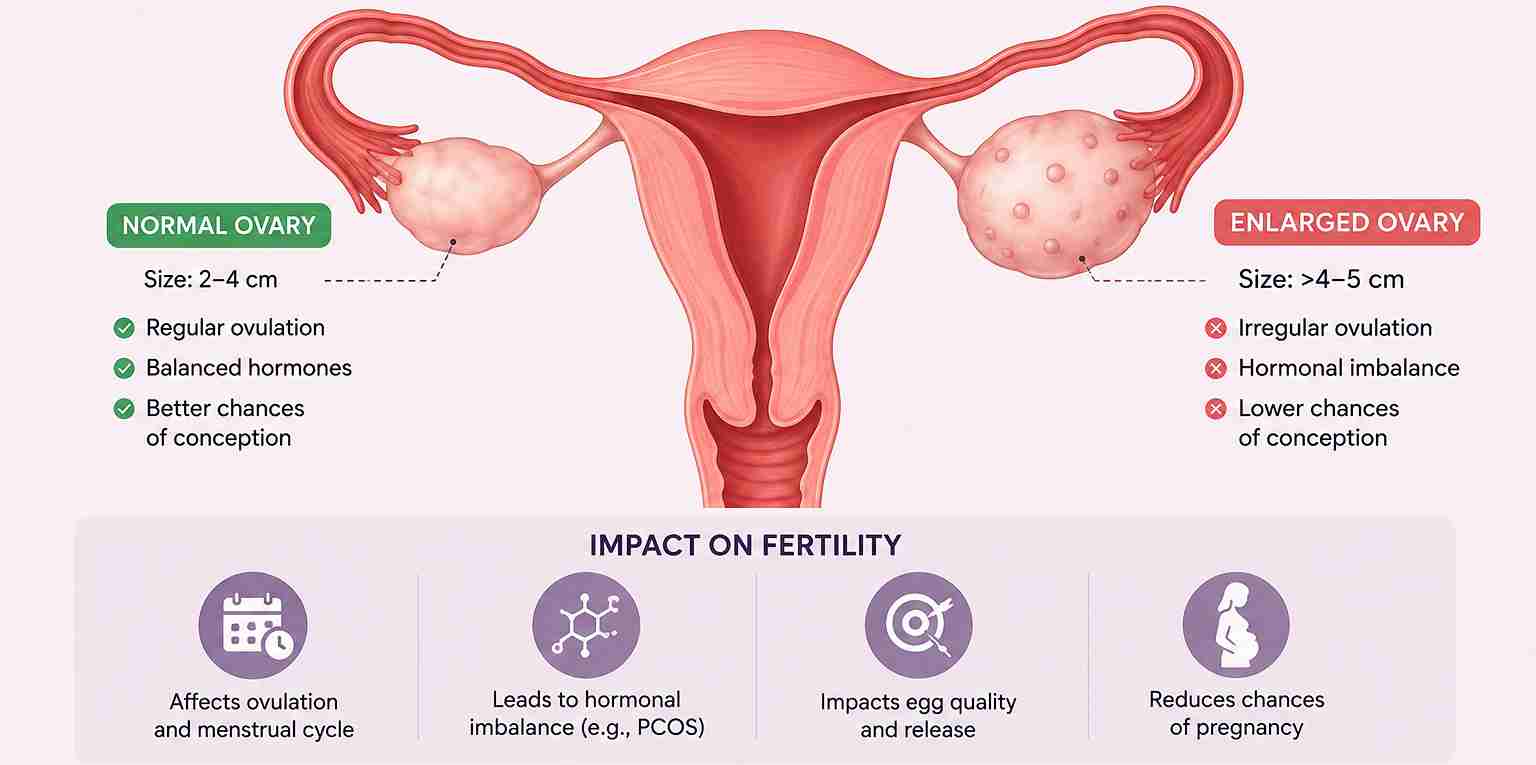
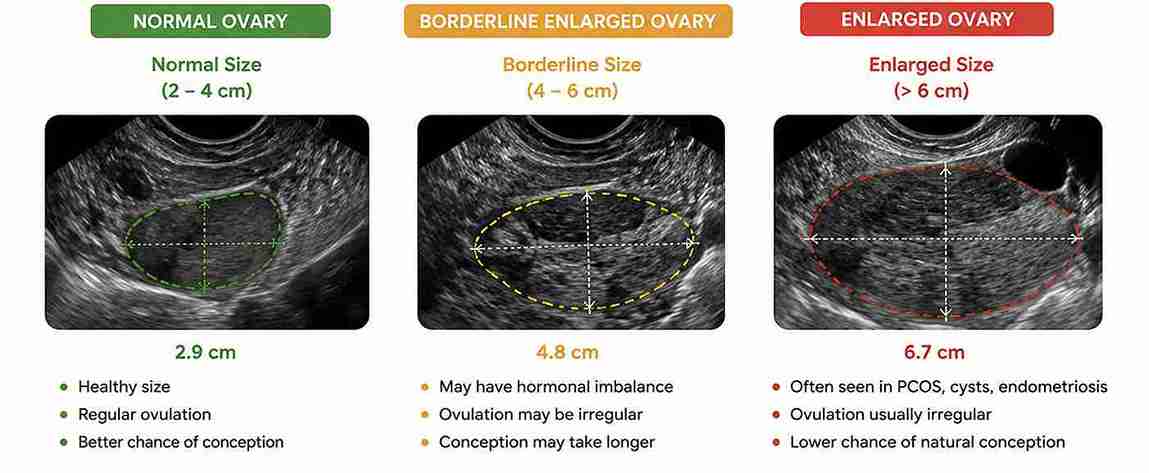
In the reproductive years, a healthy ovary measures roughly 3.5 cm by 2 cm by 1 cm, with a volume of about 4 to 10 cm³ (cubic centimetres, sometimes written as cc or mL). Size is not fixed. It changes naturally across the menstrual cycle as follicles grow and release, and it falls steadily with age, from a peak in the early twenties to a much smaller volume after menopause. It is also completely normal for one ovary to be slightly larger than the other.
Measure
Typical Range
Length × width × depth
Approximately 3.5 cm × 2 cm × 1 cm
Ovarian volume (during the reproductive years)
Approximately 4–10 cm³ (also expressed as cc or mL)
Right ovary compared with the left
Both ovaries are usually similar in size, although one may be slightly larger, which is considered normal.
After menopause
Ovarian volume typically decreases to approximately 2–3 cm³ or less.
Why a note about ovary size on your scan can be unsettling
Most people first meet the words “ovarian volume” on an ultrasound report. You go in for a routine pelvic or transvaginal scan, a measurement is noted, and within minutes, you are searching online to find out whether that number means you cannot conceive. In India, where pelvic scans are a common early step in any fertility check, this happens a lot, and a single figure that sits a little outside an average range is easy to over-read. The reassuring truth is that ovary size is just one data point. On its own, it tells your doctor very little. It becomes meaningful only alongside your age, your cycle, your ovulation and your reserve markers, which together give the real picture.
Does ovary size affect fertility?
The short answer is no, not on its own. Ovary size is a rough, indirect signal. Function and reserve, not millimetres, decide your chances of conceiving.
Does ovary size directly affect fertility?
No. A number on a scan is not a verdict. Ovarian volume varies from cycle to cycle and even between different people measuring the same scan, and fertility guidelines treat it as a weak, indirect marker rather than a reliable predictor on its own. What actually decides whether you conceive is whether you ovulate, the quality of the egg that is released, healthy fallopian tubes and healthy sperm, none of which is captured by the size of the ovary itself.
What actually predicts fertility
The dependable markers of ovarian reserve are antral follicle count (AFC, the number of small resting follicles measuring 2 to 10 mm that a specialist counts on ultrasound) and AMH, a hormone that reflects how many eggs you have. These two move together and tell your doctor far more than size does. Reserve is also closely tied to age and egg quality. If a low result is part of the picture, it is worth understanding what it does and does not mean, which is covered in our guide to natural conception with low AMH.
Why follicles matter more than ovary size
More important than the ovary as a whole are the follicles inside it. Follicles are the fluid-filled sacs that house and grow the eggs, and a mature follicle ready to release an egg is generally about 18 to 24 mm. Here is the point most articles skip: the follicle is what the scan measures, but the egg (the oocyte) inside it is microscopic, around 0.1 mm, far too small to see on ultrasound. So when a report mentions a “26 mm egg,” it is really describing a follicle, and a follicle larger than the usual mature range can sometimes mean the egg is over-mature or that the structure is a cyst rather than a healthy follicle. This is why specialists watch follicles grow across a cycle rather than reading a single ovary measurement.
What makes ovaries smaller or larger than normal?
Several factors can push ovary size outside the usual range, and each is interpreted differently:
Advancing age: Ovaries shrink, and egg numbers fall with age, so smaller ovaries often reflect a lower remaining reserve.
Premature ovarian insufficiency: Ovaries that are small and underactive before the age of 40 can point to an early decline in reserve.
Polycystic ovary syndrome (PCOS): enlarged ovaries carrying many small follicles are a hallmark of PCOS and its effect on fertility, and can disrupt regular ovulation.
Ovarian cysts: A cyst can make one ovary look enlarged on a scan, often only temporarily.
Natural cycle changes: ovary size rises and falls through the month as follicles develop, so when the scan was done matters.
Natural asymmetry: one ovary being slightly larger than the other is normal and not a concern in itself.
What to do if your scan mentioned ovary size
Ask for the tests that give the real picture
Rather than fixating on a single measurement, ask about the tests that actually describe reserve and function: antral follicle count on a transvaginal ultrasound, an AMH blood test, and, where needed, FSH and estradiol. It is also worth confirming that you are ovulating, which you can begin to track at home using ovulation test kits and your fertile window. Together, these tell you what a size measurement alone never can.
When size points to something treatable
If small ovaries suggest a low reserve, an assessment helps you plan and, importantly, not wait too long before seeking help. If enlarged ovaries suggest PCOS, the focus shifts to restoring regular ovulation. Where ovulation is the obstacle, treatments such as ovulation induction or IVF can help, always guided by a specialist who looks at the whole picture rather than one figure. Avoid drawing firm conclusions from a scan report on your own, and take any out-of-range note to a fertility specialist for context.
How much does ovarian reserve testing cost in India?
If a scan has raised questions about your ovaries, the next step is usually a small set of reserve tests. Cost depends on your city, the laboratory, and whether tests are booked individually or as a bundle.
Test
Indicative Cost
Pelvic or transvaginal ultrasound with antral follicle count (AFC)
Approximately ₹1,200–₹3,600*
AMH (Anti-Müllerian Hormone) blood test
Approximately ₹5,000*
FSH and oestradiol hormone panel
Approximately ₹800–₹5,000*
When should you see a doctor?
Ovary size is rarely an emergency, but a few situations are worth a specialist review, especially if you are trying to conceive.
Situation
Why It Matters
An ultrasound shows unusually small ovaries
May indicate a reduced ovarian reserve and warrants earlier fertility assessment.
An ultrasound shows enlarged ovaries or multiple small follicles
May suggest polycystic ovary syndrome (PCOS), which can affect ovulation.
Irregular, very infrequent, or absent menstrual periods
May indicate an ovulation disorder that requires medical evaluation.
Trying to conceive for 12 months without success (or 6 months if over 35 years)
This meets the usual criteria for a comprehensive fertility assessment.
Family history of early menopause
Early ovarian reserve testing may help guide fertility planning and treatment decisions.
A specialist can read your scan alongside your reserve and ovulation results and tell you what it really means for conceiving.
Not on its own. Ovarian function and reserve, measured by antral follicle count and AMH, matter far more than the size of the ovary. Size is only a rough, indirect clue that a specialist reads alongside other findings.
What is the best size of an ovary to get pregnant?
There is no single best or magic size. A healthy ovary in the reproductive years is roughly 3.5 cm by 2 cm by 1 cm, with a volume of about 4 to 10 cm³, but conception depends on ovulation and reserve rather than hitting an exact measurement.
Can you get pregnant with a small ovary?
Yes. Smaller ovaries can suggest a lower egg reserve, which may make conception take longer, but many women with small ovaries conceive. A reserve assessment helps you understand your own situation and plan accordingly.
Is a 2 cm ovary normal?
A single dimension of around 2 cm can fall within the normal range, since a healthy ovary is roughly 3.5 cm by 2 cm by 1 cm. What matters is the overall volume and, more importantly, your reserve and ovulation, so one figure is best interpreted by your doctor.
Schedule your consultation Today!
Book your consultation with our fertility experts the first step toward your parenthood journey.