Embryo cryopreservation is the procedure of freezing IVF (In-vitro Fertilization) embryos for future use. At Cloudnine Fertility, embryos are typically frozen at the blastocyst stage using vitrification (ultra-rapid freezing) and stored in liquid nitrogen at -196 °C. The process protects embryo quality, allows safer single-embryo transfers, and is fully permitted under Indian law.
What is embryo cryopreservation?
Embryo cryopreservation is the laboratory technique of cooling fertilised IVF embryos to sub-zero temperatures so that all biological activity pauses, the embryo remains viable for years, and it can later be thawed and transferred into the uterus. Modern fertility centres use vitrification - a rapid-cooling method that turns the embryo into a glass-like state without forming damaging ice crystals - rather than the older slow-freezing approach. The result is markedly higher post-thaw embryo survival, often above 95% at Cloudnine Fertility-grade laboratories.
Term
Meaning in Plain English
Cryopreservation
Freezing cells, tissue, or embryos for long-term storage.
Vitrification
Ultra-rapid freezing that prevents ice crystal damage.
Blastocyst
Day 5–6 embryo, the stage at which freezing is usually done.
Liquid nitrogen
The storage medium maintained at a temperature of -196°C.
FET
Frozen embryo transfer – placing a thawed embryo into the uterus.
Why has embryo freezing become routine in Indian IVF?
Two decades ago, embryo freezing in India was a backup plan; today it is part of the main treatment pathway in most well-equipped fertility centres in Gurgaon, Delhi NCR, and other metros. Three shifts have driven this. First, vitrification replaced slow freezing in the mid-2000s and dramatically improved post-thaw survival. Second, growing evidence suggests that frozen embryo transfer can offer comparable, and in some patient groups slightly better, live birth rates compared with fresh transfer, while reducing the risk of ovarian hyperstimulation syndrome (OHSS). Third, the Assisted Reproductive Technology (Regulation) Act, 2021 - the ART Act - gave embryo freezing in India a clear legal framework. The result is that most IVF cycles at a Cloudnine Fertility-grade centre now involve at least some embryo freezing as standard.
How is embryo cryopreservation actually performed?
Embryo cryopreservation is layered onto an existing IVF cycle. The procedure itself happens entirely in the embryology laboratory; for the patient, the visible part is the IVF cycle up to egg retrieval. A Cloudnine fertility specialist and embryologist will walk you through the exact sequence used at your centre, but the broad steps are consistent.
Step 1: Ovarian stimulation and egg retrieval
Hormonal injections are used for roughly 10-14 days to encourage the ovaries to mature several eggs at once. Eggs are then collected under sedation through a short transvaginal procedure. This part of the cycle is identical regardless of whether you plan a fresh transfer, a frozen transfer, or only freezing.
Step 2: Fertilisation and embryo culture
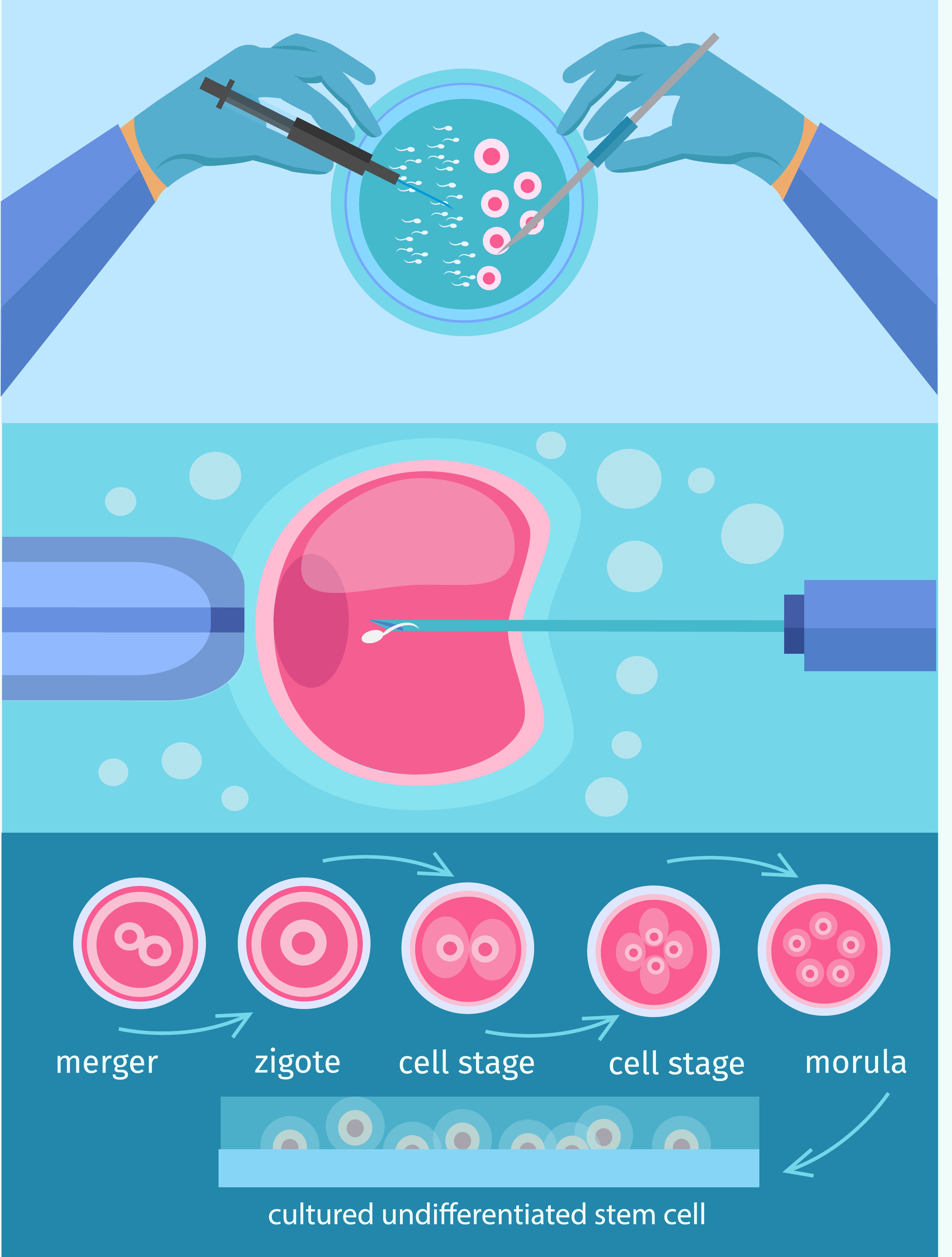
Collected eggs are fertilised in the laboratory, either through conventional IVF or by ICSI (intracytoplasmic sperm injection, used when sperm parameters require it). Resulting embryos are then cultured in carefully controlled incubators for 5-6 days until they reach the blastocyst stage, when the inner cells (which become the baby) and outer cells (which become the placenta) are clearly differentiated.
Step 3: Embryo grading and selection for freezing
Before freezing, each blastocyst is graded by the embryologist on three parameters: expansion (how developed the blastocyst is, scored 1–6), inner cell mass quality (graded A, B or C), and trophectoderm quality (also graded A, B, or C). A 4AA, 4AB, or 5AA blastocyst is generally considered top quality, while a 3BB or 4BC may still be perfectly viable. The grade influences priority for transfer but does not automatically exclude lower-graded embryos from being frozen, as many of these still result in healthy pregnancies.
Step 4: Vitrification
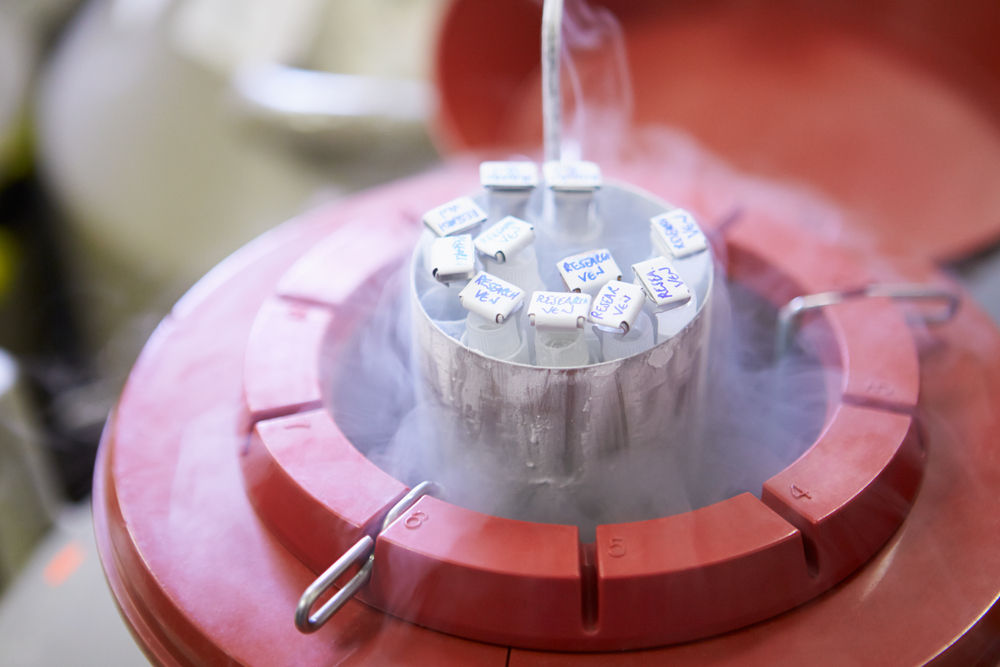
Each chosen blastocyst is exposed briefly to a cryoprotectant solution that draws water out of the cells and replaces it with substances that protect against ice damage. The embryo is then placed on a fine carrier (a vitrification straw) and plunged into liquid nitrogen at -196 °C. Cooling happens at thousands of degrees per minute, fast enough that water has no time to crystallise. Each straw is labelled with a unique identifier linking it to the patient's records.
Step 5: Storage in liquid nitrogen tanks
Vitrified embryos are stored in cryogenic tanks within the embryology laboratory. At Cloudnine Fertility-grade centres, tanks are continuously temperature-monitored with alarms, and nitrogen levels are checked and topped up according to a strict schedule. Embryos can remain viable in this state for many years - and pregnancies from embryos frozen for over a decade have been reported in published case series - with no measurable decline in quality.
Step 6: Thawing and frozen embryo transfer (when you are ready)
When you return for transfer, the chosen embryo is warmed rapidly, the cryoprotectant is washed out in graded steps, and the embryo is assessed for survival. A modern vitrification programme typically reports survival rates above 95%. The embryo is then transferred into the uterus during a frozen embryo transfer (FET) cycle, in which your endometrium (the lining of the uterus) is carefully prepared with hormonal support so that the timing matches the embryo's stage of development.
Why might your fertility specialist recommend freezing embryos?
Embryo freezing is not just a backup - for many couples, it is the preferred plan. The most common reasons a Cloudnine fertility specialist will recommend freezing one or more embryos include:
Surplus embryos after a fresh transfer: If a cycle produces more good-quality blastocysts than are transferred, freezing the rest preserves them for future attempts without another full IVF stimulation.
Preventing OHSS: In patients at high risk of ovarian hyperstimulation syndrome, freezing all embryos and transferring them in a later cycle allows the ovaries to recover first.
PGT-A and other genetic testing: Embryos undergoing preimplantation genetic testing for aneuploidy (PGT-A) must be frozen while genetic results are awaited.
Fertility preservation before medical treatment: Patients about to undergo chemotherapy, radiotherapy, or certain surgeries may freeze embryos to protect future family-building options.
Planned single embryo transfer: Freezing supports elective single embryo transfer, which is preferred in India to lower the risk of twin pregnancy and its complications.
Personal or logistical reasons: Career timing, partner availability, or simply a desire to space pregnancies can all be sound reasons to freeze embryos for later use.
How should you prepare for embryo cryopreservation?
Before the cycle: questions to ask your specialist
Embryo freezing involves clinical, financial, and emotional decisions. The most useful questions to take into your consultation at Cloudnine Fertility include:
How many embryos do you expect to freeze? This depends on age, ovarian reserve markers such as AMH (anti-Müllerian hormone), and embryo quality.
Will all embryos be frozen, or some transferred fresh? A "freeze-all" strategy is sometimes preferred; in other cases, a fresh transfer is reasonable.
What is the survival rate at thaw at this centre? Well-run vitrification programmes report above 95% survival; ask for the centre's own audited figures.
How long can embryos remain frozen? Discuss the legal framework under the ART Act, the centre's storage limits, and annual storage fees.
What does it cost - and what is included? Clarify whether the IVF cycle fee covers freezing and the first year of storage, or whether these are billed separately.
During the cycle: practical preparation
Once your treatment plan is confirmed, day-to-day preparation is largely the same as any IVF cycle:
Follow medication schedules precisely - missed or delayed injections can affect the number and quality of eggs retrieved.
Eat warm, balanced, protein-rich meals and stay well hydrated, especially in Indian summer.
Complete consent forms carefully: Indian law requires written consent for embryo freezing and clear instructions for the future use, donation, or discard of embryos.
Keep your contact details up to date: Cloudnine Fertility will reach out to confirm annual storage and renew as long as your embryos remain in storage.
When should you talk to a Cloudnine fertility specialist about freezing?
Embryo cryopreservation is not the right choice for every patient or every cycle. The following situations are common reasons to ask a Cloudnine Fertility specialist whether freezing should be part of your plan.
Situation
Why a Specialist Conversation Is Useful
About to start IVF for the first time
Helps you plan ahead: freeze-all, fresh transfer, or both.
High AMH or polycystic ovaries
Higher OHSS risk often makes a freeze-all strategy safer.
Considering PGT-A or other genetic testing
Embryos must be frozen while genetic results are awaited.
Cancer diagnosis with chemotherapy or radiotherapy planned
Fertility preservation should be discussed before treatment begins.
Wanting to delay pregnancy for personal or career reasons
Freezing while younger may protect future success rates.
Surplus embryos after a previous fresh transfer
Existing embryos can be vitrified for later attempts.
If any of these apply to you, book a fertility consultation with a Cloudnine specialist to discuss whether embryo freezing fits your situation.
What outcomes can you realistically expect from frozen embryo transfer?
Outcomes from cryopreservation are best understood in two stages: how well embryos survive thawing and how many result in a healthy pregnancy. The numbers below are typical ranges reported in published cohorts and Indian centre audits; your own results depend on age, embryo grade, and uterine factors. A Cloudnine specialist will personalise these figures during counselling.
Stage
Typical Range at a Modern Vitrification Centre
What It Means for You
Embryo survival at thaw
95-98%
Most vitrified embryos resume normal development after warming.
Live birth rate per FET (under 35)
45-55%
Comparable to, and sometimes higher than, fresh transfer.
Live birth rate per FET (35-37)
40-50%
Age remains the strongest predictor of success.
Live birth rate per FET (38-40)
30-40%
Lower yield, but multiple cycles are often achievable.
Live birth rate per FET (41 and above)
15-25%
Outcomes improve with donor eggs in selected cases.
Storage duration without quality loss
Many years
Pregnancies from embryos frozen 10+ years are well documented.
Type image caption here (optional
Want to consult the best fertility in india? Please find the links below.
Yes. Embryo cryopreservation is permitted under the Assisted Reproductive Technology (Regulation) Act, 2021. The Act sets out rules for written consent, maximum storage durations, conditions for donation or discard, and the qualifications required for ART centres. Reputable clinics such as Cloudnine Fertility operate within this legal framework and document each step transparently.
Is 37 too late to freeze eggs or embryos?
No, 37 is not "too late", but it is later than ideal. Egg quality and quantity decline gradually from the mid-30s and more steeply after 38. Freezing embryos at 37 is still worthwhile and often successful, particularly when multiple eggs are retrieved in a single cycle. A Cloudnine specialist can review your AMH, antral follicle count, and overall picture to give you a personalised view of likely outcomes.
How painful is frozen embryo transfer?
Frozen embryo transfer itself is usually not painful. The procedure takes a few minutes, does not require anaesthesia, and most patients describe it as similar to a cervical smear test. Mild cramping or pressure during catheter placement is normal. The IVF stimulation phase that precedes embryo creation is more physically demanding than the transfer itself.
Is a 4AA or 5AA embryo better?
Both are considered top-quality blastocysts. The number (4 or 5) describes how expanded the blastocyst is - 5 is slightly more expanded than 4. The letters describe the inner cell mass and trophectoderm quality, with AA being the best grade for both. A 5AA is marginally more developed than a 4AA, but in practice, both carry excellent implantation potential, and live birth rates are very similar.
Schedule your consultation Today!
Book your consultation with our fertility experts the first step toward your parenthood journey.