If you are reading this after a pregnancy loss, you are probably looking for a reason. Somewhere in a scan report or a consultation, someone mentioned a cyst on your ovary, and the question has stayed with you.
Here is the answer. An ovarian cyst is not a recognised cause of miscarriage. It does not appear on any guideline list of things investigated after repeated pregnancy loss, and there is no established mechanism by which a cyst sitting on the ovary interrupts a pregnancy developing in the uterus. The rest of this page explains why, covers the one exception, and sets out what repeated loss is actually investigated for.
The short answer, and the one real exception
No. An ovarian cyst is not a recognised cause of miscarriage, and it is not a recognised cause of recurrent miscarriage either. When specialists investigate two or more losses, they work through a defined set of categories. Ovarian cysts are not in any of them.
Cysts are also extremely common. Most are functional cysts that form as part of the ordinary monthly cycle and resolve on their own within a few weeks. They are often found incidentally on scans, including scans that confirm a pregnancy. That timing is a large part of why they feel significant. If you want the broader picture, we cover ovarian cysts and fertility separately.
There is one exception worth knowing about. Ovarian endometriosis, where cysts called endometriomas form on the ovary, is associated with a higher miscarriage rate. The detail that matters, set out in full below, is that the association appears to reflect the underlying disease rather than the cyst itself. Most cyst and pregnancy loss questions resolve the same way: the cyst rarely matters.
Why a cyst on the ovary does not affect a pregnancy in the uterus
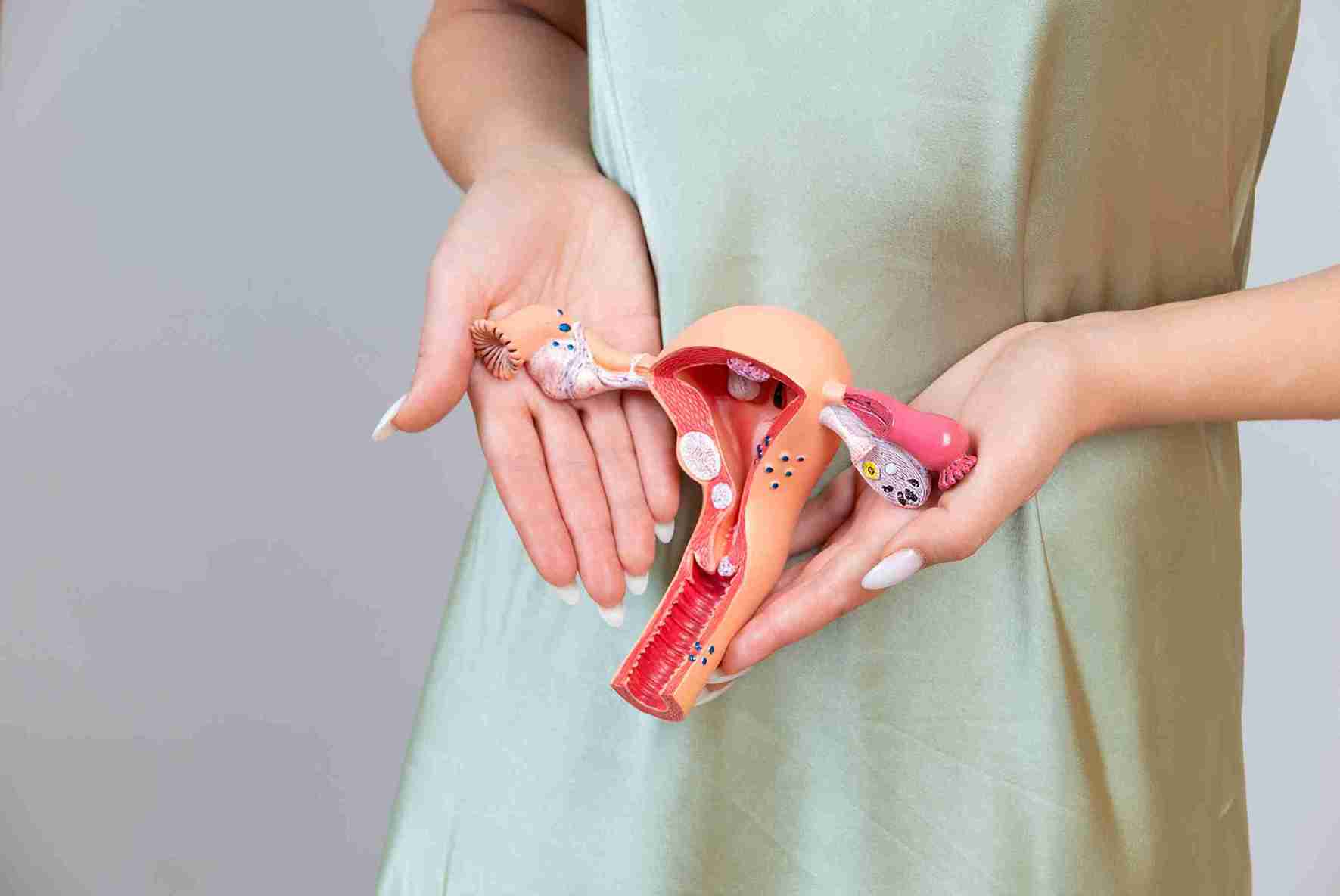
The clearest way to think about whether an ovarian cyst can affect pregnancy is to follow the anatomy. A pregnancy implants and develops in the endometrium (the lining of the uterus). The ovaries sit on either side, connected to the uterus by the fallopian tubes but structurally separate from the cavity where the pregnancy grows.
A cyst is a fluid-filled sac within or on the surface of the ovary. For it to end a pregnancy, it would need a route to the implantation site, and it does not have one. It does not sit in the uterine cavity. It does not disturb the endometrium. It does not cross the placental circulation, which forms from uterine blood vessels and not ovarian ones.
Functional cysts are also hormonally ordinary. They are a by-product of the same cycle that produced the egg, and no evidence shows they disturb the hormones a pregnancy depends on. In fact, the one ovarian structure hormonally central to early pregnancy supports it.
Corpus luteum cysts actually support early pregnancy
After ovulation, the emptied follicle becomes the corpus luteum, a temporary hormone-producing structure. It produces progesterone (the hormone that maintains the uterine lining), which sustains pregnancy through its earliest weeks, until the placenta takes over at around ten to twelve weeks. When it fills with fluid, it is called a corpus luteum cyst, and it is a normal finding in early pregnancy.
So a woman told at her first scan that she has a corpus luteum cyst has been told about the structure holding her pregnancy together, not a threat to it. We cover corpus luteum cysts in early pregnancy in more depth.
The one genuine association: ovarian endometriosis
Endometriosis is a condition in which tissue similar to the uterine lining grows outside the uterus. When it forms cysts on the ovary, those cysts are endometriomas, known in India far more commonly as chocolate cysts, or endometriomas. Here the answer is different, because a real association with miscarriage does exist.
A 2025 cohort study of 1,127 spontaneously conceived pregnancies, published in May 2025, compared 170 women with ovarian endometriosis against 957 without. Miscarriage occurred in 21.8 percent of the endometriosis group and 7.5 percent of the comparison group, with an adjusted odds ratio of 3.41. Pregnancies conceived through assisted reproduction were excluded.
That is a real association. The crucial nuance is what the same study found next: cyst size and bilaterality were not associated with complications. A larger endometrioma did not carry more risk than a smaller one, and having them on both ovaries did not carry more risk than one. If the cyst itself were doing the damage, size would be expected to matter. It did not. The association points to endometriosis as a disease of inflammation and altered implantation, with the cyst as its visible marker rather than its mechanism.
This is also why removing a cyst is not a treatment for miscarriage. Surgery on the ovary carries its own cost to ovarian reserve, so the decision is weighed individually and for other reasons. We set out whether an endometrioma should be operated on separately. One further limitation worth stating: this was a single-center retrospective study, which shows association and not causation.
Feature
Viral Infection
Bacterial Infection
Cause
Viruses
Bacteria
Common examples
Cold, flu, many sore throats
Strep throat, some ear infections
Typical treatment
Supportive care
May require antibiotics
Antibiotics
Do not work against viruses
May be prescribed when appropriate
What about torsion or rupture during pregnancy?
These are real concerns, and they deserve a clear answer. Ovarian torsion is the twisting of the ovary on its own blood supply, and a rupture is a cyst bursting. Both are uncommon, and both are surgical emergencies when they happen.
What matters for this question is how they present. Torsion and rupture announce themselves. They cause sudden, severe, usually one-sided pain, often with vomiting, faintness or collapse, and they take a woman to an emergency department within hours. They are not quiet events that are discovered later.
That distinction matters because a loss found at a routine scan weeks after everything looked normal isn't explained by torsion or rupture. If either had occurred, it would have been unmissable at the time. Where a cyst is already known in pregnancy, monitoring follows a straightforward pathway rather than an interventional one.
What repeated pregnancy loss is actually investigated for
The European Society of Human Reproduction and Embryology sets out the reference standard here, in its recurrent pregnancy loss guideline (2022 update, published in 2023). Together with comparable guidance elsewhere, the recognised categories investigated after repeated loss are consistent:
Genetic factors, including chromosomal rearrangements in either partner.
Anatomical factors, meaning the shape and structure of the uterine cavity itself.
Endocrine factors, such as thyroid and blood sugar control.
Clotting and immune factors, including antiphospholipid syndrome (an immune condition that raises clotting risk).
No identified cause, which remains the single largest group. Pooled across 105 studies and nearly 48,000 women, around 37 percent of recurrent loss is unexplained after a full workup.
Ovarian cysts do not appear on any of these lists. That absence is not an oversight; it reflects that no mechanism has been established and no guideline body recommends investigating them for this reason. If you have had two or more losses, this is the ground your assessment should cover, and we set out what recurrent miscarriage is investigated for in India in full on a dedicated page.
A clear clinical answer is not the same as support. If you are carrying grief alongside these questions, that deserves attention of its own, and asking for bereavement counselling alongside a fertility assessment is a reasonable thing to request.
When a cyst in early pregnancy does need attention
None of the above means a cyst in pregnancy is ignored. It means it is monitored rather than feared. However, some symptoms require same-day attention. Get seen urgently if you have any of the following:
Get seen the same day if you have:
Sudden, severe pain on one side of the lower abdomen or pelvis.
Pain with vomiting, fainting or dizziness, or pain that stops you from standing.
Fever alongside pelvic pain.
Heavy vaginal bleeding, particularly with clots or with pain.
Pain at the tip of the shoulder, which can indicate bleeding inside the abdomen.
These are reasons to be assessed. They are not a verdict on the pregnancy, and ovarian cyst early pregnancy bleeding has a wide range of explanations, most of which are not a loss. Assessment usually starts with an ultrasound scan and an examination.
What to ask your specialist
If you are going into an appointment with these questions, these five are worth taking with you:
What type of cyst is this, based on how it looks on the scan?
Is there any sign of endometriosis beyond the cyst itself?
Does this cyst need monitoring, and on what timescale?
Given my history of loss, what should actually be investigated?
Should anything be done before trying again, and why?
If you have had two or more losses, the useful next step is a structured assessment rather than a decision about the cyst. You can speak to a fertility specialist about repeated pregnancy loss at Cloudnine Fertility, and where fertility treatment is being considered, cyst surgery and ovarian reserve before fertility treatment is a separate conversation with its own trade-offs.
FAQs
Your questions, clearly answered
Find clear, trusted answers to the most common questions about IVF—designed to guide and support you every step of the way.
Can an ovarian cyst cause a miscarriage?
No. An ovarian cyst is not a recognised cause of miscarriage. A pregnancy develops in the uterus, and a cyst sitting on the ovary has no route to affect it.
Can an ovarian cyst cause recurrent miscarriage?
No. Ovarian cysts do not appear on any guideline list of causes investigated after repeated pregnancy loss. If you have had two or more losses, the workup looks elsewhere.
Does a corpus luteum cyst increase miscarriage risk?
No. The corpus luteum produces the progesterone that supports a pregnancy in its early weeks. A corpus luteum cyst is a normal finding in early pregnancy, not a warning sign.
Is endometriosis linked to miscarriage?
There is a genuine association. A 2025 study of 1,127 pregnancies found a miscarriage rate of 21.8 percent in women with ovarian endometriosis compared with 7.5 percent without. The link appears to be with the disease itself rather than the cyst.
Does the size of an ovarian cyst change miscarriage risk?
The available evidence does not show that. In the 2025 endometriosis cohort, neither cyst size nor having cysts on both ovaries was associated with pregnancy complications.
Should an ovarian cyst be removed to prevent miscarriage?
No. Surgery is not performed to prevent miscarriage, and removing a cyst can lower ovarian reserve. Any decision to operate is made for other reasons and weighed individually.
Can a ruptured ovarian cyst cause a miscarriage?
Rupture is uncommon and causes sudden severe pain that needs urgent assessment. It does not explain a loss that happens quietly weeks after a normal scan.
Can ovarian torsion in pregnancy cause a miscarriage?
Ovarian torsion is a rare emergency that presents with sudden intense one-sided pain, often with vomiting. It needs immediate care, but it is not a common cause of pregnancy loss.