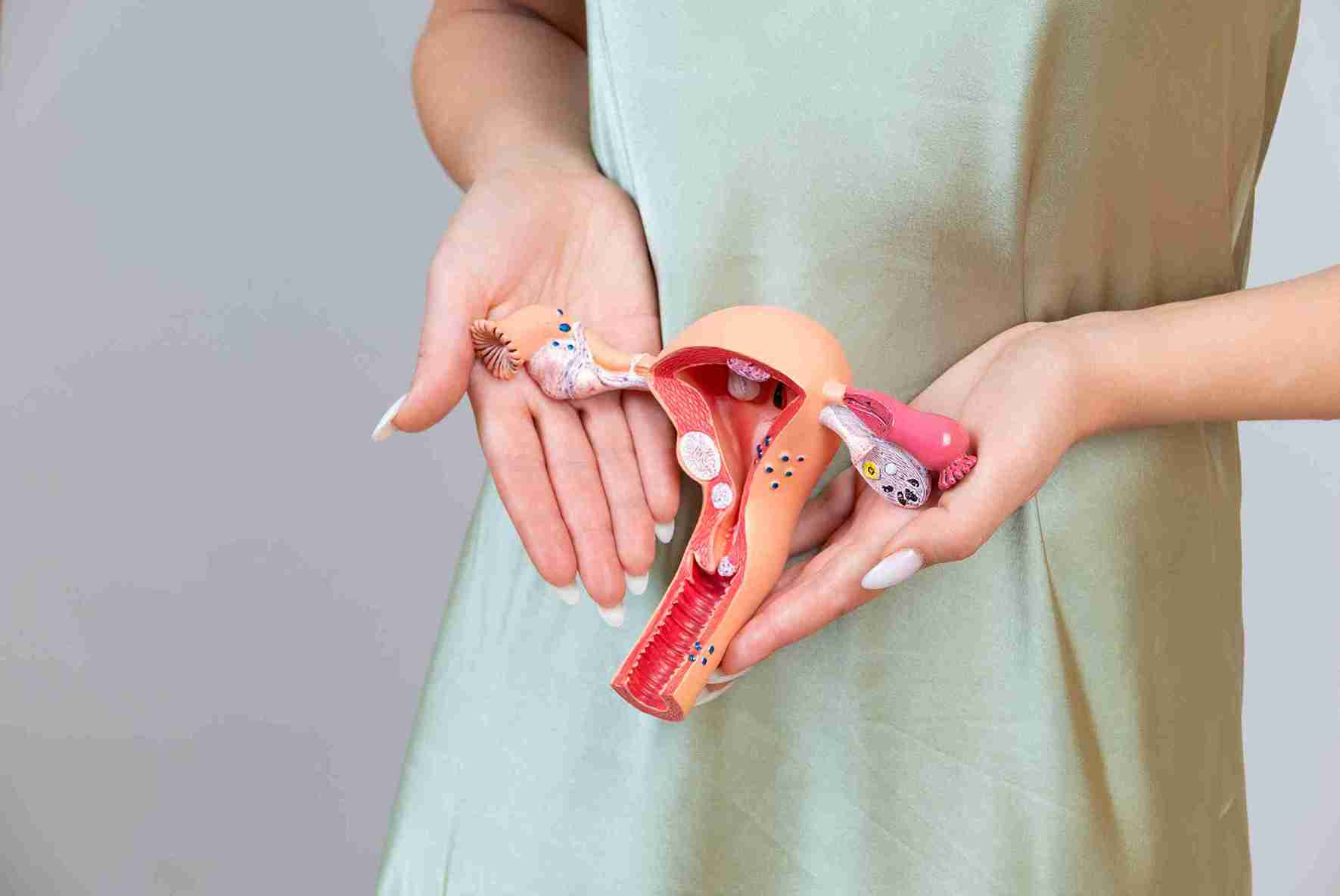
Oophorectomy and Your Ovarian Reserve: Pregnancy With One Ovary
October 12, 2026
Cloudnine
No items found.
Oophorectomy and Your Ovarian Reserve: Pregnancy With One Ovary
October 12, 2026
Cloudnine
No items found.
If one ovary has been removed, your ovarian reserve is roughly halved, and the remaining ovary does not fully make up the difference. Your chance of conceiving naturally is largely preserved. Your response to IVF stimulation is not. Both of those statements are true at the same time, and most pages give you only one of them.
This page is about what follows the surgery rather than the surgery itself. It covers what an oophorectomy actually changes, how to read an AMH result taken afterwards, what natural conception realistically looks like with one ovary, and what to expect from IVF. Each position below is stated plainly, with the evidence behind it, including where that evidence is genuinely mixed.
What an oophorectomy removes, and what it does not
An oophorectomy (the surgical removal of an ovary) describes what was taken out. It does not tell you why, and it does not tell you how much of your fertility went with it.
A unilateral oophorectomy removes one ovary and leaves the other in place. This page addresses that situation. If your operation note names a side, it tells you which ovary was removed and nothing more: the remaining ovary does the same job whichever side it sits on, so left and right carry no different outlook.
The distinction that matters most is the one people conflate most often. An ovarian cystectomy removes a cyst and keeps the ovary. An oophorectomy removes the whole ovary. These are different operations with different consequences for your reserve, and being told you had cyst surgery does not tell you which one you had. Your discharge summary or operation note will.
Surgeons sometimes plan one procedure and perform another. A cystectomy can become an oophorectomy during the operation if the cyst is larger than expected, the ovary has twisted and lost its blood supply, or the tissue looks suspicious. So even if you remember the plan you agreed to before surgery, it is worth checking what was actually done. The terms in your notes follow a simple pattern: "oophor" refers to the ovary, "salpingo" to the fallopian tube, "unilateral" means one side and "bilateral" means both sides.
Procedure
What is removed
What remains
Unilateral oophorectomy
One whole ovary
The other ovary, and both fallopian tubes unless the note says otherwise
Unilateral salpingo-oophorectomy
One ovary and the fallopian tube on that side
The opposite ovary and its tube
Bilateral salpingo-oophorectomy
Both ovaries and both fallopian tubes
No ovarian tissue, and no eggs of your own
Ovarian cystectomy
The cyst only
The ovary, with some reduction in its tissue
Operation notes often use abbreviations rather than full names. You may see RSO or LSO for a right or left salpingo-oophorectomy, BSO for a bilateral one, and "left ovarian cystectomy" or "right ovarian cystectomy" for cyst removal on that side. If the note mentions a procedure on the fallopian tube alone, such as a salpingectomy, the ovary on that side has been kept.
Once you know which operation you had, the next step is to find out where your reserve stands now. An AMH blood test and an antral follicle count on ultrasound give a current picture, and comparing them with any results from before surgery shows how much has changed. If you are planning a pregnancy, a fertility specialist can use these numbers to advise whether trying naturally, starting treatment sooner or considering egg freezing makes the most sense for you.
How the operation is performed and what recovery looks like week by week are covered separately in our ovarian cyst surgery guide and cyst removal recovery timeline. If your ovary was conserved rather than removed, the question of what cyst surgery does to your reserve belongs to our cyst surgery before IVF guide instead of this page.
No, your remaining ovary does not compensate fully
No. Your remaining ovary does not fully compensate for the one that was removed.
It does take on more work, and that's real. In women having IVF, a single remaining ovary recruits and yields more follicles than one ovary of a woman who still has two. But it does not close the gap. Total egg yield stays below that of women with two ovaries, blood markers point the same way, and higher doses of stimulation medication are typically needed to get there.
Here is the counter-claim, stated fairly, because it is everywhere. A number of pages answering this question say that the remaining ovary takes over the function of the missing one, or that fertility should return to normal once you have recovered. That overstates what the published evidence supports. A systematic review and meta-analysis of women with a previous unilateral oophorectomy undergoing assisted reproduction found lower AMH (anti-Mullerian hormone, a blood marker of how many eggs remain) and higher FSH (follicle-stimulating hormone, which drives follicles to grow each cycle) than in women with two ovaries. When researchers tested the obvious compensating mechanism, whether each remaining follicle produces more AMH to make up the shortfall, they did not find it. The pool is smaller, and the body does not manufacture a replacement.
What compensation does happen looks like recruitment rather than replacement: the single ovary puts more of what it has into each cycle. That is why yield falls by less than half rather than by nothing at all.
How one ovary actually works
The mechanism is worth setting out plainly, because the version circulating in search results compresses four separate things into a single word.
Compensation is partial, not total. The remaining ovary recruits more follicles per cycle than it would have done with its twin still in place. It does not double its output, and it does not restore the reserve that was removed.
Ovulation continues in most cycles. You do not lose every second chance. A dominant follicle is usually selected each cycle from the one ovary you have, rather than the ovaries taking turns.
Hormone production is maintained. One ovary produces enough oestrogen and progesterone to support a regular cycle and a pregnancy. That is why hormone replacement is not expected after removal of one ovary.
The egg supply is still halved. Reserve is a stock, not a rate. Working harder each month does not add eggs back to the pool, which is why blood markers and IVF yield both fall while monthly ovulation does not.
Three of those four are genuinely reassuring. The fourth is the one that gets left out, and it decides what happens in an IVF cycle.
The practical version is short. Expect a real reduction. Don't expect everything to halve, and don't expect nothing to change.
What changes and what does not after one ovary is removed
The most useful thing anyone can hand you at this point is a straight list of what moves and what does not. Each row below is written to stand on its own, and each carries an honest note on how confident the evidence is, because one of these questions is genuinely unsettled.
Two rows deserve a word before you read them. The live birth row is the one most often reported as settled. It is not. Pooled analyses of assisted reproduction outcomes have found lower pregnancy and live birth rates in women with one ovary, while a large matched cohort study found equivalent live birth rates per transfer, alongside equivalent fertilisation, blastocyst and chromosomal normality rates. Those findings sit side by side in the literature. The second is the menopause row, where the effect is real but modest, and where the picture differs for women whose ovary was removed in childhood rather than adulthood.
What happens
How strong the evidence is
What it means for you
Monthly ovulation continues in most cycles. The single ovary does not take alternate months off.
Strong
Expect regular cycles and a fertile window each month.
Natural conception odds are largely preserved. Most women with one healthy ovary conceive without treatment.
Moderate. Observational data; no large randomised trials
Try as you otherwise would, and use the standard review timelines.
AMH runs lower than in women with two ovaries.
Strong
A lower reading is expected. It is not comparable with your pre-surgery result.
Antral follicle count is lower in total, though the remaining ovary counts higher than one ovary would in a woman with two.
Moderate
A lower total count is expected and is not by itself a poor sign.
FSH runs slightly higher.
Moderate. The difference may be small enough not to matter clinically
Interpret it alongside your age and cycle history, not on its own.
Eggs collected per IVF cycle are fewer, but more than half the number collected from women with two ovaries.
Strong
Plan for a smaller harvest per cycle, and possibly more than one cycle.
IVF live birth rate findings are genuinely mixed. Pooled analyses report lower rates. A large matched cohort found no difference per transfer.
Weak to moderate. The studies conflict
Fewer eggs does not automatically mean a lower chance of a baby.
Age at natural menopause is slightly earlier, typically by about a year or two when the surgery happened in adulthood.
Moderate
A modest shift, not the large advance that halving the reserve might suggest.
Hormone replacement is not expected after removal of one ovary. The remaining ovary keeps producing hormones.
Strong
Surgical menopause follows removal of both ovaries, not one.
The single most useful step after losing one ovary is to get a current AMH and antral follicle count. Those two numbers turn the general picture in this table into advice about your own timeline.
If you take one row away, make it the sixth. Fewer eggs per cycle is the reliable, repeatable finding. Almost everything else on this list is either preserved, modest, or still being argued about.
Your new AMH is not comparable to your old AMH
An AMH result taken after your surgery cannot be read against one taken before it.
AMH is produced by the small developing follicles in your ovaries, and a blood test measures the total arriving from both of them. Remove one ovary, and you remove part of the source. The number falls because there is less tissue making it, not because the ovary you kept has deteriorated. Reading that drop as a collapse in fertility is a category error, and it causes a great deal of avoidable distress.
Two further points are worth holding on to. There is often a dip in the first months after surgery that is steeper than the level things eventually settle at, so a test taken very soon afterwards can read lower than the number you will live with. Some recovery has been reported after that early period, particularly in younger patients. And AMH was never a strong predictor of natural conception in the first place: it predicts how many eggs a stimulation cycle is likely to produce, which is a different question from whether you will conceive on your own.
If you want to understand what the test is measuring, what a result means at your age, or what a low reading does and does not imply, those questions are answered in our guide to what AMH is and who needs the test, our AMH levels by age explainer, and our guide to natural conception with low AMH. This page deliberately includes no thresholds or reference ranges, because reading them in the wrong context is exactly the mistake it is trying to prevent.
Conceiving naturally with one ovary
Yes, in most cases. The remaining ovary ovulates in most cycles.
This surprises people, because there is a persistent belief that ovaries alternate months and that losing one therefore costs you every second chance. That is not how it works. Follicle selection is driven by hormones reaching both ovaries, and a single ovary will usually produce a dominant follicle each cycle rather than sitting out every other month.
What you need for natural conception is unchanged: one ovulating ovary, at least one open fallopian tube, a uterus, and sperm. If the tube on the remaining side is healthy, the equipment is there. Conception is also possible when the remaining ovary and the remaining tube are on opposite sides, because an egg can be picked up across the pelvis, though this is less efficient and can take longer.
The honest caveat is about timing rather than possibility. A smaller reserve does not usually stop conception, but it can make it take somewhat longer, and the point at which age becomes the dominant factor arrives on the same schedule it always would have. That argues for not letting the clock run quietly.
Use the standard review timelines, and lower your threshold for acting on them. Guidance from ACOG and ASRM is to seek a fertility evaluation after twelve months of trying if you are under 35, after six months if you are 35 or older, and to speak to a specialist straight away if you are over 40 or have a known reason for reduced fertility. A previous oophorectomy counts as a known reason. Treat those timelines as your outer limit rather than a target, and raise your plans with your gynaecologist before you start trying rather than after.
Do you still get periods with one ovary?
Yes. Periods continue as before, because ovulation continues and your uterus is untouched by the surgery. Some women find their cycle is briefly irregular for the first two or three months while things settle, which is expected rather than a warning sign. Periods stopping altogether, irregularity that persists well beyond that settling period, or hot flushes beginning are all reasons for a gynaecology review rather than a wait.
Pregnancy symptoms are no different either. There is no such thing as one-ovary pregnancy symptoms. Implantation, early pregnancy signs and the pregnancy itself proceed in the same way regardless of how many ovaries you started with.
IVF with one ovary: the honest version
Fewer eggs per cycle is the expected result of having one ovary, not the sign of a failed cycle.
Expect a smaller harvest. In matched comparisons, women with one ovary yield fewer mature eggs per cycle than women with two, but consistently more than half as many, which is the compensation effect showing up in practice. Expect higher stimulation doses and often a day or so longer on medication to get there. Your clinic is not doing anything unusual when it plans a cycle that way.
What does not appear to change is what happens to the eggs once they are collected. Fertilisation rates, the proportion of embryos reaching blastocyst stage, and the proportion found to be chromosomally normal have all been reported as equivalent between women with one and two ovaries. Egg quality is not the casualty here. Egg quantity is.
Live birth is where honesty matters most. A pooled analysis of studies comparing IVF in women with one and two ovaries reported lower pregnancy and live birth rates in the single-ovary group, and a multicentre cohort study reached the same conclusion. Against that, a large matched cohort found equivalent live birth rates both per transfer and per patient who reached transfer, while noting that it was not large enough to rule out a modest difference. Read together, the fair summary is this: lower egg yield is certain, lower live birth is possible and unproven, and any difference is one of degree rather than of kind.
What it changes about planning is straightforward. Expect that reaching the same number of embryos may take more than one collection. Discuss that at the outset, so it becomes a plan rather than a disappointment.
Book a fertility consultation with Cloudnine Fertility to have your remaining reserve assessed and a realistic cycle plan built around one ovary rather than around an average.
Does age change the picture?
Yes, but probably not in the direction you are bracing for.
The finding usually cited here comes from a study of ovarian response to stimulation. In women with two ovaries, response declined slowly until around age 32 and more steeply after that. In women with one ovary, response in the younger group was roughly halved compared with two-ovary women, as a halved reserve would predict. What often gets left out is what happened above 32: response did not fall away faster in the single-ovary group. It held up better than the halved-reserve model predicted, and the same work found the eventual shift in menopause timing was a year or two rather than the near-decade a simple halving would imply.
So the loss is largely front-loaded rather than a deficit that compounds year on year. That is a reassuring finding, not an alarming one. Age still matters, for the same reasons it matters for everyone, and the way egg numbers and quality change over time is worth understanding on its own terms.
If you are over 40 with one ovary, the honest position is that your age is doing more of the work than the missing ovary is. Conception is still possible. The timelines are shorter, and the case for a specialist assessment straight away rather than after months of trying is correspondingly stronger.
If you are planning a pregnancy soon
Bring the conversation forward rather than the deadline. Ask for an assessment of your remaining reserve and your tubes before you start trying, so that if there is a second problem you find it early rather than after a year. The review timelines in the previous section are your outer limit, not your starting point.
If you are not ready to try yet
This is the point at which fertility preservation deserves a real conversation, not a vague intention. Egg freezing is a more relevant option after an oophorectomy than it would otherwise be at your age, and its value falls as time passes. Deciding against it is a legitimate choice. Not deciding is the one that costs.
Why the ovary was removed matters more than the removal
Two women can have the same operation and different outlooks. The reason the ovary had to come out is frequently the better predictor, because whatever damaged one ovary has often touched the other one too.
Endometriosis. The ovary that was removed is rarely the only one affected. Endometriosis can reduce reserve in the remaining ovary and cause adhesions that affect how the tube picks up an egg. This is the situation where a lower-than-expected reserve is most often explained by the disease rather than by the surgery.
Ovarian torsion. The reason an ovary is lost most suddenly. It is removed because the blood supply could not be restored, the other ovary is usually unaffected, which is comparatively good news.
Borderline or malignant tumours. Follow-up, and sometimes additional treatment, shapes the fertility plan more than the removal itself does. Timing conversations should involve both your oncology team and a fertility specialist.
Risk-reducing surgery. Removal to lower cancer risk, often where there is an inherited risk in the family. Here the plan is usually made in advance, which is exactly when fertility preservation is easiest to arrange.
Large or recurrent cysts. Where the ovary could not be conserved. Whether further cyst surgery on the remaining ovary is advisable before IVF is a separate decision with its own trade-offs, and it belongs to our endometrioma and fertility guide.
If you do not know why your ovary was removed, ask for your operation note and histopathology report. It changes the conversation more than anything else on this page. If you also have PCOS, that affects ovulation in a way the surgery does not, and it is usually the bigger lever on your chances. If you are being told that your remaining ovary looks small or large on a scan, what ovary size actually indicates is a separate question with a separate answer.
What are the side effects of having only one ovary?
Fewer than most people expect, and far fewer than after removal of both ovaries.
The strongest evidence comes from a registry study that matched more than two hundred thousand women who had one ovary and tube removed with women who had not, and followed them for a median of thirteen years. It found no increased risk of coronary artery disease and no increased risk of osteoporosis. It also found a reduced risk of high-grade serous ovarian cancer, the most aggressive common type. Those findings stand in deliberate contrast to removal of both ovaries, where bone and cardiovascular effects are well documented.
Day to day, most women notice very little. Cycles continue, hormone levels are maintained, and no hormone replacement is expected. What does change is already set out on this page: a smaller egg reserve, a lower AMH reading, and fewer eggs per IVF cycle.
To be honest about the limits of the evidence, long-term research has concentrated on bone and heart health. Some smaller reviews have raised questions about other long-term outcomes that larger studies have not confirmed. That is a reason to keep up routine health checks, not a reason for alarm.
If both ovaries were removed
If both ovaries have been removed, pregnancy using your own eggs is not possible. There are no ovaries to produce eggs, and no treatment restores that. The single exception is if eggs or embryos were frozen before the surgery, in which case they remain usable.
Pregnancy itself is still possible. With a uterus in place, donor egg IVF is an established route, and a pregnancy carried that way is a pregnancy in every sense that matters.
Removing both ovaries also causes surgical menopause, which arrives immediately rather than gradually. It is a managed condition rather than an untreated one, and the management is a conversation to have with your gynaecologist rather than something to settle alone from reading. Ask specifically about bone and cardiovascular health alongside symptom control, because those matter over decades rather than months.
If you are reading this section because it applies to you, it is worth booking one appointment that covers the whole picture at once rather than assembling it in pieces.
When to seek care
Most recovery after ovary removal is uneventful. The list below covers the reasons to seek assessment rather than wait, and the timescale for each.
Sign or situation
What it may indicate
What to do
Fever, worsening abdominal pain, or a wound that is hot, swollen or leaking
Possible infection after surgery
Contact your surgical team today
Sudden severe one-sided pelvic pain, with or without vomiting
Possible torsion of the remaining ovary, which is an emergency
Go to an emergency department immediately
Heavy vaginal bleeding, breathlessness, or calf pain and swelling
Possible bleeding or a clot
Emergency assessment the same day
Periods stop, or hot flushes and night sweats begin, before the age of 40
Possible early decline in the remaining ovary
Book a gynaecology review within weeks
Trying to conceive for 12 months under 35, or 6 months at 35 or over
The standard threshold for fertility evaluation, and you have a known risk factor
Book a fertility consultation now
If you have had an ovary removed and are planning a pregnancy, book a fertility consultation with Cloudnine Fertility for a reserve assessment and a plan built around your situation rather than an average one.
Want to consult the Best Fertility in india? Please find the links below.
Find clear, trusted answers to the most common questions about IVF—designed to guide and support you every step of the way.
Can you get pregnant with one ovary?
Yes, in most cases. The remaining ovary ovulates in most cycles, and natural conception rates are close to those of women with two ovaries.
Does the remaining ovary compensate for the one that was removed?
Not fully. It takes on more of the work, but ovarian reserve stays roughly halved, with lower AMH and higher FSH than in women with two ovaries.
Does removing one ovary halve your fertility?
No. Natural conception is largely preserved. What measurably falls is the number of eggs collected in an IVF cycle.
Will my AMH drop after an oophorectomy?
Yes, and that is expected. AMH reflects both ovaries, so a post-surgery result cannot be compared with a pre-surgery one as though fertility had halved.