



Blastocyst Culture & Transfer at Cloudnine

Growing embryos to day 5 in the lab, so the strongest embryo can be selected for transfer - often a single one.

Book A Consultation
1 Lakh+
Happy Clients
100+
Specialists
47+
Centers
16
Cities
What Is Blastocyst Culture?

Blastocyst culture is the practice of growing embryos in the laboratory for five to six days - to the blastocyst stage - instead of transferring them earlier, at day two or three. A blastocyst is a more developed embryo of around 100–200 cells, with a fluid-filled cavity and two distinct cell groups: the inner cell mass (which becomes the baby) and the trophectoderm (which becomes the placenta).

Culturing to this stage lets embryologists see which embryos develop the furthest, so the one most likely to implant can be chosen - often allowing a single embryo to be transferred. It is part of an IVF or ICSI cycle, and surplus good-quality blastocysts can be frozen for a later frozen embryo transfer. See Who Should Consider Blastocyst Culture? to find your situation.

Why Choose Cloudnine for Blastocyst Culture

[X]% Blastulation Rate
[X]% Blastulation Rate
Across Cloudnine cycles, [X]% of suitable fertilised eggs reach the blastocyst stage, tracked continuously as a measure of lab performance.
Time-Lapse Embryo Monitoring
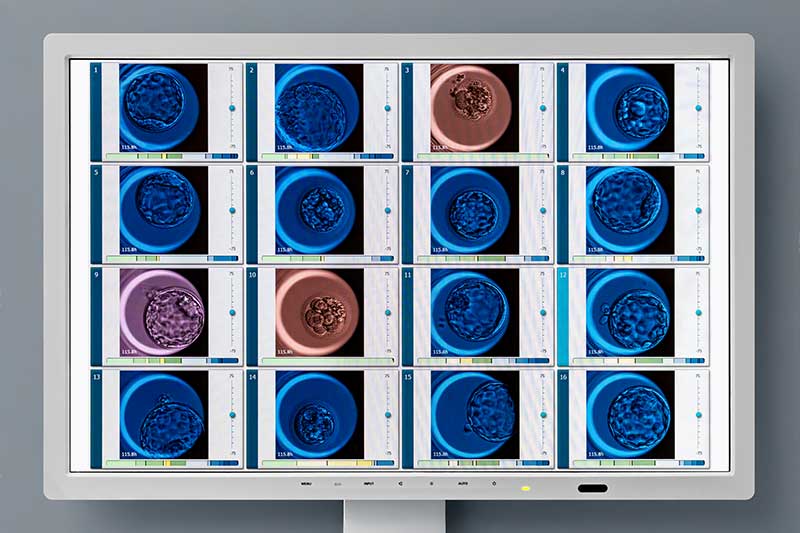
Embryos are observed continuously in time-lapse incubators, so selection is based on development patterns without disturbing the culture environment.
NABH-Accredited Embryology Labs
Extended culture happens in labs with controlled air, temperature and continuous monitoring, meeting NABH and international standards.
Single-Embryo Transfer Where Suitable
Better selection means we can often transfer one strong blastocyst, lowering the chance of twins and the risks that come with them.
Experienced Embryologists & Transfer Specialists
Grading, selection and transfer are carried out by experienced embryology and clinical teams, with ultrasound-guided placement.
Transparent Pricing, No Hidden Costs
You receive an itemised breakdown at consultation, including any add-on cost over a standard IVF cycle, before you commit. EMI options available.

What Is Blastocyst Culture & How Does It Work?

  • Fertilisation - After egg retrieval, eggs are fertilised by IVF or ICSI in the lab - usually on the same day - to create embryos.
  • Extended Culture - The embryos are grown in a specialised culture medium inside an incubator that mimics the body, and monitored as they develop over five to six days.
  • Grading & Selection - Embryologists assess each embryo's development and grade the blastocysts, identifying the one (or ones) most likely to implant.
  • Transfer or Freezing - The selected blastocyst is transferred to the uterus through a thin catheter under ultrasound guidance; surplus good-quality blastocysts can be frozen for later.
Day 0 egg retrieval · Day 1 fertilisation check · Day 2–3 cleavage (2–8 cells) · Day 4 morula · Day 5–6 blastocyst.
Extended culture to day 5–6 doesn't change the embryo - it lets the embryos show which are developing best.
The transfer itself is a short, outpatient procedure, similar in sensation to a Pap smear, with no sedation needed.

Who Should Consider Blastocyst Culture

Blastocyst culture is often recommended when there are enough embryos to allow meaningful selection, or when a single-embryo transfer is the goal. It's not the right choice for everyone - with very few embryos, growing them to day 5 carries a real chance that none reach the blastocyst stage. The honest aim of this section is to help you understand when extended culture helps, and when a day-3 transfer may be the safer plan. Your specialist will advise based on your embryos.
Several Embryos Available
When a good number of embryos fertilise, extended culture helps identify the strongest for transfer.
Aiming for Single-Embryo Transfer
When the goal is to transfer one embryo and avoid twins, blastocyst selection supports that choice.
Previous IVF Failure with Day-3 Transfers
When earlier cleavage-stage transfers haven't worked, blastocyst culture may give more information for selection.
Planning PGT (Genetic Testing)
Genetic testing is performed on a blastocyst-stage biopsy, so embryos are grown to day 5 before testing. (No sex-selection - PCPNDT Act.)
Planning to Freeze Embryos
Blastocysts vitrify and survive thawing well, making this stage suitable for freezing and a later frozen embryo transfer.
Wanting to Reduce Multiple-Pregnancy Risk
Because selection is better, fewer embryos need to be transferred, lowering the chance of a multiple pregnancy.
join us today

Not sure whether extended culture is right for you?

Book a consultation and our specialists will recommend the best plan for your embryos.
Call Us:
E-mail Us:

Your Step-by-Step Blastocyst Journey

Blastocyst culture happens within an IVF or ICSI cycle - the difference is in the lab, where embryos are grown for a few days longer before transfer. Here's what to expect at each stage, with the time markers you need to plan around.
Step 1
Consultation & Planning
Your specialist reviews your history and confirms whether extended culture suits your cycle, and whether transfer or freezing is the plan. [Time: 30–45 min]
Step 2
Ovarian Stimulation & Monitoring
Medication helps the ovaries produce several eggs, tracked with ultrasound and blood tests. [Time: ~10–12 days]
Step 3
Egg Retrieval & Fertilisation
Eggs are retrieved under sedation and fertilised by IVF or ICSI the same day. [Time: half-day visit]
Step 4
Extended Culture to Blastocyst
Embryos are grown and monitored in the lab for five to six days, and the blastocysts are graded. [Time: 5–6 days]
Step 5
Blastocyst Transfer (or Freezing)
The selected blastocyst is transferred via a thin catheter under ultrasound guidance; surplus blastocysts can be frozen. [Time: ~15-minute procedure]
Step 6
Pregnancy Test & Next Steps
A blood pregnancy test is done about 10–14 days after transfer. We discuss next steps either way, including using any frozen blastocysts. [Time: ~2 weeks post-transfer]

Precautions and Aftercare

  • Take Medication Exactly as Prescribed - Stimulation and any post-transfer hormones must be taken on schedule. Set alarms; don't skip or delay doses without speaking to your specialist.
  • Watch for OHSS Symptoms (During Stimulation) - Because blastocyst culture follows an IVF stimulation, report severe bloating, abdominal pain, rapid weight gain or breathlessness promptly.
  • Rest on Transfer Day, Then Resume Normal Activity - Take it easy on transfer day. From the next day, gentle normal activity is fine - strict bed rest is not necessary and isn't supported by evidence.
  • Avoid Strenuous Exercise & Sexual Activity for 24–48 Hours - Light walking is fine. Avoid intense exercise, heavy lifting and sexual activity for the first day or two.
  • Limit Alcohol, Tobacco and Caffeine - Avoid alcohol and tobacco through the cycle and the two-week wait; limit caffeine to about one cup a day.
  • Eat Well, Sleep Well, Stay Hydrated - Balanced nutrition, good sleep and hydration support recovery and implantation.
  • Look After Your Emotional Wellbeing - The two-week wait is demanding, and the chance that an embryo may not reach blastocyst adds uncertainty. Counselling support is available.
  • Red-flag callout - When to call your doctor - Contact your specialist urgently for: severe abdominal pain · heavy bleeding (more than spotting) · fever above 38°C · severe bloating or rapid weight gain · fainting or breathlessness.
testimonials

Heartfelt stories of hope and Success

Chaithra S
Electronic City
“It's awesome experience”
It's awesome experience to get a consultation from such a good experienced doctor. Dr Nirmala and Sister Fatima assisted very well
Suraj Kumar
Dwarka
“I had a very good experience”
I had a very good experience with Cloudnine Fertility for my IUI treatment. The doctors and staff were very supportive and professional.
Akhil Dalal
Chandigarh
“Best hospital in Tricity”
Best hospital in tricity Dr Kanchi is best in reproductive treatment. Staff is good hospital meet high standard of treatment and services. We got our result positive in one ho. Thanks alot team cloudnine.
Shariq Iqbal
Varthur Road
“Staff here polite and friendly”
Staff here polite and friendly..Hospital takes care of the hygiene well.
Mannu Arushi
HiTech City
“have a good experience”
Very good staff each and every point, have a good experience
Success Stories

Real journeys. Real hope.

Hear directly from patients who turned uncertainty into joy with the right care and guidance.
Location

Fertility care across India, closer to you

Select City
Reset
5
Pari Chowk
,
Noida
Noida
This is some text inside of a div block.
4.9
Nagarbhavi
,
Bengaluru
Bengaluru
This is some text inside of a div block.
4.8
Vikaspuri
,
New Delhi
New Delhi
This is some text inside of a div block.
4.9
Baner
,
Pune
Pune
This is some text inside of a div block.
5
Gomti Nagar
,
Lucknow
Lucknow
This is some text inside of a div block.
4.9
Rohini
,
New Delhi
New Delhi
This is some text inside of a div block.
4.9
Kompally
,
Hyderabad
Hyderabad
This is some text inside of a div block.
4.7
Thanisandra
,
Bengaluru
Bengaluru
This is some text inside of a div block.
No results found.
Reset All
Thank you! Your submission has been received!
Oops! Something went wrong while submitting the form.
From the Expert’s Desk

Guidance you can trust at every step

Get clear, expert-backed insights into fertility treatments, timelines and decisions, so you always know what comes next.
latest blogs

Fertility insights to guide your journey

Explore expert-backed articles that answer your questions and help you make informed decisions about fertility care.
View all Blogs
No items found.

Awards & Recognitions

Cloudnine continues to be recognised for excellence in fertility and maternity care, reflecting our commitment to clinical quality, patient trust and innovation.
FAQs

Blastocyst Questions, Clearly Answered

Clear, expert-reviewed answers to the most common questions about blastocyst culture and transfer - what it is, when it helps, the day-3-versus-day-5 question, success and cost.
Curious About IVF? Let's Talk.
Call Us:
E-mail Us:

What is a blastocyst?

A blastocyst is an embryo that has developed for five to six days and reached about 100–200 cells, with a fluid-filled cavity and two cell groups - the inner cell mass and the trophectoderm. It's the stage at which an embryo would naturally be ready to implant. Growing embryos to this stage helps identify the strongest for transfer.

Is a day-5 (blastocyst) transfer better than a day-3 transfer?

Not always - day-5 transfer allows stronger embryo selection and single-embryo transfer, but day-3 transfer can be safer when only a few embryos are available. The right choice depends on how many embryos you have and how they're developing. Your specialist will recommend the best option for you.

Will all my embryos become blastocysts?

No - not every fertilised egg reaches the blastocyst stage, and this is normal. Embryos that stop developing in the lab would also have been unlikely to implant. Your specialist will explain what to expect based on your embryo number and age.

Does blastocyst culture improve IVF success?

For many patients, transferring at the blastocyst stage improves the implantation rate per transfer, because the embryo is better developed and better selected. It also supports single-embryo transfer, lowering the risk of twins. Your specialist will discuss whether it suits your cycle.

Can blastocysts be frozen?

Yes - good-quality surplus blastocysts can be frozen by vitrification and stored for a later frozen embryo transfer. Blastocysts generally survive thawing well. This means a single egg-retrieval cycle can offer more than one chance at pregnancy.

Blastocyst Transfer

Thank you! Your submission has been received!
Oops! Something went wrong while submitting the form.

WHAT IS A BLASTOCYST TRANSFER ROUTINE?

Blastocyst transfer is a technique that works in tandem with a traditional in vitro fertilisation (IVF) procedure. In conventional IVF, a fertilised egg is transferred to the uterus within four days of fertilisation. However, by incubating embryos for up to six days and letting them develop into blastocysts, the odds of implantation significantly increase. On the sixth day, following a detailed blastocyst assessment, our embryologists pick the two best blastocysts to be deposited inside the womb.

WHY CHOOSE A BLASTOCYST TRANSFER ROUTINE?

A blastocyst transfer emulates the natural conception process by preparing an embryo to the stage that it would have been at if it had arrived in the uterus, the conventional way. The process is far superior to a pure in vitro fertilisation (IVF) procedure.

EFFECTIVE TIMING

In traditional IVF transfers, an embryo is transferred to the uterus before the uterine lining is fully prepared to receive it. In natural circumstances, an embryo is about six days old when it lands in the uterus. A blastocyst transfer presents the embryo and the uterus with conditions likened to natural conception.

REDUCED RISK OF MULTIPLE BIRTHS

The six-day mark is an effective barometer to measure the health of a blastocyst. A blastocyst that continues to thrive well into its sixth day is likely to survive uterine conditions. On Cloudnine, we transfer up to two blastocysts into the womb, per IVF cycle. Our embryologists follow a meticulous filtration process to pick the best blastocysts from the available pool.

IS A BLASTOCYST TRANSFER ROUTINE RIGHT FOR ME?

A blastocyst transfer demonstrates the best results in younger women. If your fertility specialist has determined that you're a good candidate for in vitro fertilisation (IVF), or if previous IVF attempts have failed on account of hindered implantation, a blastocyst transfer routine may be for you. Women with low healthy egg reserves are excellent fits for blastocyst procedures.

WHAT ARE THE STEPS OF A BLASTOCYST TRANSFER ROUTINE?

The steps involved in a blastocyst transfer mirror those of an in vitro fertilisation (IVF) routine. The only difference between a blastocyst transfer and a typical IVF procedure is the age of the embryo at implantation. In the latter, an embryo is about four days old, whereas a blastocyst transfer entails the ageing of an embryo to six days.

1. EGG COLLECTION

Egg collection is a painless, plain-sailing routine that doesn't usually last longer than half an hour. The procedure involves the retrieval of eggs from mature follicles, using a device known as a scan probe.

2. FERTILISATION

3. EMBRYO DEVELOPMENT

The embryos created during fertilisation are preserved in a laboratory incubator until they reach the blastocyst stage. By crossing the six-day mark in an incubator, these embryos are more likely to withstand and thrive in a uterine environment. Only the healthiest blastocysts are implanted into the uterus, with the ones left over being cryopreserved for the future.

4. EMBRYO TRANSFER

When an embryo reaches the six-day threshold, it is called a blastocyst. It is an ideal time for the blastocyst to make an appearance in the uterus at this stage. It is now strong enough to weather the uterine environment, and an embryologist carefully places the healthiest blastocyst inside the uterus. On Cloudnine, our ethos is deep-seated in safety and well-being, and we believe in promoting safe, healthy pregnancies. Thus, we transfer a maximum of two blastocysts in any one IVF cycle.

5. PREGNANCY

About two weeks after your IVF procedure, you will be invited in to take a pregnancy test to gauge the success of the blastocyst transfer. An ultrasound scan will follow once you're six weeks into your maternity journey. This time, we'll check for a tiny heartbeat.

6. FOLLOW-UPS

If your blastocyst transfer has been fruitful, it's always a good idea to be thorough with your follow-ups. Being regular could ward off potential complications. Sometimes, procedures that don't pan out favourably can be emotionally taxing for hopeful parents. On Cloudnine, we reach out to couples that have experienced up to three unsuccessful IVF cycles, through individual counselling sessions. These complimentary consultations offer relief and support during such difficult times and present a range of alternative fertility options that can be pursued.

WHAT ARE THE RISKS OF A BLASTOCYST TRANSFER ROUTINE?

A blastocyst transfer routine could prove worthwhile for couples whose chances of conceiving from in vitro fertilisation (IVF) are considerable. While the risks that are tethered to blastocyst transfer have no bearing on one's health or safety, unfavourable outcomes are possible if the procedure is not conducted diligently. The fertility specialists on Cloudnine are seasoned experts of the blastocyst routine, and ensure that every step is performed meticulously.

INADEQUATE DEVELOPMENT OF EMBRYOS

The success of a blastocyst transfer routine pivots on the ability of a selection of embryos to reach the blastocyst stage. Not all embryos may develop adequately to become blastocysts. Sometimes, embryos stagnate at the four-cell stage. In such a case, your embryologist may advise you to go ahead with a simple IVF procedure, to secure your chances of gaining at least some healthy four-day-old embryos, as opposed to no blastocysts at the end of six days.

MULTIPLE BIRTHS

As with a regular IVF routine, inserting more than one blastocyst could result in multiple births. On Cloudnine, we ensure that no more than two blastocysts are deposited into the uterus in any given cycle.

BLASTOCYST TRANSFER

Blastocyst culture and transfer is a technique developed for in vitro fertilization (IVF). This procedure intends to maximize pregnancy rates while minimizing the risk of multiple pregnancies. At Cloudnine, our fertility doctors and embryologist are providing the best Blastocyst Transfer treatment for women, especially older women to overcome infertility.

MULTIPLE BIRTHS

The advanced infertility technologies like Blastocyst transfer reduce the risk of multiple births. The expert embryologists at our Fertility centre treats women infertility with Blastocyst transfer to reduce the risk of multiple pregnancies. It also improves the success rate of IVF and other treatments as well.