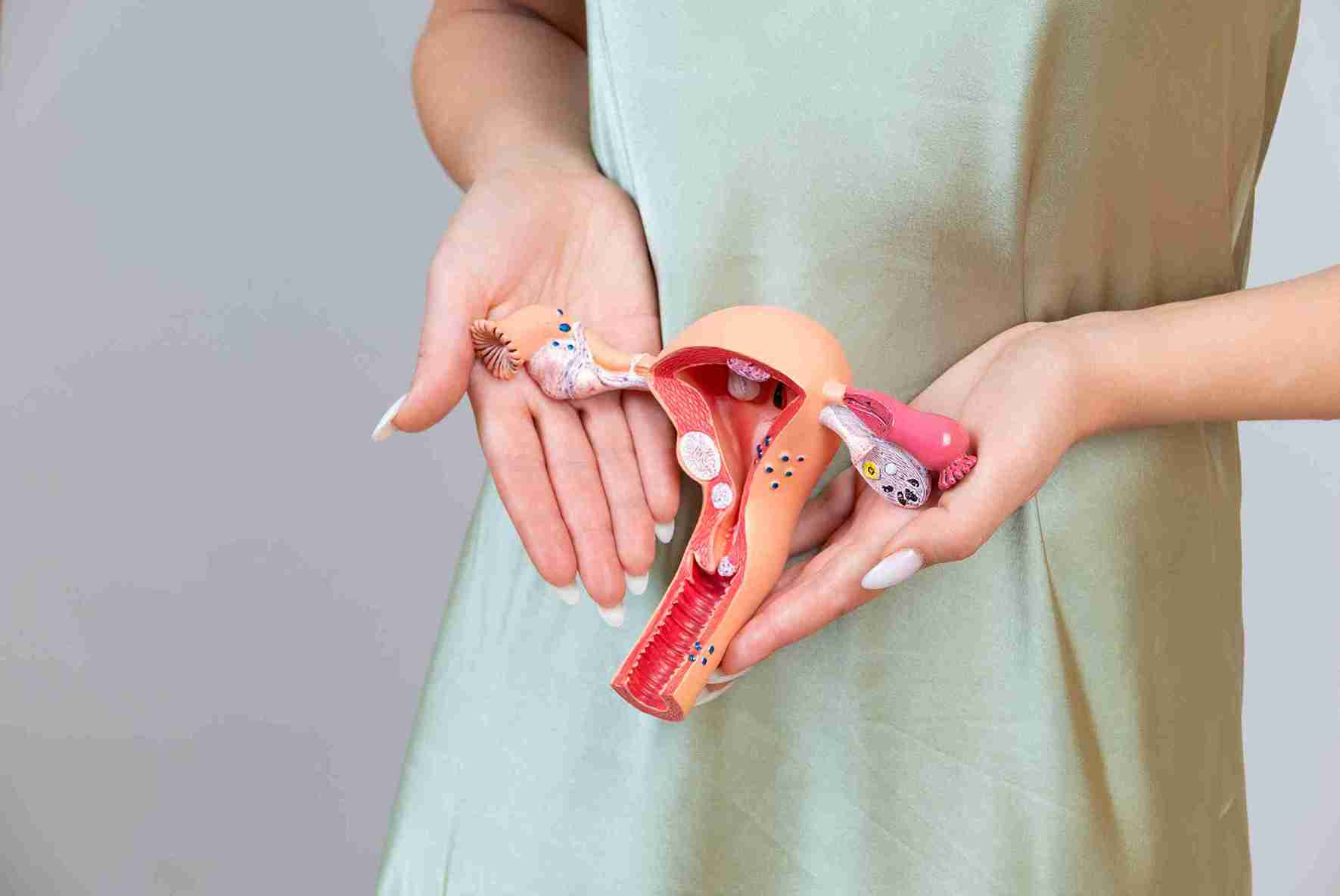
Hormonal imbalance is not a diagnosis. It describes cycles in which the signals that trigger ovulation do not fire cleanly, so a follicle stays behind as an ovarian cyst. It names a mechanism, not a condition, and there is no single test that confirms it.
Why an unfinished cycle leaves an ovarian cyst behind
Every cycle, a small fluid-filled sac called a follicle grows on the ovary and matures an egg. Two things can go wrong with that sequence, and both leave an ovarian cyst behind.
In the first, the luteinising hormone surge (the mid-cycle signal that tells the follicle to release its egg) does not arrive, or arrives too weakly. The follicle keeps growing and fills with fluid instead of opening. This is a follicular ovarian cyst, the most common type.
In the second, the egg is released normally, but the emptied follicle does not shrink back as it should. It seals over and collects fluid or a small amount of blood. This is a corpus luteum ovarian cyst, named after the structure a follicle becomes once the egg has gone.
Both are functional ovarian cysts, because they come from the ovary doing its ordinary job imperfectly rather than from disease. Most settle without treatment over two to three cycles. Follicular ovarian cysts and corpus luteum ovarian cysts are each covered in full in their own guides.
There is no test called a hormone balance test
Patients often come in asking for a hormone balance test. No such test exists. Every blood test a gynaecologist orders measures one specific hormone at one specific point in the cycle, and each answers a narrow question. None of them returns a verdict on whether your hormones are balanced, because that is not a measurable state.
This matters because results read on their own are routinely misinterpreted. A hormone level sits inside a range that shifts by cycle day, by age and by whether you ovulated that month. The same number can be normal in one context and worth investigating in another. That is also why the same test can be repeated at a different point in the cycle and read completely differently. Your gynaecologist reads the numbers against your cycle history, your symptoms and your scan, and it is that combination that produces a diagnosis, never a panel on its own.
What people ask for
What is actually tested
What the result can and cannot tell you
A hormone panel
Individual hormones are measured on a set cycle day, usually early in the cycle, to see how that cycle is starting.
Can show whether a cycle is starting as expected. Cannot confirm or rule out a hormonal imbalance as a condition, because no such diagnosis exists.
A thyroid check
Thyroid function, because thyroid disorders disturb periods and ovulation.
Can identify a thyroid disorder that needs treating in its own right. Is not established as a cause of ovarian cysts.
A testosterone or androgen test
Androgen levels, the group of hormones linked to acne, excess hair growth and irregular cycles.
Can support a polycystic ovary syndrome assessment alongside a scan and your cycle history. Does not diagnose anything on its own.
An egg reserve test
Ovarian reserve markers, meaning an estimate of how many eggs remain available.
Can indicate ovarian reserve. Says nothing about why an ovarian cyst formed or whether it will settle.
What will not correct a hormone-driven ovarian cyst?
No supplement clears an ovarian cyst. No diet clears an ovarian cyst. No detox or cleanse clears an ovarian cyst. No seed-cycling routine clears an ovarian cyst.
These are not cautious statements pending better evidence. No controlled trial has shown any of these approaches can shrink or resolve an ovarian cyst, and the ovarian cysts that do settle on such regimens are functional ones that would have settled anyway. That coincidence is why the claims persist and why they are repeated so widely online in India.
The real cost is delay. An ovarian cyst left unreviewed for six months while a remedy is tried is an ovarian cyst nobody has reassessed, and the small number that need attention are exactly the ones that do not settle on their own.
Separately, and this is a different claim: where an ovarian cyst is driven by polycystic ovary syndrome (a hormonal and metabolic condition that affects ovulation), managing weight and insulin resistance can improve the underlying condition. That is treating the driver, not clearing a cyst.
Home and natural remedies for ovarian cysts and diet and ovarian cysts are covered separately.
WHEN TO GET IT LOOKED AT
If you have been told you have an ovarian cyst, keep the follow-up scan your gynaecologist arranged, even if the symptoms have settled. The scan is what confirms it has gone.
Seek same-day medical care for sudden severe pelvic pain, particularly with nausea, vomiting, fever or feeling faint. An ovarian cyst can occasionally rupture or twist the ovary, and both need urgent assessment. Sharp pelvic pain on one side sets out how to tell ovulation pain from a cyst.
Want to consult the Best Fertility in india? Please find the links below.
What does hormonal imbalance mean in ovarian cysts?
It describes cycles in which the hormone signals that trigger ovulation do not work as expected, so a follicle persists as a cyst. It is a description of a mechanism, not a diagnosis on its own.
Is there a test for hormonal imbalance?
No. There is no single test that diagnoses a hormonal imbalance. Cycle-timed blood tests, thyroid function and ovarian reserve markers each measure one thing, and they are read alongside your symptoms and a scan rather than on their own.
Can supplements or a diet correct a hormone-driven ovarian cyst?
No. No supplement, diet, detox or seed-cycling routine has been shown to clear an ovarian cyst. Where a cyst is driven by polycystic ovary syndrome, managing weight and insulin can help the underlying condition, which is not the same as clearing a cyst.
Schedule your consultation Today!
Book your consultation with our fertility experts the first step toward your parenthood journey.