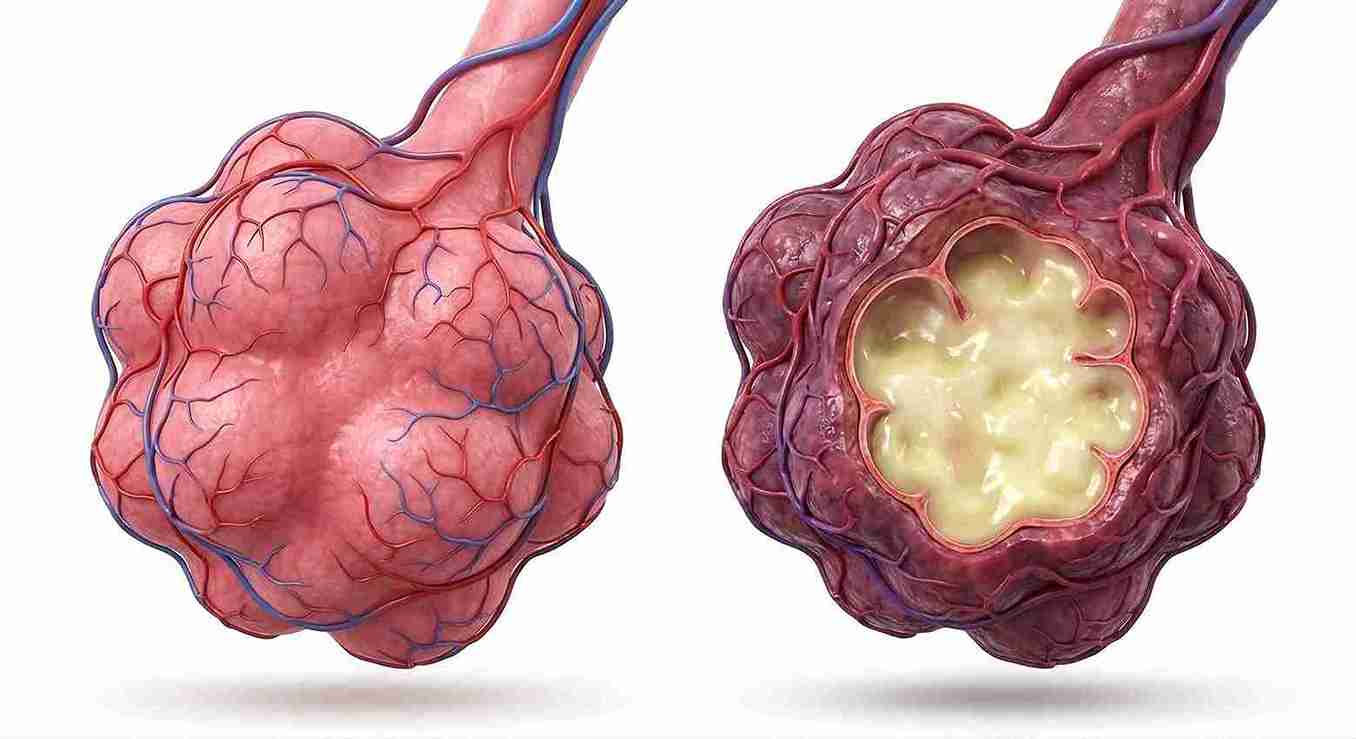
A corpus luteum cyst is a fluid-filled sac that forms in the ovary after ovulation, at the exact spot where the egg was released. In early pregnancy, it is an expected finding rather than a problem. It makes the progesterone that sustains the pregnancy until the placenta takes over, and it usually disappears by the second trimester.
What is a corpus luteum cyst?
After ovulation, the emptied follicle collapses and reorganises into a small temporary hormone gland called the corpus luteum (Latin for yellow body). Its job is to release progesterone, the hormone that prepares and holds the womb lining. Sometimes, instead of shrinking and sealing over, the structure fills with fluid or with blood and is reported as a corpus luteum cyst. It is the same structure at a different stage, not a different disease. This is why it is classed as a functional cyst, meaning a cyst produced by the ovary doing its normal monthly work.
A corpus luteum and a corpus luteum cyst are the same structure at two points on the same normal process, which is why the distinction confuses so many people reading a scan report. After an egg is released, the emptied follicle collapses and reorganises into the corpus luteum (a temporary hormone gland that produces progesterone to support a possible pregnancy). Usually it seals over as it forms. Sometimes it fills with fluid or a small amount of blood instead, and once it does, the same structure crosses a size threshold on ultrasound and gets reported as a cyst. Nothing has gone wrong. The table below sets out where the two differ and where they do not.
Feature
Corpus Luteum
Corpus Luteum Cyst
What It Is
The temporary hormone-producing structure formed from the ovarian follicle after ovulation.
The same structure when it becomes enlarged because it fills with fluid or blood instead of regressing normally.
Typical Size
Usually around 2–3 cm.
Commonly around 3–5 cm, although it can occasionally be larger.
How Normal Is It?
It normally forms during cycles in which ovulation occurs.
It is also usually a functional finding and, in most cases, remains benign and self-limiting.
Hormone Output
Produces mainly progesterone, with smaller amounts of oestrogen and relaxin.
Usually continues to produce progesterone while it remains functional.
What Happens Next
If pregnancy does not occur, it normally regresses within about two weeks.
It usually regresses as well, although this may take somewhat longer.
On Your Report
May simply be described as a corpus luteum.
May be described as a corpus luteum cyst. The word “cyst” does not automatically mean that it is dangerous.
Is it the same as a functional cyst?
Yes. Functional cysts have two subtypes: follicular cysts, which form before ovulation, and corpus luteum cysts, which form after it. Everything on this page concerns the second type.
Why this has appeared on your early pregnancy scan
Most women only ever hear the phrase because of an early dating or viability scan. Transvaginal ultrasound in the first trimester is detailed enough to resolve structures of a centimetre or two, so the corpus luteum is visible in the great majority of early pregnancies. It has almost certainly been there in every cycle you have ovulated; this is simply the first time anyone has looked closely and written it down.
In Indian practice, early scans are routine, and reports are handed directly to patients, often without an accompanying explanation. The word cyst then does the damage. It is worth separating two quite different situations at the outset: an incidental corpus luteum cyst found on a routine scan in a woman with no symptoms, which needs nothing, and a cyst found while investigating sudden severe pain, which needs assessment that day. Almost everyone reading this is in the first group.
Why you have a corpus luteum cyst in early pregnancy
In early pregnancy, the corpus luteum does not fade away as it normally would. The implanting embryo releases human chorionic gonadotropin (hCG, the hormone that a pregnancy test detects), and hCG signals the corpus luteum to remain active and continue producing progesterone. Clinicians call this the rescued corpus luteum. Because it persists rather than regressing, it is more likely to be seen on a scan and more likely to have enlarged into a cyst. Its presence in the first trimester is expected physiology, not a complication of your pregnancy.
How it forms, step by step
Ovulation: The follicle ruptures at ovulation and releases the egg, leaving a small collapsed cavity with a raw, newly formed blood supply.
Luteinisation: Under the influence of luteinising hormone, the remaining follicle cells transform into progesterone-producing lutein cells, and the cavity becomes the corpus luteum.
Filling: If the cavity does not seal cleanly, fluid or blood from those fragile new vessels collects inside it, and the enlarged structure is reported as a corpus luteum cyst.
What the corpus luteum actually does during pregnancy
It is not a passive leftover. For the first weeks of pregnancy, it is the sole source of the hormones holding everything together.
Progesterone: keeps the womb lining thick, secretory and receptive so the embryo can implant and stay implanted.
Cycle suppression: prevents the lining from shedding, which is why your period does not arrive.
Estrogen: smaller amounts of estrogen support the growth of the lining and its blood supply.
Relaxin: a hormone involved in softening connective tissue as the pregnancy establishes.
The handover to the placenta, and when it happens
The point at which the placenta takes over progesterone production from the corpus luteum is called the luteoplacental shift. It is a gradual crossover rather than a switch. The corpus luteum supplies roughly three quarters of circulating progesterone at six weeks, about half by ten to eleven weeks, and a third by fourteen to fifteen weeks, with the placenta making up the difference.
If a corpus luteum cyst is found on an early pregnancy scan, the reflex is to worry about it. The biology points the other way. For the first several weeks of pregnancy, the corpus luteum is the main source of progesterone, the hormone that maintains the uterine lining and holds the pregnancy. The placenta takes over that job gradually, in a handover known as the luteoplacental shift. So a corpus luteum cyst seen at seven weeks is not an incidental finding that happens to be harmless. It is the structure currently doing the work. The table below shows how the handover progresses.
Gestational Age
Main Progesterone Source
What This Means in Practice
Weeks 4 to 6
Corpus luteum, providing a substantial share of progesterone
The corpus luteum is doing important hormonal work. This is an early period of significant dependence on it.
Weeks 7 to 9
Handover underway, with the placenta contributing increasingly more
This is the luteoplacental shift, during which placental hormone production progressively takes over.
Weeks 10 to 12
Placenta is becoming the main source
Corpus luteum hormone production generally declines as placental production becomes dominant.
Weeks 12 to 16
Placenta is effectively the primary source
The corpus luteum has usually regressed or is close to regression by this stage.
This timeline is the reason clinicians care about the exact gestational age if surgery is ever discussed, and the reason progesterone support in assisted conception is usually continued into this window rather than stopped at the positive test.
Is a corpus luteum cyst a good sign in early pregnancy?
It is a normal sign rather than a good one, and the distinction matters. Its presence confirms that ovulation happened and that the pregnancy has produced enough hCG to sustain the corpus luteum, which is reassuring as far as it goes. But it does not predict whether a pregnancy will continue. Research looking at corpus luteum appearance and blood flow as a predictor of first trimester outcome remains inconsistent, and nothing about the size or look of your cyst tells you how your pregnancy will progress. Anyone presenting it as proof of a healthy pregnancy is overreaching. Equally, its absence on a scan is not a bad sign.
Does a corpus luteum cyst mean I am pregnant?
No. A corpus luteum forms after ovulation in every cycle, pregnant or not. If there is no pregnancy, it simply regresses over roughly two weeks and your period follows. A corpus luteum cyst on a scan tells you that you ovulated recently. It tells you nothing about conception, because the corpus luteum makes progesterone, not hCG, and only hCG confirms pregnancy. If you want an answer, take a pregnancy test or ask for a blood beta hCG. Conversely, yes, you can absolutely have a corpus luteum cyst and not be pregnant, and this is the far more common situation.
Does a corpus luteum cyst affect the baby?
No. It sits in the ovary, entirely outside the womb, and has no physical contact with the developing pregnancy. It does not cross into pregnancy, does not raise the risk of birth defects, and does not affect growth. Its only relationship with the pregnancy is hormonal, and that relationship is supportive.
Can a corpus luteum cyst cause miscarriage?
A corpus luteum cyst that is simply present does not cause miscarriage, and there is no evidence that having one raises your risk. There is one honest exception, and it concerns removal rather than the cyst itself. If the corpus luteum is surgically removed before the placenta has taken over, usually before about ten weeks, the pregnancy loses its progesterone source. In that specific situation, progesterone support is given precisely because the natural supply has been taken away. This is a well-recognised surgical consideration, not a risk attached to leaving a cyst alone, and it is one of the main reasons surgeons avoid operating on the ovary early in pregnancy unless there is an emergency.
What if the corpus luteum does not work properly?
This is where honest hedging is required. The idea that an underperforming corpus luteum, often labelled luteal phase deficiency, causes recurrent early pregnancy loss has been debated for decades, and the evidence remains contested. There is no agreed diagnostic test for it, single progesterone readings in early pregnancy fluctuate too much to interpret in isolation, and routine progesterone supplementation is not recommended for everyone. If you have had recurrent losses, that warrants a proper investigation of its own rather than a conclusion drawn from a cyst on a scan.
What your scan report is actually describing
Ultrasound reports are written for the referring clinician, not for you, and the vocabulary is alarming out of context. Most of the words that worry patients are the standard descriptors of a healthy corpus luteum.
Wording on Your Report
What It Actually Means
Thick-walled, crenulated
The wall is thick and has a crinkled or irregular edge. This is a classic appearance of a corpus luteum and is not, by itself, a warning feature.
Peripheral vascularity, ring of fire
A ring of blood flow around the cyst wall seen on Doppler imaging. It is commonly seen with an active corpus luteum.
Anechoic
The contents appear black on ultrasound, usually indicating clear fluid.
Internal echoes, low-level echoes
There is material within the cyst, often representing blood or blood products following ovulation.
Unilocular
A single compartment with no internal dividing walls. This is generally a reassuring description.
Reticular, lace-like, fishnet, cobweb
Fine fibrin strands formed as blood clots within the cyst. This can be seen with a haemorrhagic corpus luteum.
Retracting clot
A blood clot pulling away from the cyst wall. It has no internal blood flow, which helps distinguish it from solid tissue.
Simple
Clear fluid, thin walls, and no solid components. This is generally a reassuring ultrasound description.
What size of corpus luteum cyst is normal in pregnancy?
Most corpus luteum cysts in early pregnancy measure between 3 cm and 5 cm. Size on its own is a weaker signal than appearance, but it does shape how closely you are followed up.
Most of the anxiety around a corpus luteum cyst comes from the report, not the cyst. Radiology wording is written for the referring clinician, not the patient, so words that simply describe what the scan looked like read as though something is wrong. Thick walls, internal echoes and a ring of blood flow all sound alarming and are, in this context, the expected appearance of a structure that is working normally. Knowing what the vocabulary actually describes is usually enough to settle the worry before your follow-up appointment. The table below translates the descriptors that appear most often.
Size on Scan
What It Usually Indicates
Usual Approach
Under 3 cm
A normal corpus luteum rather than a cyst.
Nothing. It may not even be reported as a cyst.
3 cm to 5 cm
The common size range for a corpus luteum cyst in early pregnancy.
Reassurance. Usually no repeat imaging is needed if you have no symptoms.
5 cm to 7 cm
Still very likely to be functional, with a modestly higher risk of ovarian torsion.
Often a repeat scan is recommended to confirm that it is shrinking.
Over 7 cm, or still present after 16 weeks
Less likely to be behaving as a simple functional cyst.
Reassessment of the appearance and obstetric review.
Read together, these descriptors are the reason radiologists are usually confident about a corpus luteum on sight. The combination of a thick crinkled wall, a ring of flow around it and clear or lace-like contents inside is characteristic enough that most reports will name it directly. What genuinely changes the picture is different wording: solid areas with blood flow inside them, dividing walls within the cyst, thickened growths on the inner wall, or fluid in the abdomen alongside the cyst. If your report does not use that second set of terms, the descriptors above are describing something your body does every cycle.
Is a 5 cm corpus luteum cyst in pregnancy dangerous? Usually not. At 5 cm, if the cyst is simple or shows the typical haemorrhagic pattern and you have no pain, it is managed by observation. What the radiologist sees matters more than the number: thin walls, a single compartment, no solid growing areas and no blood flow inside the contents are all reassuring, at 5 cm just as at 3 cm.
What the ring of fire sign means
Ring of fire describes a circle of blood flow around the wall of the cyst on colour Doppler. In a corpus luteum, it reflects the dense new blood supply that a working hormone gland needs, and it is the most consistent feature of an active corpus luteum. One important caution: an ectopic pregnancy can produce a very similar ring, so this sign on its own cannot separate the two. It is helpful in combination with other findings, never in isolation.
Why your report says complex when it is only a corpus luteum
Complex, in ultrasound reporting, simply means the contents are not uniformly clear fluid. Blood inside a corpus luteum produces internal echoes, and that is enough to earn the word. It does not carry the meaning most patients assume, which is something suspicious. A haemorrhagic corpus luteum is one of the commonest reasons for a complex-looking cyst in a woman of reproductive age, and it resolves on its own. If a report genuinely describes concerning features, it will say so in different terms: solid areas with blood flow inside them, thick irregular internal walls, or growth over time.
Haemorrhagic corpus luteum
A haemorrhagic corpus luteum is a corpus luteum that has bled into itself. The vessels that grow into the ovulation site are thin-walled and rupture easily, so this is common rather than unusual. On a scan, it typically shows:
A rounded ovarian structure, most often around 3 cm to 5 cm, with a thick but regular wall.
Fine, weakly bright strands crossing the inside, described as reticular, lace-like, or fishnet. These are fibrin strands from clotting blood, and unlike true dividing walls, they are very thin and carry no blood flow.
Sometimes a solid-looking clot with concave edges, retracting towards the wall. A clot pulls inward as it shrinks; a growth would push outward.
No blood flow within the internal contents, only around the wall.
It causes one-sided pain in some women and none at all in others, and it usually resolves within a few weeks. The main clinical risk of misreading it is unnecessary surgery.
Corpus luteum cyst and ectopic pregnancy: how they are told apart
This is the single most important distinction in early pregnancy imaging, and it is worth being straightforward about the difficulty. A corpus luteum sits next to the fallopian tube, and an ectopic pregnancy in that tube can look similar on a first pass. The two are separated by a combination of features rather than any one finding.
There is one genuinely important lookalike. A corpus luteum sits inside the ovary, and an ectopic pregnancy (a pregnancy implanted outside the womb, most often in the fallopian tube) sits beside it, and on a scan the two can look similar enough that distinguishing them is a recognised diagnostic challenge. This is why an early pregnancy scan is done by someone trained to tell them apart, and why a scan is sometimes repeated a few days later rather than called on the first look. The features below are what the sonographer is weighing up. They are set out here so the process makes sense, not so that you can assess your own scan.
Feature
Corpus Luteum
Ectopic Pregnancy (Tubal Ring)
Position
Inside the outline of the ovary, with a rim of normal ovarian tissue around it.
Beside the ovary, usually separable from ovarian tissue.
Wall Brightness
Equal to or darker than the surrounding ovary and typically darker than the womb lining.
Usually brighter than the surrounding ovary and, in some cases, brighter than the womb lining.
Sliding Organ Sign
Moves together with the ovary when gentle probe pressure is applied.
Slides separately from the ovary.
Internal Contents
Often clear or crossed by fine fibrin strands.
More often appears solid or has low-level echoes; a yolk sac may be visible inside.
Ring of Fire on Doppler
Commonly present.
Can also be present, so this sign alone cannot reliably distinguish the two.
Free Fluid in the Pelvis
Usually none or a small amount of clear fluid.
More often present and may contain internal echoes, which can suggest blood.
Two things are worth taking from this. The first is that no single feature settles it. The ring of fire appears in both, and it is the combination of position, movement, wall brightness and contents that leads to an answer, sometimes alongside a repeat scan and blood tests. The second matters more. This distinction is made on symptoms as well as images, so what you feel is part of the assessment. Seek urgent medical care if you have one-sided pelvic pain that is severe or worsening, shoulder tip pain, vaginal bleeding in early pregnancy, faintness or dizziness, or pain when opening your bowels. Do not wait for a scheduled scan if any of these appear.
Can a corpus luteum cyst be mistaken for an ectopic pregnancy?
Yes, and pretending otherwise would be dishonest. It is a genuine and well-documented diagnostic overlap. Around five per cent of ectopic pregnancies also sit on the same side as the corpus luteum, which removes the reassurance that side alone might offer. When the picture is not clear, the answer is not a single better scan but a sequence: serial blood beta-hCG measurements alongside a repeat scan after an interval, usually reviewed by an experienced early pregnancy sonographer. If you have been told to come back for a repeat scan and a repeat blood test, that is the correct process working, not a sign that something has been missed.
Why some corpus luteums become cysts
Every ovulatory cycle produces a corpus luteum. Only some become large enough or fluid-filled enough to be called a cyst. The reasons are mechanical and hormonal, and none of them is things you caused.
Failure to seal after ovulation: if the collapsed follicle does not close cleanly after the egg is released, fluid accumulates inside the cavity.
Bleeding into the cavity: the new vessels supplying the corpus luteum are thin-walled and rupture easily, so blood collects inside and enlarges it.
The hCG rescue signal: in pregnancy, hCG keeps the corpus luteum alive and active for weeks longer than usual, giving it more time to enlarge.
Ovulation induction and IVF stimulation: when several follicles are recruited, several corpus luteums form, and more of them are visible on scans.
An unusually rich blood supply: the corpus luteum is one of the most vascular structures in the body for its size, which is exactly why it bleeds into itself so readily.
Nothing you did: diet, exercise, lifting, stress, travel and intercourse do not cause corpus luteum cysts, and nothing you did or did not do explains this finding.
What to do if your scan shows a corpus luteum cyst
For the overwhelming majority of women, the answer is genuinely nothing. The management of a functional cyst is observation, and observation is a decision, not an absence of one.
What monitoring actually involves
If you have no symptoms and the cyst is under about 5 cm with a typical appearance, guidelines do not require a repeat scan at all. Indian practice tends to re-scan more often than this, which is worth knowing so a repeat is not read as a sign of concern.
Where a repeat is arranged, it is usually scheduled a few weeks later or at your next routine scan to confirm the cyst is shrinking rather than growing.
One-sided ache is common. Simple pain relief that your treating clinician has confirmed is suitable in pregnancy is reasonable. Do not self-medicate in the first trimester.
Normal activity, work, walking, exercise and intercourse are all safe. Ask specifically whether your cyst is over about 6 cm, at which point the torsion conversation becomes relevant.
If your report describes a persistent cyst at or beyond 16 weeks, ask for reassessment rather than simply a repeat.
What does not work, and why it matters
This section exists because the alternative is to find these answers somewhere, with a product to sell.
Nothing speeds it up: no medication, supplement, diet or exercise makes a corpus luteum cyst resolve faster. It resolves on its own timetable, which is tied to the pregnancy hormone cycle, not to anything you can influence.
Progesterone does not shrink it: progesterone is given to support a pregnancy in specific situations. It does not shrink the cyst, and it is not a treatment for it. The two are commonly conflated by patients on fertility treatment.
Birth control pills are prevention, not treatment: the pill works by suppressing ovulation, so it can reduce how often new functional cysts form. It does nothing to an existing one, and it has no role at all in pregnancy.
No diet or home remedy: castor oil packs, heat therapy, apple cider vinegar, specific diets and herbal preparations have no evidence of shrinking ovarian cysts. The real harm is rarely the remedy itself. It is the delay in getting pain reassessed while you wait for one to work.
Corpus luteum cysts after fertility treatment
If you have conceived through treatment, whether you have a corpus luteum at all depends entirely on the type of cycle you had. The table below explains most of the confusion around progesterone support.
Cycle Type
Do You Have a Corpus Luteum?
What Follows From That
Natural Conception or Timed Intercourse
Yes, usually one
Your own corpus luteum produces progesterone. No additional support is normally needed.
Ovulation Induction or Intrauterine Insemination
Yes, sometimes more than one
Multiple corpus luteum cysts can be an expected finding rather than a complication.
Fresh Embryo Transfer After IVF
Yes, often several, although the follicles were aspirated during egg collection
Corpus luteum function can be affected by the stimulation protocol, so luteal support is commonly used.
Natural-Cycle Frozen Embryo Transfer
Yes, your own
A functioning corpus luteum is present, so progesterone support may be lighter depending on the protocol.
Medicated or Hormone-Replacement Frozen Embryo Transfer
No
Progesterone comes from the prescribed medication, so it should not be stopped early unless your fertility team advises you to do so.
Why progesterone support is given after embryo transfer
In a medicated frozen transfer cycle, ovulation is deliberately suppressed, so no corpus luteum forms and there is no natural progesterone source at all. In a fresh IVF cycle, the corpus luteum that does form often underperforms due to the drugs used to control the cycle. In both cases, supplementary progesterone serves as a substitute for a source that is absent or impaired, and it is typically continued during the window in which the placenta takes over. Only your treating team should decide when to stop it. Never stop it because a scan showed a corpus luteum cyst.
Is there a corpus luteum in a frozen embryo transfer cycle?
It depends on the cycle. A natural cycle frozen transfer relies on your own ovulation, so you do have a corpus luteum. A medicated or hormone replacement frozen transfer suppresses ovulation and replaces the hormones from outside, so you have none. This is an important difference and one that is rarely explained clearly. It is also the reason women who conceive through medicated frozen transfers are monitored slightly differently.
Does a corpus luteum cyst after IUI mean the cycle worked?
No, and it is worth saying this plainly rather than kindly. A corpus luteum cyst on a scan during the two-week wait confirms that you ovulated, which means the timing of the insemination was right. It cannot confirm that fertilisation or implantation occurred, because the corpus luteum forms after ovulation whether or not conception follows. Only a beta hCG blood test at the appropriate point answers that question. If a scan during the wait has raised your hopes, this is genuinely neutral information.
Will a corpus luteum cyst delay my next IVF cycle?
Sometimes, and the decision turns on whether the cyst is still hormonally active rather than on its size. At a baseline scan on day two or three, a persisting corpus luteum cyst producing progesterone can interfere with the start of stimulation, so your team may check an oestradiol level and either proceed, aspirate the cyst, or wait one cycle for it to resolve. Waiting a cycle in this situation is a routine adjustment, not a setback.
Theca lutein cysts: a related but different finding
Theca lutein cysts are a distinct type of functional cyst driven by unusually high hCG levels. Unlike corpus luteum cysts, they are typically bilateral (present in both ovaries) and multiple, giving the ovaries an enlarged, multi-compartment appearance. They are seen in multiple pregnancy, in molar pregnancy, and in ovarian hyperstimulation after fertility treatment. Because they are hCG-driven, they resolve as hCG falls after delivery or treatment. They are mentioned here because they can be confused with corpus luteum cysts on a report, but their significance is different: they prompt a look at why hCG is high, rather than reassurance alone.
When a corpus luteum cyst becomes a problem
Complications are uncommon, but they are the reason this page cannot end at reassurance. Both of the situations below are surgical emergencies, and both are recognised by the sudden onset and severity of pain rather than by anything on a previous scan.
Rupture
A haemorrhagic corpus luteum can burst, releasing blood into the abdomen. This causes sudden, sharp, one-sided pain that sometimes spreads across the abdomen. When bleeding is significant, it can cause dizziness, faintness, a racing pulse, and pain referred to the shoulder tip, due to blood irritating the diaphragm. Most ruptures settle with observation and pain relief. Significant internal bleeding requires urgent surgery.
Ovarian torsion
Torsion is the twisting of the ovary on its blood supply. An enlarged ovary is heavier and more mobile, which is why a larger cyst raises the risk, and pregnancy raises it further because the enlarging womb changes the position of the ovaries. Torsion is most common in the first trimester and is more frequent after ovarian stimulation. It causes sudden severe one-sided pain, usually with nausea and vomiting, and it does not settle. It is a surgical emergency because a twisted ovary loses its blood supply within hours.
When surgery is considered, and when it is avoided
Surgery is rare and is reserved for clear indications:
confirmed or strongly suspected ovarian torsion, which is operated on immediately at any gestation.
rupture with significant ongoing internal bleeding.
a mass with features that are genuinely suspicious rather than functional, or one that persists and grows well beyond the point at which a functional cyst should have resolved.
Outside an emergency, the preferred window is the second trimester, broadly 14 to 20 weeks. There are two reasons for waiting. The first trimester is when most functional cysts resolve without intervention, so operating early means operating on cysts that would otherwise resolve. And removing the corpus luteum before the placenta has taken over removes the pregnancy's progesterone source, which is why progesterone support is given if that becomes unavoidable. Where surgery is needed, a laparoscopic (keyhole) approach is generally preferred.
Go to hospital straight away if you have any of the following
Sudden, severe or rapidly worsening abdominal or pelvic pain
Pain with persistent vomiting that will not settle
Dizziness, fainting, or feeling like you might pass out
A racing or pounding pulse, or clammy pale skin
Heavy vaginal bleeding
Pain at the tip of your shoulder alongside abdominal pain
Fever with abdominal pain
Any vaginal bleeding in pregnancy should be reported the same day, even if it is light and even if you feel well
How much do the scans and tests for a corpus luteum cyst cost in India?
A corpus luteum cyst is not itself treated, so there is no procedure cost attached to the diagnosis in the vast majority of cases. What you may pay for is the imaging and blood work used to confirm it is behaving as expected, and, very rarely, surgery if a complication develops. Costs vary by city, by whether a scan is done as a standalone investigation or as part of an antenatal package, and by whether any procedure is day care or requires admission.
Costs vary by city, by whether a scan is done as a standalone appointment or as part of a package, and by how much of the workup is needed in your case. Most women with a corpus luteum cyst need only a scan and, if anything at all, a repeat scan a few weeks later. The larger figures below apply to a small minority, where a complication is suspected and surgery becomes necessary. The table is a guide to what each item costs, not a prediction of what your care will cost. Your treating team can give you a written estimate once they know which of these you actually need.
Test or Procedure
Indicative Cost at Cloudnine Fertility
Transvaginal or Pelvic Ultrasound
₹1,000–₹3,500
Repeat or Follow-up Scan
₹2,000–₹4,500
Follicular Monitoring Scan Series
₹1,500–₹3,000 per scan
Serum Beta-hCG (Single)
₹800–₹1,500
Serum Beta-hCG (Serial, Repeated After 48 Hours)
₹1,000–₹1,500
Serum Progesterone
₹800–₹1,300
Serum Oestradiol (Baseline Scan Work-up)
₹800–₹1,500
Diagnostic or Operative Laparoscopy (Complication Only)
₹60,000–₹1,50,000
One thing worth knowing before you compare quotes. Blood tests such as beta hCG are frequently ordered in pairs, taken forty eight hours apart, because it is the change between the two results that carries the information rather than either figure alone. Ask whether a quoted price covers one sample or both. The same applies to follicular monitoring, which is a series of scans across a cycle rather than a single appointment, so a per scan price and a per cycle price are very different numbers.
What decides the cost is how many scans you end up needing, not the cyst itself. A single reassurance scan in an uncomplicated pregnancy is one line item. Serial scanning with repeat blood tests, which is what happens when an ectopic pregnancy has to be ruled out, costs more because it is repeated. It is reasonable to ask at the point of booking whether a follow-up scan is included in your antenatal package.
When to see a doctor about a corpus luteum cyst
Most corpus luteum cysts need no appointment of their own. The table below separates what can wait for your next routine visit from what cannot wait at all.
Your Situation
What to Do
How Soon
Cyst reported on a routine scan, with no symptoms
Mention it at your next scheduled appointment.
Routine
Mild, one-sided ache that comes and goes
Mention it to your doctor and ask which pain relief is suitable during pregnancy.
Routine
Light spotting, otherwise feeling well
Report it the same day. Any bleeding during pregnancy should be assessed rather than assumed to be harmless.
Same day
Cyst over 5 cm or still present after 16 weeks
Ask for reassessment and further characterisation rather than simply repeating the same scan.
Within a week or two
Pregnancy of unknown location or an unclear scan
Attend for serial beta-hCG testing and repeat ultrasound as arranged.
As scheduled; do not skip
Sudden severe pain, vomiting, faintness, shoulder-tip pain, or heavy bleeding
Go to an emergency department immediately.
Immediately
If you are trying to conceive and cysts keep appearing, or you have been trying for twelve months without success, or six months if you are over 35, that is a separate conversation worth having with a fertility specialist rather than something to attribute to a corpus luteum cyst.
What usually happens next
For most women, the entire course of a corpus luteum cyst in pregnancy is uneventful and requires nothing at all.
The likely course of a corpus luteum cyst is reassuring, and it helps to see the whole range at once rather than only the parts that worry people. The great majority resolve without any treatment at all. A smaller number cause discomfort along the way, and a small minority run into a complication that needs attention quickly. The table below sets out each of these in rough order of how often they occur, so that the uncommon outcomes are visible without being mistaken for likely ones.
Outcome
How Often
What It Looks Like
Resolves on Its Own with No Treatment
The great majority
Shrinks as the placenta takes over hormone production, usually resolving by about 12–16 weeks.
Causes Mild One-Sided Discomfort
Common
An intermittent dull ache that settles as the cyst regresses.
Bleeds into Itself (Haemorrhagic)
Fairly common
May cause a few days of sharper pain, followed by gradual improvement over several weeks.
Persists Past 16 Weeks
Uncommon
Prompts reassessment of the ultrasound appearance and clinical situation rather than automatically requiring immediate treatment.
Ruptures with Significant Bleeding
Uncommon
Can cause sudden pain and requires urgent assessment; surgery is occasionally needed.
Causes Ovarian Torsion
Rare
May cause sudden severe pelvic pain with vomiting and requires emergency assessment.
Turns Out to Be Cancer
Not an expected outcome of a typical corpus luteum cyst
Corpus luteum cysts are functional cysts and are not considered a precursor to ovarian cancer.
Want to consult the Best Fertility in india? Please find the links below.
Does a corpus luteum in the right ovary mean I am having a boy?
No. The sex of a baby is determined by whether the fertilising sperm carries an X or a Y chromosome, and the ovary that released the egg has no bearing on it. A small number of observational studies have reported weak differences in population-level sex ratios between right-sided and left-sided ovulation, but these are statistical patterns across thousands of pregnancies, and they cannot predict the sex of an individual baby. It is also important to note that in India, determining or disclosing the sex of a foetus before birth is prohibited by law under the Pre-Conception and Pre-Natal Diagnostic Techniques Act. No clinician or scan report will offer this information, and none should be asked to.
Can a corpus luteum cyst cause a false positive pregnancy test?
No. Pregnancy tests detect hCG, and the corpus luteum does not produce hCG. It produces progesterone. A positive test therefore remains reliable whether or not you have a corpus luteum cyst. This is one of the most commonly misanswered questions online, often by pages that conflate progesterone with the pregnancy hormone.
Can a corpus luteum cyst cause pregnancy symptoms when I am not pregnant?
Partly, yes, and the honest answer is more useful than a flat no. A persisting corpus luteum produces progesterone for longer than usual, and progesterone causes breast tenderness, bloating, fatigue and mild nausea. Those symptoms are genuinely real and genuinely hormonal. What they are not is evidence of pregnancy. The mechanism is real; the conclusion people draw from it is not. A test settles it.
Can a corpus luteum cyst delay my period?
Yes. If the corpus luteum persists beyond its usual lifespan, progesterone stays elevated, and the womb lining does not shed on schedule, so your period can be delayed by days or occasionally weeks. This does not remove the need for a pregnancy test. A delayed period has more than one possible cause, and a cyst on a scan is not a substitute for testing.
Schedule your consultation Today!
Book your consultation with our fertility experts the first step toward your parenthood journey.