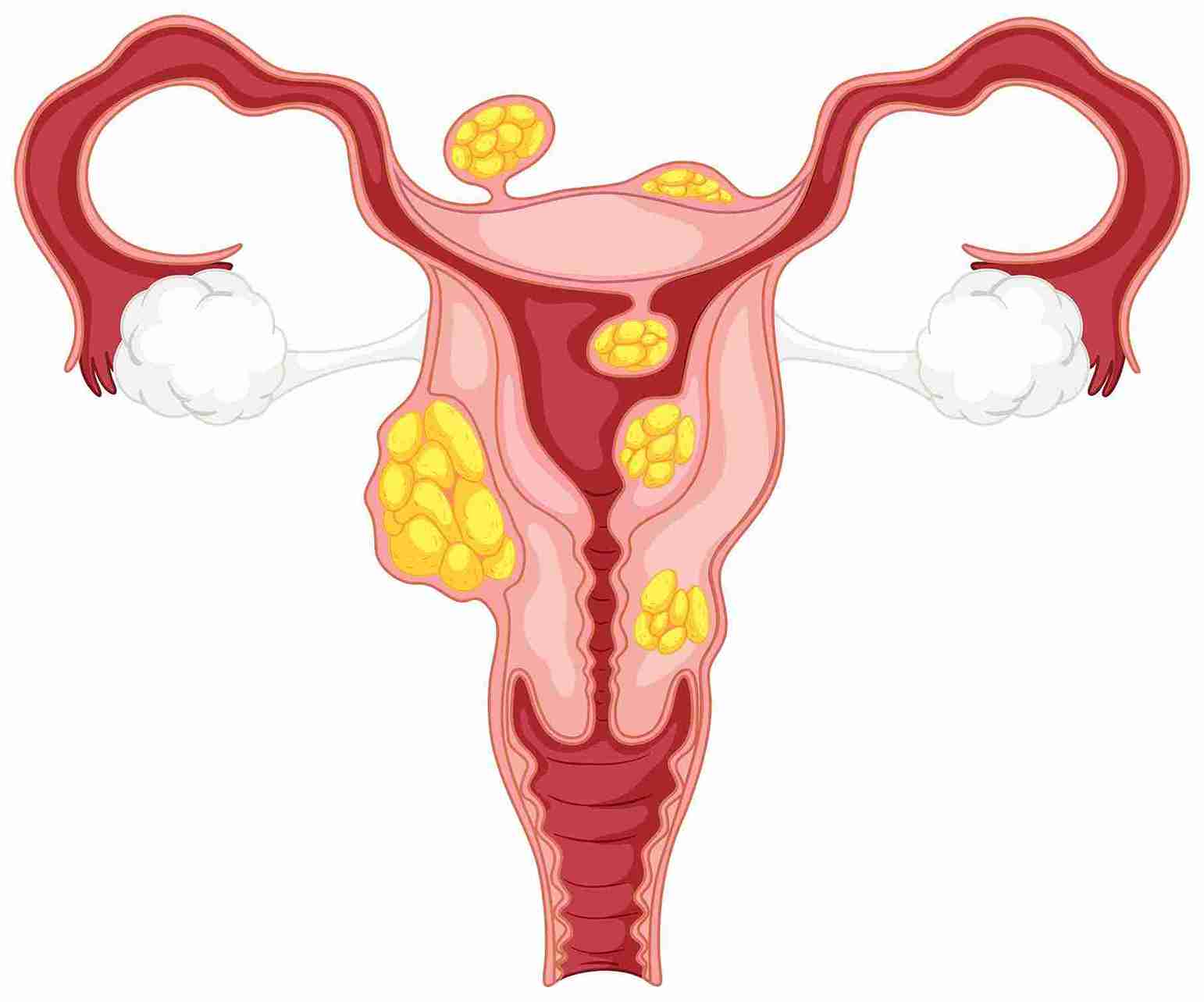
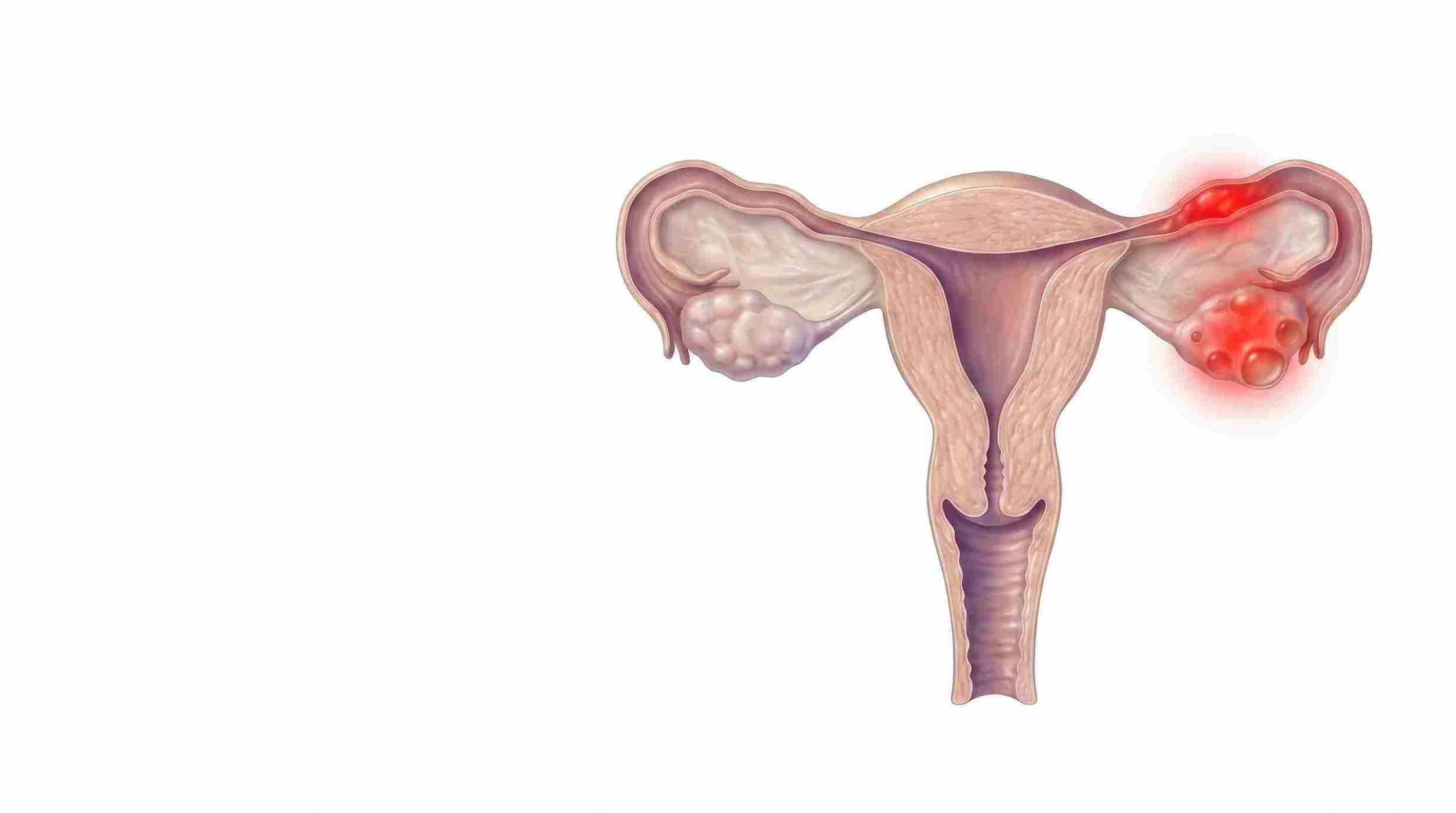
A follicular cyst is a fluid-filled sac that forms when an ovarian follicle fails to rupture at ovulation and keeps growing instead of releasing its egg. In plain terms, it is an egg sac that continues to fill instead of opening. Most cause no symptoms, are not serious, and clear on their own within one to three menstrual cycles.
What is a follicular cyst?
Every cycle, a group of follicles (small fluid-filled sacs in the ovary, each holding an immature egg) begins to grow. One becomes dominant and reaches roughly 18 mm to 25 mm before it opens and releases its egg. A follicular cyst is that same structure carrying on past the point at which it should have opened. It is not a tumour and not a growth. It is normal ovarian tissue behaving normally in the wrong sequence, which is why it is called a functional cyst, and it is the most common ovarian cyst in the reproductive years.
The table below compares a normal ovarian follicle with a follicular cyst across size, meaning and what usually happens next.
Feature
Ovarian Follicle
Follicular Cyst
What It Is
A normal fluid-filled sac containing a developing egg.
A follicle that has continued to grow without rupturing and releasing the egg.
Typical Size
Usually grows to around 18–24 mm when mature.
Often measures more than 3 cm.
Common Cut-off
Generally under 3 cm.
Generally over 3 cm.
What It Means
Indicates normal follicular development and that ovulation may be approaching.
May indicate that the follicle did not rupture, so ovulation may not have occurred in that cycle.
Usual Action
Usually no treatment is needed; monitoring may be used to confirm growth and ovulation.
Usually observation is sufficient; a repeat ultrasound may be recommended depending on size and appearance.
The commonly cited cut-off is 3 cm, or 30 mm. Treat it as a convention rather than a fixed standard: some centres use 2.5 cm, and measurement varies between operators, so 28 mm on one scan and 31 mm on another is not a meaningful change. What matters is whether the appearance is simple and whether it clears.
Who gets follicular cysts, and how common are they?
Anyone who ovulates can develop a follicular cyst, and most women form one at some point without ever knowing. They are the most common ovarian cyst in the reproductive years and become rare after menopause, which is why the same finding is assessed differently at 28 and at 58. In India, they are usually found by accident, because pelvic ultrasound is used widely at routine gynaecology visits, during fertility workup and at antenatal scans. That context matters: an incidental cyst in a woman with no symptoms is a different situation from a cyst found while investigating pain.
How does a follicular cyst form?
A follicular cyst forms when the hormonal signal that triggers ovulation is absent or too weak, so the dominant follicle never ruptures. Instead of collapsing and releasing its egg, it keeps drawing in fluid and enlarges. The cyst is not the problem in itself. It is the visible trace of a cycle in which ovulation did not happen.
Why does a follicle turn into a cyst? Step by step
A follicle matures through the first half of the cycle and reaches ovulatory size.
The surge in luteinising hormone that should trigger rupture is absent or inadequate.
The follicle does not open, so the egg is not released.
Fluid continues to collect inside the unruptured follicle.
It crosses the size at which a follicle is called a cyst.
What hormone imbalance causes follicular cysts?
The immediate trigger is a failed or blunted luteinising hormone (LH) surge. LH instructs a mature follicle to rupture, while follicle stimulating hormone (FSH) drives its growth. Both are governed by the hypothalamic pituitary ovarian axis, the signalling loop between the brain and ovaries. Anything that disturbs that loop in a given month can produce a cycle without ovulation, and therefore a cyst.
What is the normal size of a follicular cyst?
Most follicular cysts sit between 3 cm and 5 cm. Some reach 7 cm and occasionally larger. The table below sets out what each band means in practice, using the Society of Radiologists in Ultrasound consensus thresholds for simple cysts in premenopausal women.
Size Band
What It Usually Means
Typical Action
Re-scan Interval
Under 3 cm
Within the range of a normal follicle; often reported only in passing.
None
Not routinely needed
3 cm to 5 cm
The typical size range of a simple follicular cyst.
Observation
One scan at 6–12 weeks if symptomatic or being tracked
5 cm to 7 cm
Still commonly functional, but large enough that many centres confirm that it has resolved.
Observation with a booked follow-up
6–12 weeks
Over 7 cm
At the upper end of the functional range and more likely to represent a different type of cyst.
Characterisation and specialist review
Individualised
Is a 7 cm follicular cyst still functional?
It can be, but this is the honest edge of the range. The larger a simple cyst gets, the more likely it is to be something other than a follicular cyst, so a 7 cm finding is characterised properly rather than reassured away.
What size follicular cyst needs surgery?
Size alone does not decide this, and any answer offering a single number is oversimplifying. Surgery is rarely needed. What drives the decision is persistence across several cycles, an appearance that is not simple, growth between two scans, or a complication such as torsion. A cyst can enlarge over a cycle and usually then plateaus, so growth measured across two separate scans is the finding that prompts review. A 6 cm cyst that clears in eight weeks needs nothing. A 4 cm cyst still present after four cycles needs a proper answer about what it actually is.
What causes a follicular cyst?
Follicular cysts come from a variation in normal ovulation rather than from an underlying disease. The recognised contributors are:
An anovulatory cycle: a month in which ovulation simply did not occur. This is the commonest reason and can happen to anyone.
An inadequate LH surge: the rupture signal fires weakly or not at all, so the follicle stays closed.
Ovulation induction medicines: drugs used to stimulate the ovaries can leave a residual follicle that persists into the next cycle. Common, expected and usually temporary.
A previous functional cyst: women who have formed one before are more likely to form another.
Irregular cycles: cycles that vary in length are more often anovulatory, and anovulation is what produces the cyst.
Can stress cause a follicular cyst?
Not directly. Stress does not create a cyst. What sustained stress can do is disturb the signalling that governs ovulation, and a cycle without ovulation can leave a follicular cyst behind. The link is real but indirect.
Do birth control pills cause follicular cysts?
No. Combined oral contraceptives suppress ovulation, and because follicular cysts arise from ovulation going incomplete, women on the combined pill generally form fewer of them rather than more. Note the second half of that answer: preventing new cysts and shrinking an existing one are not the same thing.
Is this PCOS?
Almost certainly not. Polycystic ovary syndrome is a hormonal condition defined by a combination of features, and the polycystic appearance is many small follicles rather than one enlarged cyst. A single follicular cyst is not a diagnosis of PCOS.
Can follicular cysts be prevented?
Largely no, and this is worth stating plainly. Follicular cysts are a by-product of ordinary ovulation. No diet, supplement or lifestyle change has been shown to prevent them. The only thing that reliably reduces how often they form is suppressing ovulation, which is a contraceptive decision rather than a treatment.
What should you do if a scan shows a follicular cyst?
For most women, very little. The two things worth understanding are what your scan report says and what treatment, if any, is genuinely warranted.
How is a follicular cyst diagnosed, and what does your report mean?
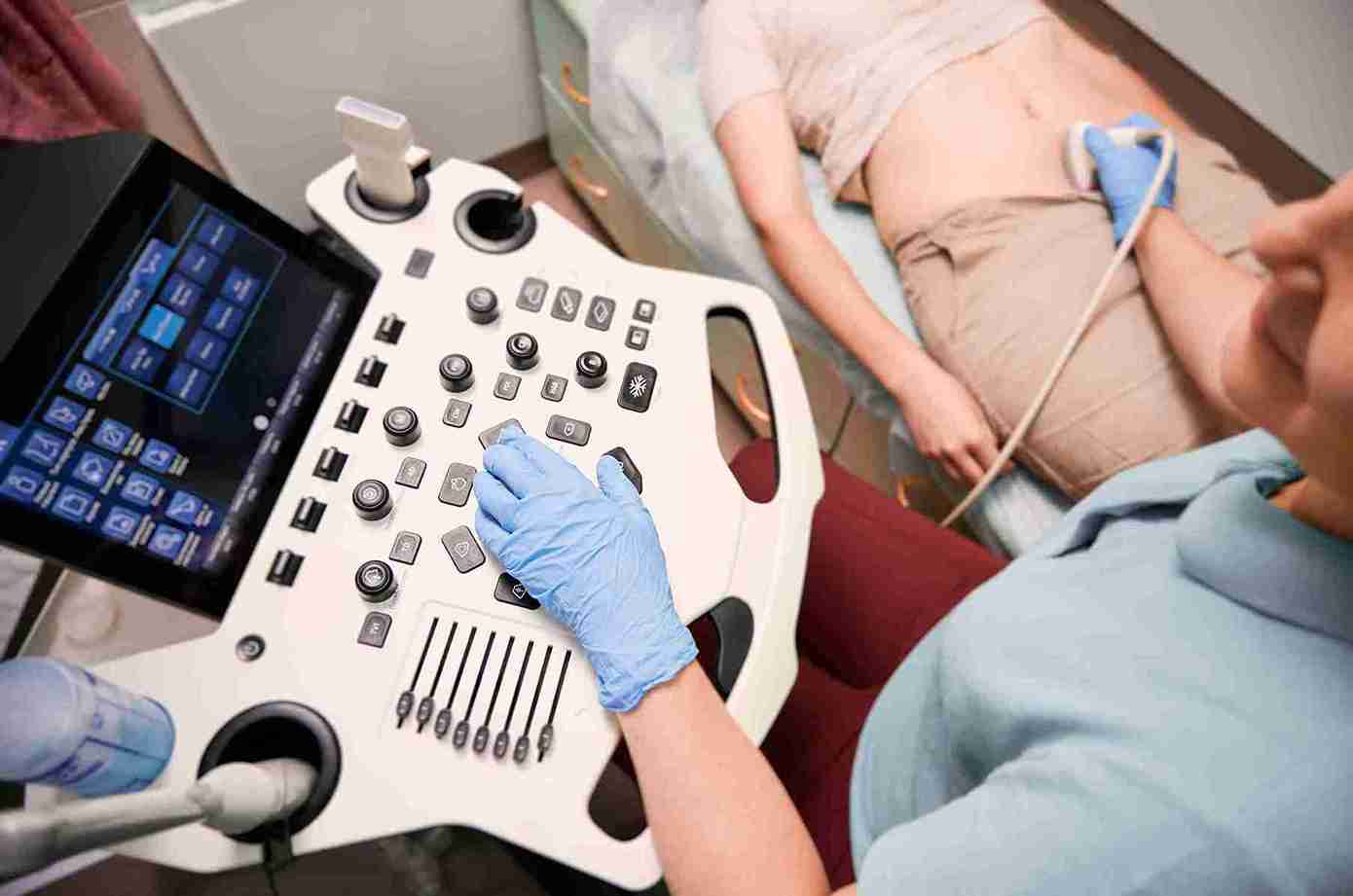
Diagnosis is made on ultrasound, usually transvaginal, which gives a clearer view of the ovaries than an abdominal scan. On the images, a follicular cyst appears as:
Round or oval
Anechoic, meaning uniformly dark because it contains clear fluid
Thin and smooth-walled
Free of internal septations, the thin dividing walls seen in complex cysts
Free of solid components
Showing posterior acoustic enhancement, a bright area behind it confirming fluid
If your report says simple ovarian cyst, that is most likely what this page describes: in a woman of reproductive age, most simple cysts are follicular. If it says complex cyst, or mentions septations or solid areas, it is not a follicular cyst, and this guidance does not apply to you.
Do you need a blood test?
Usually not. CA 125 is not a screening test and is not routinely indicated for a simple cyst in a woman of reproductive age, where it is often raised for benign reasons.
When should the scan be done?
Days 5 to 10, just after your period. Scanning then avoids the commonest error here: mistaking a normal growing follicle for a cyst. If you were scanned mid-cycle, that alone can explain the finding.
Scan reports rarely use the word "cyst" on its own. If your report names something more specific, the timeline above may not apply to you, because not every ovarian cyst behaves the way a follicular cyst does. Find your term below before assuming it will clear on its own.
If Your Report Says
What It Means
Where This Is Covered
Corpus Luteum Cyst
Forms after ovulation rather than before it. The timing and implications are different from a follicular cyst.
Functional Ovarian Cysts Guide
Endometrioma or Chocolate Cyst
Related to endometriosis. It does not usually resolve on its own like a functional follicular cyst.
Endometrioma Guide
Complex Cyst
Has internal septations or solid-appearing areas and is not considered a simple follicular cyst.
Complex Ovarian Cysts Guide
Polycystic Ovaries
Describes an appearance with many small follicles rather than one cyst. It is an ultrasound finding and does not by itself establish a PCOS diagnosis.
PCOS Guide
What treatment does a follicular cyst actually need?
In most cases, nothing. Watchful waiting with a repeat scan is the standard approach, and the absence of treatment is the correct answer rather than a failure to offer one. Where there is discomfort, simple pain relief and local heat are reasonable under medical guidance. Several widely repeated claims do not hold up:
No medicine dissolves an ovarian cyst. There is no drug that shrinks one. Medication here is for pain, nothing else.
Birth control pills do not shrink an existing cyst. A Cochrane review of eight trials involving 686 women found that combined oral contraceptives did not speed up resolution in any trial. They reduce how often new cysts form.
Nothing dissolves a cyst naturally. Castor oil packs, herbal preparations and detox regimens do not act on ovarian tissue. Heat helps pain. It does not change size.
No foods need to be avoided. Diet does not shrink a functional cyst. There is no cyst diet.
Exercise neither shrinks a cyst nor causes harm. It is safe to keep exercising with a small simple cyst. Stop if a movement is painful.
Surgery is almost never needed. Laparoscopy is reserved for complications or a cyst proven not to be functional.
Is it safe to have sex?
Yes, generally. A large cyst may make intercourse uncomfortable, and if it does, mention it at your review. Normal sexual activity does not rupture a cyst.
How much does it cost to check and manage a follicular cyst in India?
For most women, there is nothing to treat, so there is no treatment cost. The only expense is usually one follow-up scan, and often not even that. The costs below apply to the minority of cases that need more.
Item
When It Applies
Cost in India
Pelvic or Transvaginal Ultrasound
Initial diagnosis, often already performed for another reason
₹1,000–₹3,500
Repeat Ultrasound at 6–12 Weeks
Confirming that the cyst has resolved
₹2,000–₹4,500
Fertility Specialist Consultation
Recurrent cysts or if you are trying to conceive
₹1,200–₹2,000
Laparoscopic Cyst Removal
Rare; generally considered for persistent, complicated, or non-functional cysts when surgery is indicated
₹80,000–₹2,00,000
If you are quoted a treatment package on the basis of one simple cyst on one scan, it is reasonable to ask what exactly is being treated and why watchful waiting is not appropriate first.
When should you see a doctor about a follicular cyst?
A small simple cyst does not need an urgent appointment. It needs a follow-up scan at the interval your clinician suggests. Some symptoms do need faster attention.
Most ovarian cysts are found by chance and settle on their own, so the question that matters is not whether you have one but how it is behaving. Pain that arrives suddenly is handled differently from pain that has built up slowly. Use the signs below to decide how fast to act;
Sign
What to Do
Sudden severe one-sided pelvic pain
Seek emergency medical care. This can indicate ovarian cyst rupture or ovarian torsion.
Severe pain with vomiting, fever, or fainting
Seek emergency medical care the same day.
Rapidly increasing abdominal swelling
Arrange an urgent medical review.
Pain that is persistent rather than sudden
Book a routine gynaecology appointment.
The cyst is still present on a follow-up scan
Ask your doctor whether further characterisation or specialist assessment is needed rather than simply waiting.
Repeated cysts while trying to conceive
Consider seeing a fertility specialist to assess ovulation and other fertility factors, rather than focusing only on the cysts.
Rupture is possible and is often painless, resolving without surgery. Torsion, where the ovary twists, is rare with small cysts and becomes more relevant above 5 cm. The useful reframe: the danger is almost never the cyst itself; it is assuming a cyst is functional when nobody has confirmed it has cleared.
Most do, and most do so without any intervention. The usual window is one to three menstrual cycles.
Most functional cysts (fluid-filled sacs that form as part of a normal ovulation cycle) clear without any treatment. What people are rarely told is how long that actually takes. A lot of content online says a cyst will be gone by your next period, which is true often enough to be reassuring and wrong often enough to be unhelpful when it is still there six weeks later. The honest answer is a window rather than a date.
Timepoint
What Usually Happens
By the Next Period
Many follicular cysts have already resolved. This is common, but resolution within one cycle is not guaranteed.
4 to 8 Weeks
This is a common window for spontaneous resolution.
6 to 12 Weeks
A repeat ultrasound may be used during this interval to confirm that the cyst has cleared.
Beyond Three Cycles
Persistence warrants reassessment and possible re-characterisation rather than simply continuing to wait.
How do you know it has gone?
Only a repeat ultrasound confirms it. Symptoms are not a reliable guide, because most follicular cysts were never causing symptoms, so feeling fine tells you nothing about whether the cyst is still there. That is why the follow-up scan is worth attending.
What happens if a follicular cyst does not go away?
A cyst that persists beyond two or three cycles was probably never a simple follicular cyst. Cochrane reviewers reached the same conclusion, noting that persistent cysts tended to be pathological rather than physiological. Persistence is not a sign the cyst is worsening. It is a sign the original label may have been wrong, and the next step is characterisation, not another twelve weeks of waiting.
Can a follicular cyst come back?
Yes, and usually that is normal rather than concerning. The distinction almost nobody makes: this is a new cyst formed in a later cycle, not the same one returning. Repeated cysts across many cycles point toward repeated anovulation, which is worth investigating on its own terms.
Do follicular cysts affect fertility?
A single follicular cyst does not reduce your fertility. The cyst is a marker, not a mechanism. What can matter is the anovulation it reveals, because a cycle without ovulation is a cycle without a chance of conception. Nobody needs treatment for the cyst, but if cysts keep appearing, the ovulation pattern behind them deserves attention.
Does it mean you are not ovulating at all?
It suggests that particular cycle was anovulatory. It does not mean you never ovulate. One cyst is not a diagnosis.
Does it affect AMH or egg reserve?
No. A follicular cyst does not reduce anti-Mullerian hormone (AMH) or damage egg reserve. It can distort the antral follicle count on that scan by obscuring the ovary, which is a measurement issue, not a reserve issue.
Does it affect IVF or IUI?
A cyst on a baseline scan can occasionally lead to a cycle being deferred, because stimulating on top of a residual follicle complicates monitoring. Most resolve before the cycle starts.
Yes, most do. The great majority resolve without treatment within one to three menstrual cycles. No medicine is needed, and watchful waiting with a repeat scan is the standard approach rather than a lack of care.
How long does a follicular cyst take to disappear?
Usually four to eight weeks, which is one to two menstrual cycles. Some take up to three. A repeat scan at 6 to 12 weeks is the usual interval used to confirm resolution. If it is still there beyond that, it needs re-characterising rather than further waiting.
What is the difference between a follicle and a follicular cyst?
They are the same structure at different stages. A follicle is a normal fluid-filled sac holding a developing egg, measuring up to about 25 mm when mature. If it fails to rupture and enlarges past roughly 3 cm, it is called a follicular cyst. Some centres use 2.5 cm, so the cut-off is a convention, not a fixed rule.
Is a 5 cm follicular cyst dangerous?
Usually not. A 5 cm simple cyst in a woman of reproductive age most often resolves on its own. What changes at this size is the advice to confirm resolution with a follow-up scan, and the small risk of torsion becomes slightly more relevant. Size alone does not make a cyst dangerous.
Schedule your consultation Today!
Book your consultation with our fertility experts the first step toward your parenthood journey.