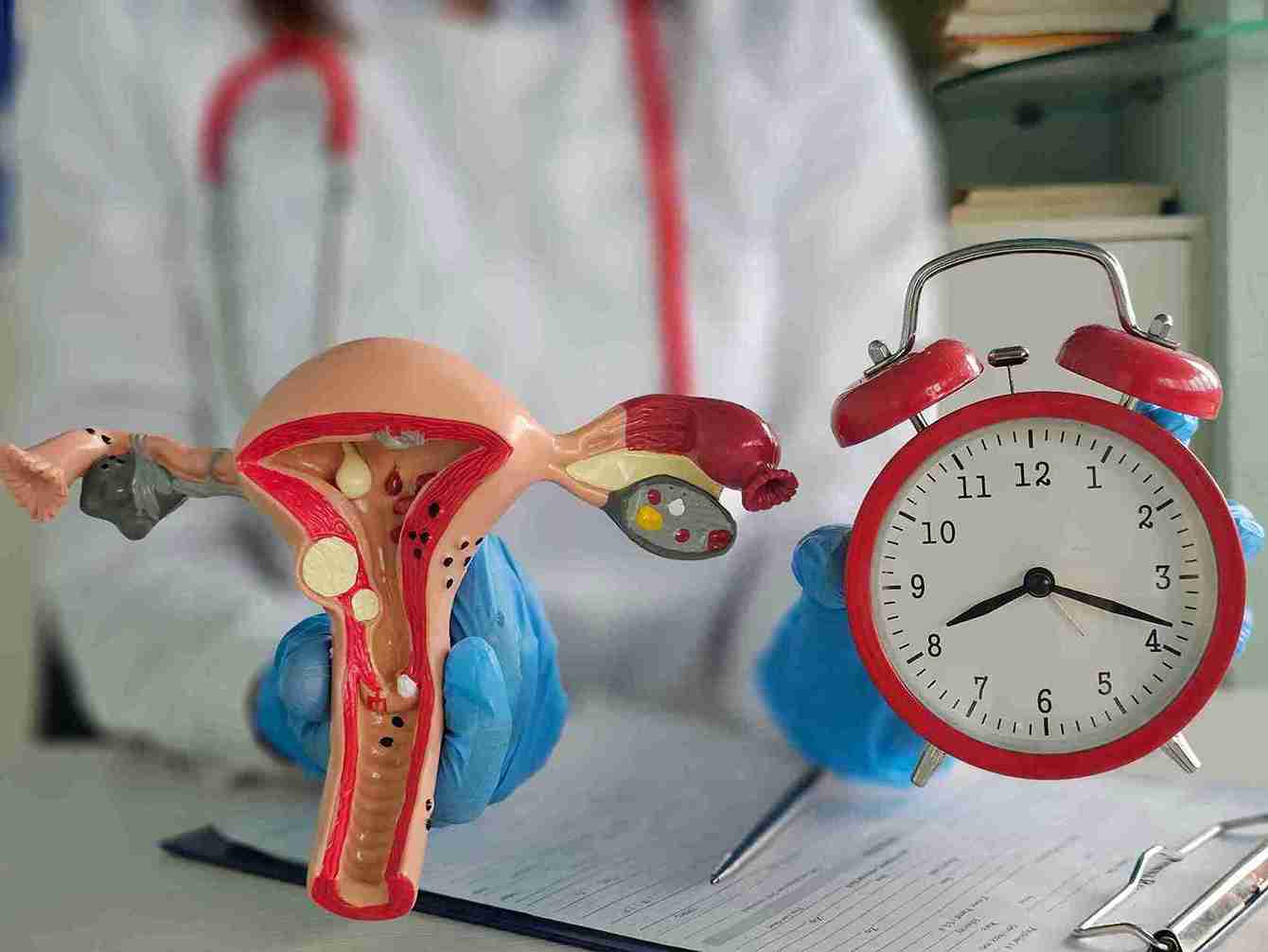
Ovarian torsion is when an ovary twists on its own supporting ligaments and cuts off its blood supply. It is uncommon, but it is a surgical emergency. Sudden severe one sided pelvic pain, usually with vomiting, needs hospital assessment the same day, not the next morning.
Go to hospital now if you have any of these
Sudden severe pain on one side of the lower abdomen or pelvis
Pain with vomiting, or nausea that will not settle
Pain bad enough that you cannot stand straight, walk or sit still
Pain that came, went away, and has now come back
Pain with a fever
Pain when you are pregnant, or think you could be pregnant
Pain after fertility injections or after egg collection
If the pain has settled but was severe, this still needs assessing today. Go to your nearest emergency department, casualty or hospital, and if you are in a fertility treatment cycle, telephone your fertility unit on the way.
What are the symptoms of ovarian torsion?
The main symptom of ovarian torsion is sudden, severe pain on one side of the lower abdomen, usually with nausea or vomiting. The pain typically starts abruptly rather than building up over days, and many women can say almost to the minute when it began. Some have had shorter, milder episodes of the same pain in the preceding days or weeks. Ovarian torsion symptoms overlap heavily with several other causes of acute pelvic pain, which is why the pattern below is used to raise suspicion rather than to make a diagnosis.
Symptom
How often it appears
What it tells you
Sudden severe pain on one side
The usual presenting symptom
The single most important feature. Abrupt onset matters more than how the pain is described.
Pain spreading to the back, flank or thigh
Common
Explains why the pain feels far larger than the ovary itself. It neither confirms nor excludes torsion.
Nausea and vomiting
Reported in most cases
More prominent here than in ordinary cyst pain. Severe one-sided pain plus vomiting is one of the few genuinely useful combinations.
Pain that comes and goes over days or weeks
Recognised and very easily missed
Suggests the ovary is twisting and untwisting. This pattern is a reason to be seen, not a reason to wait.
A tender lump felt on examination
Sometimes
Usually the swollen ovary or the cyst that made it heavy enough to rotate.
Low-grade fever
Less common, and usually later
Can appear once tissue is becoming damaged. Its absence proves nothing at all.
Fast heartbeat
Sometimes
A normal response to severe pain. It is also seen with internal bleeding, so it is not specific.
Abnormal vaginal bleeding
Occasional
Reported by a minority of women. It does not rule torsion in or out.
Two things are worth stating plainly. First, there is no symptom pattern that confirms ovarian torsion and none that excludes it. Second, not every case is dramatic. Presentation varies, and milder or slower onset pain does happen, particularly when the ovary is only partly twisted. That variation is a reason to have severe or unexplained one-sided pain assessed rather than a reason to talk yourself out of going.
What does a twisted ovary feel like?
Most women describe it as sudden, deep, and severe. It is not the slow build of period pain. It arrives, and it is immediately the worst pain in the room. Many can name the exact moment it started, sometimes tying it to a particular movement such as bending, lifting, exercising or sex.
The character is usually colicky rather than a steady ache. It comes in waves that grip and then ease slightly, without ever fully going away, and it often spreads into the back, the flank or the top of the thigh. Vomiting frequently follows within a short time, and that combination of severe one-sided pain with vomiting is one of the features that distinguishes a twisted ovary from most ordinary cyst pain.
The pain is nearly always on one side only. It happens on the right more often than the left, and there is a straightforward anatomical reason for this: on the left, the sigmoid colon sits alongside the ovary and limits how freely it can move. That extra space on the right allows the right ovary to rotate more easily. It is also why right-sided torsion is so often mistaken for appendicitis.
Mid-cycle ovulation pain can also be one-sided and sharp, but it is usually mild, short-lived, and predictable in timing, which is covered separately in our guide to sharp pelvic pain on one side. Torsion pain is a different order of severity, and it does not follow your cycle.
Why does the pain come and go?
Pain that settles does not mean the torsion has resolved safely.
An ovary does not always twist once and stay twisted. It can rotate, partially untwist, and rotate again, sometimes repeatedly over hours, days, or weeks. This is called intermittent torsion. While the ovary is twisted, blood flow is obstructed, and the pain is severe. When it untwists, blood flow returns and the pain genuinely disappears. The relief is real. The problem is not.
This matters more than almost anything else on this page, because the pain-free window is exactly when women are reassured and sent home. Examination findings settle. A scan taken in that window can look completely normal. Everyone involved, including the woman herself, reasonably concludes that whatever it was has passed. The ovary, meanwhile, remains loose enough to twist again, and each episode adds to the time it spends without a proper blood supply.
If your pain has stopped, say so, and say what it was like
Severe one-sided pain that has settled still needs assessing. When you are seen, do not describe only how you feel at that moment. Say when the pain started, how bad it was at its worst, whether you vomited, and whether this has happened before and settled. Earlier episodes that resolved are part of the picture, not evidence that you are fine, and they change how urgently you are investigated.
Is ovarian torsion an emergency?
Yes, always.
It is also uncommon, and both of those things are true at once. Ovarian torsion affects roughly 6 in 100,000 women a year. Most one sided pelvic pain is not torsion, and most ovarian cysts never twist. The reason it is treated as an emergency is not that it is likely, but that it is time sensitive and that nothing other than surgery reverses it.
The mechanism is simple. The ovary is held in place by two supporting structures that also carry its blood vessels. When the ovary rotates around them, the veins are squeezed first, so blood can still arrive but struggles to leave. The ovary swells, which tightens the twist further, and the arterial supply is progressively choked. Left long enough, ovarian tissue starts to die, which doctors call ovarian necrosis. Untwisting the ovary is the only thing that interrupts that sequence, and untwisting is a surgical act.
You may see this called adnexal torsion, meaning twisting of the ovary and often the fallopian tube together. It is the same emergency, and it is the phrasing you are most likely to see written on a discharge summary or an operation note.
It is also fair to answer the question people are afraid to type. Dying from ovarian torsion is very rare. The realistic risk is losing the ovary, not losing your life, and that is precisely why it is worth going to hospital straight away rather than waiting to see how the night goes.
What causes an ovary to twist?
In most cases, a cyst or other mass has made the ovary heavy enough to rotate. The risk rises noticeably once an ovarian mass is larger than about 5 cm, and the great majority of those masses are benign. There is no size that guarantees torsion and no size that rules it out, so 5 cm is a threshold for concern rather than a line between safe and unsafe.
The ovary is anchored by two structures: the infundibulopelvic ligament, which runs from the pelvic wall and carries the ovarian artery and vein, and the utero-ovarian ligament, which tethers the ovary to the uterus. A normal ovary sits fairly snugly between them. Add weight, or add slack, and it becomes capable of rotating around that axis. The fact that the ovary is fed from both ends becomes important later, when we look at why scans can be misleading.
Risk factor
Why it raises the risk
Where to read more
Ovarian cyst or mass larger than about 5 cm
Adds weight and length to the ovary so it can swing and rotate on its ligaments. Most such masses are benign.
Ovarian cyst symptoms
Dermoid cyst
The classic torsion cyst. Dermoids are benign, tend to be dense and can grow to a size and weight that makes rotation easier. They are over represented in torsion cases relative to how common they are.
Dermoid cysts
Ovarian stimulation for fertility treatment
Stimulation enlarges both ovaries and fills them with follicles, which increases size, weight and mobility at the same time.
Cysts from fertility treatment
Pregnancy
Hormonal changes soften the supporting tissues, and the growing uterus lifts the ovaries out of the pelvis, giving them more room to move.
Ovarian torsion in pregnancy (see below)
A previous ovarian torsion
An ovary that has twisted once is capable of twisting again, and so is the ovary on the other side.
Can it happen again (see below)
A longer than average supporting ligament
More slack means more freedom to rotate. This is why torsion can happen in girls and young women with entirely normal ovaries.
Ovarian cysts in teenagers
Previous tubal ligation
Surgery in the area can alter how the ovary and tube are supported and how freely they move.
General risk factor, no separate guide
One honest point that most pages leave out: ovarian torsion can happen in a completely normal ovary with no cyst at all. It is less common in adults than in adolescents, but it does occur, and it matters enormously if you have been told your scan is clear and are being sent away with severe pain still present. A clear scan lowers the odds. It does not close the question.
Sudden movement, heavy lifting, exercise or sex can precipitate a twist in an ovary that was already vulnerable, which is why so many women can date the pain to a specific moment. That is worth saying carefully, because women routinely blame themselves for it. This is not something you did wrong, and there is no realistic way to prevent it by being careful. The ovary had to be predisposed to twist in the first place.
Torsion is not a cancer signal in women of reproductive age, and the masses that cause it are overwhelmingly benign, as covered in ovarian cysts and cancer risk.
Ovarian torsion after fertility treatment
Fertility treatment raises the risk of ovarian torsion, and this is one of the few situations where you can know in advance that you are in a higher risk window.
Both ovulation induction and IVF stimulation work by encouraging multiple follicles to develop at once. That deliberately enlarges the ovaries, sometimes considerably, and heavier ovaries with more slack in their supporting ligaments are simply more capable of rotating. The risk is highest in the days after egg collection, when the ovaries are at their largest, and it stays raised into early pregnancy after a successful cycle, because a corpus luteum cyst and the hormonal changes of early pregnancy both add to the effect.
Ovarian hyperstimulation syndrome is a separate complication of stimulation that also enlarges the ovaries, and it is covered in cysts from fertility treatment. The two are distinct problems and are managed differently.
If you are in a treatment cycle and the pain is sudden and severe
Contact your fertility unit directly rather than waiting for your next scheduled scan or review.
Say clearly that you are in a stimulated cycle, and say where you are in it: on injections, after trigger, after egg collection, or in early pregnancy after a transfer.
If you cannot reach the unit quickly, go to the emergency department and tell them the same thing on arrival.
That one sentence changes the differential immediately. A clinician who knows you have stimulated ovaries will think about torsion far sooner than one assessing what looks like ordinary pelvic pain, and speed is the whole point.
None of this is a reason to avoid treatment. Torsion remains uncommon even in stimulated cycles, and the units that perform these cycles are also the units best placed to recognise it. It is a reason to know the symptom, and to make the phone call early rather than waiting to see whether it settles. If you are weighing up treatment options, our guide to IVF treatment explains what a stimulated cycle involves.
Ovarian torsion in pregnancy
Ovarian torsion in pregnancy is uncommon but well recognised, occurring in the region of 1 in 1,800 pregnancies. Reported rates vary between studies, and it is more frequent in pregnancies conceived after fertility treatment than in those conceived naturally.
Most cases happen in the first trimester and early second trimester, roughly between six and fourteen weeks. There are two reasons for the timing. A corpus luteum cyst forms routinely in early pregnancy and adds weight to the ovary, and the uterus is growing enough to lift the ovaries out of the pelvis without yet being large enough to hold them still.
The features that should prompt urgent assessment in pregnancy are the same as outside it:
Sudden severe pain on one side of the lower abdomen
Pain with vomiting or unrelenting nausea, beyond your usual pregnancy sickness
Pain that woke you, stopped you walking, or came and went and then returned
The point that reassures most women is this one: keyhole surgery is considered safe in pregnancy, and where torsion is suspected, the risk of not operating is greater than the risk of operating. Delaying surgery to protect the pregnancy does not protect it. It risks the ovary and leaves the underlying problem in place.
Cysts found on a routine pregnancy scan are a separate and much more common situation, and most of them need nothing more than monitoring. That is covered in ovarian cysts in pregnancy.
What else could this pain be?
Sudden severe one sided pelvic pain has a short list of serious causes, and torsion is only one of them. Two of the others are also emergencies. This is the table to read if you are trying to work out what is happening to you, with the caveat that comes after it.
Condition
How it differs
What it needs
Where to read more
Ruptured ovarian cyst
Pain is often severe at the moment of rupture and then eases over hours. Vomiting is less prominent. Heavy internal bleeding can cause dizziness or shoulder tip pain.
Assessment the same day. Most settle without surgery.
Ruptured ovarian cyst
Ectopic pregnancy
Occurs in early pregnancy, often with a missed or late period and sometimes with light bleeding. Pain may build over days rather than starting all at once.
Emergency assessment. A pregnancy test is the first step in any case.
Pain typically starts around the navel and settles into the right lower abdomen over hours, with loss of appetite and fever. Right sided torsion is mistaken for it often enough to matter, and the reverse also happens.
Emergency assessment and usually surgery.
Assessed at hospital, not a gynaecology topic
Pelvic inflammatory disease
Pain is usually on both sides and builds over days, often with abnormal discharge, fever and pain during sex.
Urgent assessment and antibiotics.
Assessed at hospital or by your gynaecologist
Kidney stone
Pain in the flank or loin that moves down towards the groin, often with blood in the urine and an inability to sit still.
Urgent assessment and pain relief.
Assessed at hospital, not a gynaecology topic
Haemorrhagic ovarian cyst that has not twisted
Bleeding into a cyst causes sudden pain that usually plateaus and then improves. Vomiting is less common.
Same day assessment and a scan.
Haemorrhagic ovarian cyst
Now the caveat, and it is the important part. None of these can be reliably separated at home, or by symptom pattern alone, or by how bad the pain feels. Experienced clinicians cannot do it from the history either, which is why the first two steps at hospital are always the same regardless of which of these is suspected: a pregnancy test, and an urgent pelvic scan. If you are trying to decide between these conditions from your sofa, the honest answer is that the decision cannot be made there.
Ovarian torsion or a ruptured cyst? They are not the same thing
No, a twisted ovary and a burst cyst are different problems with different urgency, and they are frequently confused.
When a cyst bursts, the fluid inside it escapes into the pelvis. That hurts sharply, and then, in most cases, it settles by itself over hours or a day or two as the fluid is reabsorbed. No surgery is usually needed. When an ovary twists, nothing is released and nothing settles. The blood supply stays obstructed until the ovary is untwisted, and that requires an operation. A cyst can cause a torsion, but the two events are not interchangeable, and the reassurance that applies to one does not transfer to the other. Full detail on rupture, including the bleeding signs that make it urgent, is in our guide to ruptured ovarian cysts.
How is ovarian torsion diagnosed?
This is the sequence you can expect once you arrive at hospital with sudden severe one-sided pelvic pain.
A pregnancy test, always first. It comes before imaging and before anything else, because a positive result changes the entire differential and brings ectopic pregnancy into the picture.
Examination. Where the tenderness is, whether a mass can be felt, and how you look overall.
A pelvic or transvaginal ultrasound, usually with Doppler ultrasound, which assesses blood flow. This is the first-line imaging test. It may show a swollen ovary, oedema, follicles pushed out to the rim of the ovary, free fluid in the pelvis, or a whirlpool sign, which is the appearance of the twisted vascular pedicle and is covered in more detail in our guide to reading your scan report.
Sometimes an MRI scan, as a second-line test when the picture is unclear, and there is time to obtain one.
A normal scan and normal blood flow do not rule out ovarian torsion
There are two reasons for this, and neither is widely explained. First, the ovary has two separate blood supplies, one arriving through each of its supporting ligaments, so blood flow can persist on Doppler ultrasound even while the ovary is twisting. Second, if the scan is done during a pain-free interval when the ovary has spontaneously untwisted, it will simply look normal because, at that moment, it is.
ACOG Committee Opinion 783, Adnexal Torsion in Adolescents (2019), states that there are no clinical or imaging criteria sufficient to confirm the diagnosis before surgery, and that Doppler flow alone should not guide clinical decision-making. Reported ultrasound sensitivity is around 70 percent in surgical series, with pooled estimates from meta-analysis close to 79 percent. In other words, a meaningful minority of confirmed torsions had a scan that did not show it.
The practical consequence is worth stating in plain terms. If you have severe, persistent one-sided pain and your scan is reported as normal, that result has not closed the question. It is reasonable to say so, to ask what the plan is if the pain does not settle, and to return if it worsens or comes back. Ovarian torsion is confirmed at surgery, not on a scan, and the definitive test is a diagnostic laparoscopy, which is keyhole surgery to look directly at the ovary.
How is ovarian torsion treated, and will I lose the ovary?
Most twisted ovaries are untwisted and kept, not removed.
The treatment is surgery, almost always keyhole surgery, and the central step is detorsion, meaning the surgeon untwists the ovary and restores its blood supply. Where a cyst caused the twist, it may be removed at the same time or at a later planned operation.
ACOG guidance recommends detorsion and preservation of the ovary and tube regardless of how the ovary looks during surgery, and states that a torsed ovary should not be removed unless oophorectomy (removal of the ovary) is unavoidable. This matters because a twisted ovary often looks alarming at operation: dark blue, black, apparently beyond saving. Appearance at surgery is not a reliable guide to whether the ovary will work again. Ovaries that looked black at detorsion have been shown to regain near normal appearance and normal follicular development in the weeks afterward.
The last myth worth dismantling is the deadline. There is no established maximum time after which an ovary cannot be saved. Fixed hour windows are repeated widely and are not evidence-based. In one series, women reached surgery a median of 16 hours after symptoms began, and follow-up scans showed normal follicular development in the great majority of previously twisted ovaries.
Read that as a reason to go, not a reason to relax. The absence of a cliff edge does not mean time is free. It means that if you have already waited, the ovary is very probably still worth saving, so the right response to a delay is to attend now rather than to conclude it is too late.
Does ovarian torsion affect fertility?
In most cases, no.
If the ovary is untwisted and preserved, it usually recovers its function. Follicles develop again, ovulation resumes, and the ovary goes back to doing what it did before. That is the single most likely outcome, and it is why the surgical decision to keep the ovary matters far more to your fertility than the torsion itself did.
If an ovary does have to be removed, the remaining ovary continues to release an egg each cycle and pregnancy remains entirely possible. Women routinely conceive naturally with one ovary. Ovarian reserve, the number of eggs remaining, is reduced when ovarian tissue is lost, and ESHRE guidance on fertility preservation is explicit that surgery involving ovarian tissue is a recognised cause of reduced reserve. This is worth understanding accurately: the reserve question follows from the surgery, not from the twist. Ovarian reserve and AMH after ovarian surgery are covered in oophorectomy and ovarian reserve and cyst surgery before IVF.
So the honest framing is this. Torsion is a fertility risk only to the extent that it costs you ovarian tissue, and current guidance is built around not letting it cost you any. Where fertility is a live concern, it is reasonable to say so before surgery and to ask that preservation be the aim. If you are already trying to conceive, or planning IVF treatment, a follow-up review after recovery is worth booking. Broader background is in ovarian cysts and fertility.
Can you treat a twisted ovary at home?
No. There is nothing you can do at home for a twisted ovary, and there is no position, exercise, heat pack, herbal preparation or ayurvedic treatment that can untwist it.
This is the one condition on this subject where waiting causes the harm. Unlike a burst cyst, which usually settles on its own, a twisted ovary stays twisted until someone untwists it surgically. Every hour spent trying something at home is an hour the ovary spends without its blood supply. Go to hospital.
Ovarian torsion in girls and teenagers
Torsion happens in adolescents and in younger girls, including those who have not yet started their periods. In this age group it far more often occurs in an ovary with no cyst at all, because the supporting ligament can be longer and allow the ovary to rotate freely on its own.
The practical danger for parents is misdiagnosis. Sudden severe abdominal pain with vomiting in a teenage girl is very commonly attributed to appendicitis, gastroenteritis or period pain, and torsion is not always considered. It is reasonable to ask directly whether the ovary has been looked at.
The preservation principle originates in the adolescent guidance and applies here with particular force: the ovary should be untwisted and kept whatever it looks like at surgery. More on cysts in this age group is in ovarian cysts in teenagers.
Can it happen again?
Yes. An ovary that has twisted once can twist again, and torsion can also occur later in the ovary on the other side. Recurrence is uncommon, but it is recognised often enough that it should be part of your follow up conversation rather than a surprise.
Honesty is more useful than false comfort here: for the most part, you cannot prevent it. There is no exercise to avoid, no sleeping position that helps and no supplement with any bearing on it. What can be addressed are the things that made the ovary heavy or mobile in the first place.
Treating or monitoring an underlying cyst removes the weight that made rotation possible, so follow up imaging after recovery is worthwhile.
Oophoropexy, which means surgically fixing the ovary in position so it cannot rotate, is considered in selected cases, usually where torsion has recurred or where there was no cyst to explain it. It is not a routine step and is not offered to everyone.
Reducing new cyst formation by suppressing ovulation is sometimes discussed with a specialist. Treat that as a conversation to have about your own situation, not as a general recommendation.
Recovery after keyhole surgery, including how long to take off work and when normal activity resumes, is covered in ovarian cyst surgery recovery, and the surgery itself in ovarian cyst surgery.
After a torsion, a follow up review is worth having
Once you have recovered, a consultation at Cloudnine Fertility can cover a follow up scan to check how the ovary is functioning, a review of anything that made it likely to twist, and a fertility assessment if you are trying to conceive or thinking about it. Book a consultation with a Cloudnine Fertility specialist when you are well. If you are in pain right now, go to hospital instead.
When to go to hospital
Go to your nearest emergency department or casualty, or telephone your fertility unit if you are in a treatment cycle, if you have:
Sudden severe pain on one side of the lower abdomen or pelvis, particularly with vomiting
Pain that stopped you walking, standing straight or sitting still
Severe pain that settled but has now returned, or that has come and gone more than once
Any severe one sided pain in pregnancy, or after fertility injections or egg collection
Severe pain with a fever, or with feeling faint or dizzy
Do not wait for morning. Torsion does not improve overnight, and the overnight hours are the ones most often lost.
What to say when you arrive: when the pain started and what you were doing, how severe it was at its worst, whether you vomited, whether you have had earlier episodes that settled, whether you are or could be pregnant, the date your last period started, and whether you are in a fertility treatment cycle and where you are in it.
What to bring: any previous scan reports or discharge summaries, a list of your medicines, and your treatment cycle details if you have them. If someone can come with you, bring them, because severe pain makes it hard to give a clear history.
Want to consult the Best Fertility in india? Please find the links below.
The usual first sign is sudden, severe pain on one side of the lower abdomen, often with nausea or vomiting. The pain typically starts abruptly rather than building up. Some women have had milder episodes of the same pain in the preceding days or weeks.
Is ovarian torsion a medical emergency?
Yes, always. A twisted ovary has its blood supply cut off and this cannot be reversed without surgery. It is uncommon, affecting roughly 6 in 100,000 women a year, but any sudden severe one sided pelvic pain should be assessed at hospital the same day.
Can ovarian torsion go away on its own?
An ovary can untwist on its own, which is why the pain sometimes stops. That is not the same as the problem resolving. The ovary can twist again, so pain that has settled after a severe episode still needs assessing rather than waiting to see.
What does ovarian torsion pain feel like?
Most women describe severe, deep pain on one side that starts suddenly and may come in waves. It can spread to the back, flank or thigh. Vomiting is common and is one of the features that distinguishes torsion from ordinary cyst pain.
Schedule your consultation Today!
Book your consultation with our fertility experts the first step toward your parenthood journey.