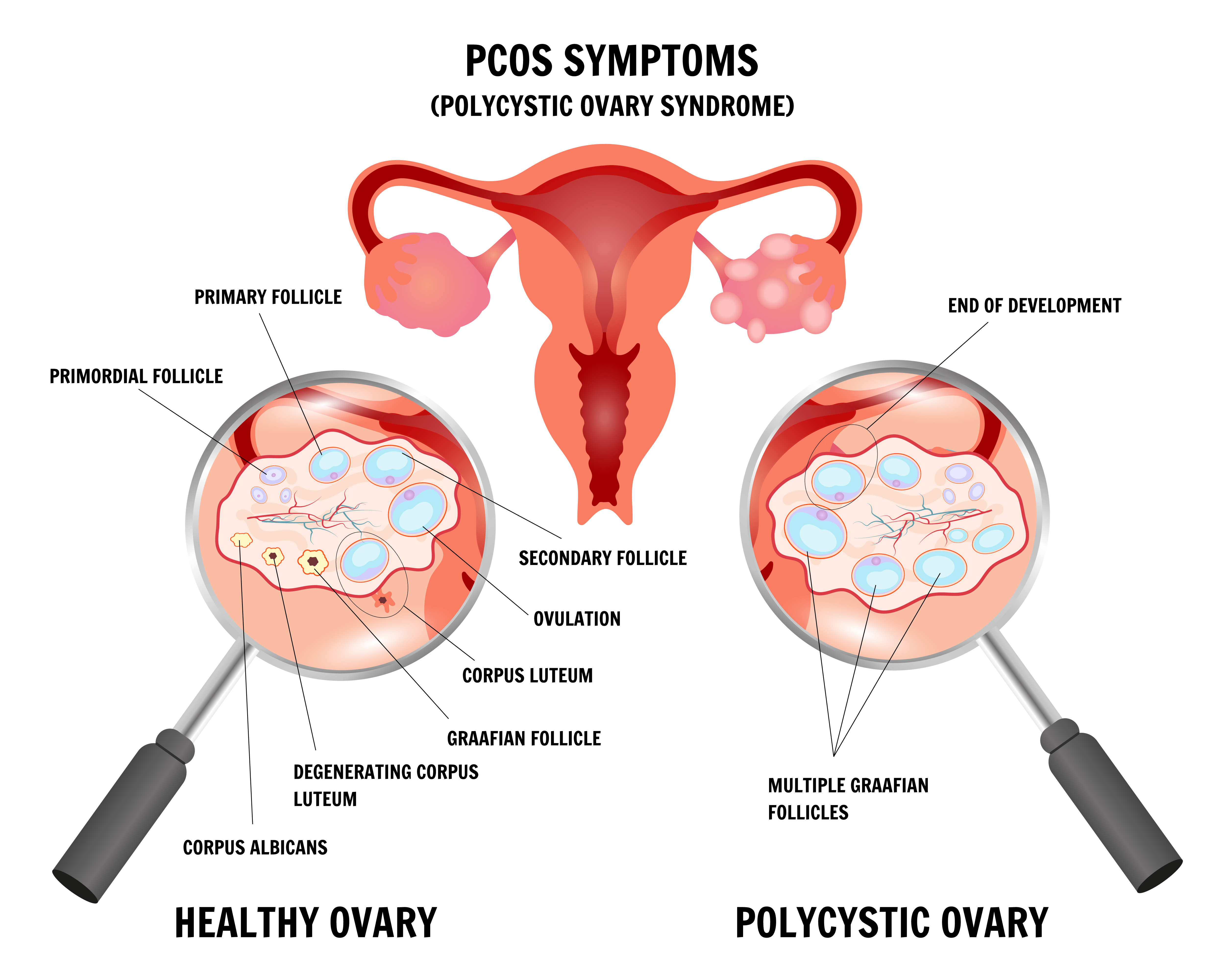
No. PCOS and ovarian cysts are different conditions. An ovarian cyst is a fluid-filled sac that forms on or in the ovary. PCOS is a hormonal and metabolic syndrome, and the follicles seen in polycystic ovaries are not cysts at all, despite the name.
No, PCOS and ovarian cysts are not the same thing
No. They are not the same thing, and one does not cause the other. An ovarian cyst is a structure: a single fluid-filled sac sitting on or inside one ovary. PCOS is a syndrome: a whole-body hormonal and metabolic pattern that happens to show up on the ovaries.
The confusion is understandable. Both involve the ovaries, both are common, and the word cystic sits inside the name PCOS (polycystic ovary syndrome). But they are diagnosed differently, managed differently, and carry different risks. A scan finding of one tells you almost nothing about the other. The rest of this page takes the differences one question at a time.
What an ovarian cyst actually is
An ovarian cyst is a fluid-filled sac that forms on or inside an ovary. Most are functional cysts, meaning the ovary makes them during a normal menstrual cycle, signaling that the ovary is working rather than failing. A follicle (the small sac in which an egg develops) that does not release its egg can keep filling with fluid and become a follicular cyst. The corpus luteum (the temporary hormone-producing structure left behind after an egg is released) can seal over and become a corpus luteum cyst.
Most ovarian cysts cause no symptoms at all and are found by chance on a scan done for another reason. When they do cause symptoms, it is usually one-sided pelvic pain or a sense of pressure. Most functional cysts resolve on their own within one to three menstrual cycles without treatment. A smaller group are pathological cysts, which are not part of the ovulation cycle and are more likely to need monitoring or removal.
Type
What It Means
Typical Outcome
Functional
Formed as part of the normal ovulation cycle.
Usually settles within one to three menstrual cycles.
Pathological
Not formed as part of the normal ovulation cycle.
May require monitoring or treatment, including removal in some cases.
What PCOS actually is
PCOS is a hormonal and metabolic syndrome, not an ovarian abnormality. It is defined by three features: androgen excess (higher than usual levels of male-type hormones, which can show as acne, excess facial or body hair, or scalp hair thinning), ovulatory dysfunction (irregular, infrequent or absent release of eggs, which usually shows as irregular or missing periods), and polycystic ovary morphology (a particular ultrasound appearance of the ovaries).
In adults, two of those three are needed for a diagnosis, once other causes have been ruled out. The wording matters: the ovarian appearance is one optional criterion out of three, not the definition of the condition.
PCOS also reaches well beyond the ovaries. It is strongly associated with insulin resistance and with longer-term metabolic and cardiovascular risk, which is why it is managed as a lifelong health condition rather than as something to be removed. Treatment depth for PCOS sits outside the scope of this page.
The naming problem: polycystic ovaries do not contain cysts
The name is misleading, and it causes a great deal of unnecessary alarm.
What a scan reports as polycystic ovaries is a high count of small immature follicles, typically two to nine millimetres across, sitting in the ovary because they were recruited for ovulation and then stalled. They are follicles that did not finish the job. They are not fluid-filled cysts; they don't need draining, and surgery doesn't remove them.
The clearest evidence that these are two different things is the counting rule itself. When a sonographer counts follicles to assess polycystic ovary morphology, corpora lutea, dominant follicles, and actual cysts are deliberately excluded from the count. The criterion for polycystic ovaries is defined by the presence of multiple follicles, not by excluding cysts.
What the scan is really showing
In adults, the 2023 international guideline defines polycystic ovary morphology as twenty or more follicles in an ovary, or an ovarian volume of ten millilitres or more, measured on a transvaginal ultrasound using a high-frequency probe. A transabdominal scan cannot count small follicles as reliably, so volume is used instead. A report that says polycystic ovaries is describing that count, and nothing more.
PCOS vs ovarian cysts at a glance
The two conditions differ on almost every clinically relevant dimension. One point is worth flagging before the table. Several widely read pages state that ovarian cysts do not affect hormone levels. That is not accurate: a corpus luteum cyst produces progesterone by design. What ovarian cysts do not do is cause the androgen excess that defines PCOS.
Feature
Ovarian Cyst
PCOS
What It Is
A fluid-filled sac on or in an ovary.
A hormonal and metabolic syndrome affecting the whole body.
What Causes It
Usually the normal ovulation cycle; less often other ovarian tissue.
Not fully understood; involves androgen excess and insulin resistance, with a genetic component.
Typical Symptoms
Often none; sometimes one-sided pelvic pain, pressure or bloating.
Irregular or absent periods, acne, excess hair growth, scalp hair thinning and weight changes.
Effect on Periods
Usually none, unless the cyst is large or bleeds.
Central to the condition: cycles may be irregular, infrequent or absent.
Effect on Hormones
Some cysts produce hormones locally, but they do not generally cause androgen excess.
Androgen excess and insulin resistance are common defining features.
How It Is Diagnosed
Usually identified directly on ultrasound.
Diagnosed using a combination of clinical features, blood tests and, when appropriate, ultrasound. A scan alone is not enough.
Does It Resolve?
Most functional cysts settle within one to three cycles.
Usually a long-term condition that can be managed but has no established permanent cure.
Effect on Fertility
Most do not affect conception.
Can make conception harder by disrupting ovulation, but effective treatments are available.
How each one is diagnosed
The two conditions are diagnosed through completely different routes, and this is where most public confusion begins.
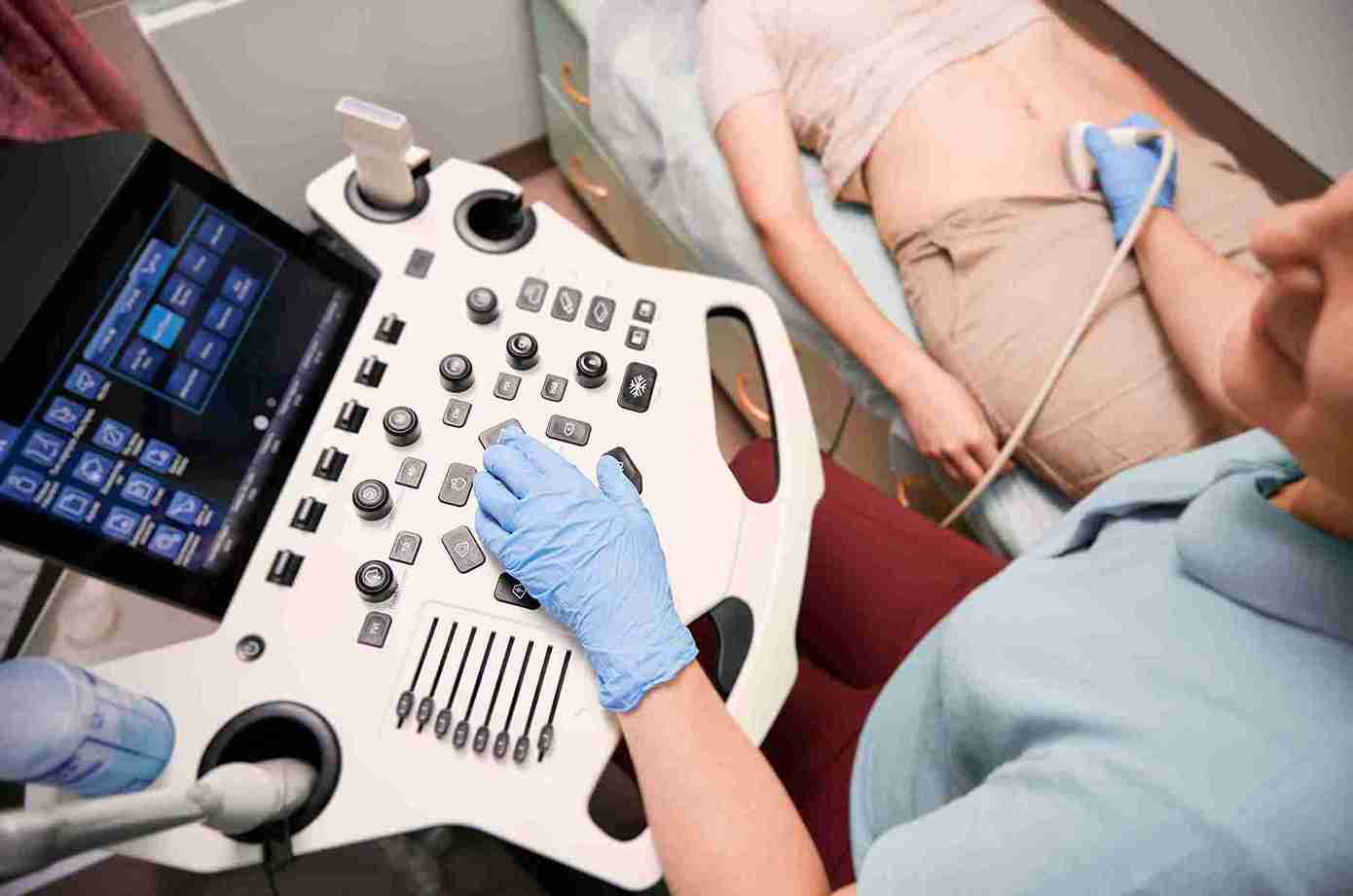
An ovarian cyst is an imaging diagnosis. A pelvic or transvaginal ultrasound shows the sac, its size, and whether its contents look simple or complex. That single scan is usually enough to confirm a cyst and decide whether it needs monitoring.
PCOS is not an imaging diagnosis. The 2023 International Evidence-based Guideline for the Assessment and Management of Polycystic Ovary Syndrome, developed by Monash University for the NHMRC Centre for Research Excellence and endorsed by ESHRE (the European Society of Human Reproduction and Embryology) and ASRM (the American Society for Reproductive Medicine), requires two of three features in adults: androgen excess, ovulatory dysfunction, and polycystic ovary morphology on ultrasound or a raised AMH (anti-Mullerian hormone, a blood marker linked to the number of small follicles). Other causes have to be excluded first. Our guide sets out the full diagnostic pathway for how PCOS is detected.
Why a scan alone cannot diagnose PCOS
It cannot. Polycystic ovary morphology is one of three criteria, and at least two must be present, so a scan alone can neither confirm nor rule out PCOS.
The 2023 guideline goes further in two directions. When irregular cycles and androgen excess are both present, an ultrasound or AMH is not required for diagnosis. And in adolescents, ultrasound and AMH are not recommended for diagnosing PCOS, because multi-follicular ovaries are so common in the years after periods begin that the finding has poor specificity. The guideline places that threshold at eight years after the first period.
So a teenager whose scan report says polycystic ovaries has not, on that basis, been diagnosed with PCOS. In that age group, both androgen excess and ovulatory dysfunction are required.
Can you have both at the same time?
Yes. Having PCOS does not protect you from developing an ordinary ovarian cyst, and having a cyst does not mean you have PCOS.
Women with PCOS ovulate irregularly rather than never, so functional cysts can and do form. On a scan, a genuine cyst in a polycystic ovary looks distinct from the surrounding small follicles: it is larger and counted separately.
Where both are present, they are usually managed separately. The cyst is assessed on its own size and appearance. PCOS is managed as a long-term hormonal and metabolic condition.
Does an ovarian cyst turn into PCOS?
No. There is no progression pathway from an ovarian cyst to PCOS. The two begin differently, they are diagnosed differently, and one does not develop into the other.
This question usually comes from women who have had several functional cysts in a row and have been told, or have read, that this is early PCOS. It is not. Repeated functional cysts describe how your ovary happens to be cycling over a given stretch of months. They do not accumulate into a syndrome.
If repeated cysts do come alongside irregular periods and signs of androgen excess, that combination is worth assessing. But the assessment is for PCOS on its own criteria, not for a cyst that has turned into something else.
Is PCOD the same as PCOS?
In Indian clinical practice, and in Indian search, PCOD (polycystic ovarian disease) and PCOS are generally used to describe the same condition. If your report or your doctor says PCOD, read it as PCOS.
You will sometimes see PCOD described as a milder version of PCOS, with PCOS presented as the serious one. That split is not part of any current international diagnostic framework. One set of criteria applies, and severity varies among individuals within it rather than between two separate labels.
International guidelines use the term PCOS, and this page uses that term throughout.
What each one means for your fertility
Most ovarian cysts do not affect your chance of conceiving. Small functional cysts come and go with the cycle and need no fertility treatment. Larger cysts, endometriomas and cysts that need surgery are the exception and are assessed one by one.
PCOS affects fertility through ovulation. Where eggs are released irregularly or not at all, the fertile window becomes unpredictable rather than absent, and that can be treated. Many women with PCOS conceive with ovulation support alone. Conception with PCOS is covered in depth in our PCOS and fertility guide.
What the Scan Shows
What It Means for Fertility
Usual Next Step
A functional ovarian cyst
Normal cycle activity, not necessarily a fertility problem.
Repeat scan after one to three cycles, if advised.
PCOS with irregular cycles
Ovulation may be unpredictable or infrequent, rather than absent.
Fertility review and ovulation support, if needed.
Both together
Two separate issues that need individual assessment.
Assess the cyst on its own merits and manage PCOS over the long term.
When to see a doctor
Seek care urgently: Get an urgent assessment for sudden, severe pelvic pain, particularly with fever, vomiting or fainting. These can point to a ruptured cyst or to ovarian torsion (twisting of the ovary), and both are emergencies.
Book a routine review if your periods are persistently irregular or absent; if you have new acne, excess facial or body hair, or scalp hair thinning; if pelvic pain or bloating lasts beyond a couple of cycles; or if a scan has reported a cyst and nobody has explained what happens next.
If you have been trying to conceive for over a year, or over six months if you are 35 or older, ask for a fertility review rather than waiting for the cycle to settle on its own.
FAQs
Your questions, clearly answered
Find clear, trusted answers to the most common questions about IVF—designed to guide and support you every step of the way.
Is PCOS the same as ovarian cysts?
No. An ovarian cyst is a fluid-filled sac on the ovary. PCOS is a hormonal and metabolic syndrome affecting ovulation, androgen levels, and metabolism. They are different conditions with different causes and different treatments.
Are polycystic ovaries full of cysts?
No. The follicles counted on a polycystic ovary scan are small, immature follicles that did not ovulate. They are not cysts. The condition is misnamed
Can you have PCOS without cysts showing on a scan?
Yes. Under the 2023 international guideline, where irregular cycles and androgen excess are both present, an ultrasound is not required to diagnose PCOS at all.
Can a scan alone diagnose PCOS?
No. Polycystic ovary morphology is only one of three diagnostic criteria, and at least two must be present. A scan alone cannot confirm or exclude PCOS.
Can an ovarian cyst turn into PCOS?
No. There is no progression pathway from an ovarian cyst to PCOS. They are separate conditions, and one does not develop into the other.
Can you have PCOS and an ovarian cyst at the same time?
Yes. Having PCOS does not prevent an ordinary ovarian cyst from forming, and having a cyst does not mean you have PCOS.
Is PCOD the same as PCOS?
In Indian clinical practice, the two terms generally refer to the same condition. International guidelines use the term PCOS.
Do ovarian cysts cause the same symptoms as PCOS?
Not usually. Most ovarian cysts cause no symptoms, and when they do, it is usually pelvic pain or pressure. PCOS more typically causes irregular periods, acne, and excess hair growth.