Yoga for Fertility: Evidence-Based Poses, and What Doesn't Work
October 29, 2026
Cloudnine
No items found.
Yoga for Fertility: Evidence-Based Poses, and What Doesn't Work
October 29, 2026
Cloudnine
No items found.
The best yoga poses for fertility are gentle ones such as butterfly, supported bridge, child's pose, and legs up the wall because they safely ease stress. Trials show yoga lowers anxiety during fertility treatment. No pose has been shown to unblock tubes, raise AMH, or reverse PCOS, so yoga supports medical care rather than replacing it.
How Does Yoga Affect Fertility?
Yoga combines posture, breathing, and relaxation. In fertility care, its proven benefit is psychological: lower anxiety and better quality of life while trying to conceive or during IVF [3][4][5]. Effects on hormones and pregnancy rates are less certain, and the table below sets out where the evidence stands.
What yoga can and cannot do for fertility
This table separates claims with supporting research from those without, so you know what to expect from a regular practice.
Reduces anxiety and stress during treatment
Indian and international studies show lower anxiety scores [4][5][6]
Supported
Improves hormones in PCOS
One Indian trial in adolescents showed lower LH, testosterone, and AMH [7]
Some support, not in women trying to conceive
Increases IVF pregnancy rates
One small trial of a mind/body programme showed a gain in a second cycle only [3]
Uncertain
Increases AMH or egg numbers
No supportive study; AMH fell in the PCOS trial [7]
Not supported
Unblocks fallopian tubes
No evidence
Myth
Cures or reverses PCOS
No evidence of cure
Myth
Why stress matters, and why it is not your fault
Many couples are told to "just relax," and they will conceive. That advice is unfair. A meta-analysis of 14 studies and 3,583 women found that emotional distress before treatment did not lower IVF pregnancy rates [8]. If a cycle fails, it is not because you were anxious.
Stress still matters to how you feel. In one American study, women with the highest levels of a salivary stress marker, alpha-amylase, were 29% less likely to conceive each month [9]. That is an association, not proof of cause. The ASRM also notes that stress can reduce sexual satisfaction and how often couples have sex [1], which is one more reason a calming daily practice is worth having.
For many Indian women, yoga is also familiar and affordable, and it sits well with the other lifestyle habits that protect fertility. Home fertility yoga needs only a mat and a cushion, and it fits around work and family. Used sensibly, it costs only 20 minutes of your day.
Does Yoga Improve Fertility? What The Research Shows
Yoga reliably reduces anxiety in women having fertility treatment, including in Indian studies. Evidence that it raises pregnancy or live birth rates is weak and comes from a small trial of a broader mind/body programme. Think of yoga for getting pregnant as support for your wellbeing during treatment, not as a fertility treatment in itself. If you are asking which exercise is best for conceiving, regular walking and gentle yoga are sensible choices, and the WHO's 150 minutes of moderate activity a week is a good target.
The Key Studies
Yoga and mind/body research in fertility
These are the studies most often quoted for fertility yoga. Note how small most are, and what each actually measured.
Domar et al. 2011, USA [3]
97 women having IVF; 10-session mind/body programme
Pregnancy 43% vs 43% in cycle 1; 52% vs 20% in cycle 2 (small subgroup)
Oron et al. 2015, Israel [4]
49 women before IVF; 6 weeks of Hatha yoga
Less anxiety and depression, better fertility quality of life; no pregnancy data
Nayak et al. 2022, Bengaluru [5]
354 women; yoga, meditation and counselling
Anxiety score fell from 12.9 to 5.4; no severe cases remained
Gaitzsch et al. 2020, review [6]
12 studies
Small to moderate fall in anxiety and depression
Nidhi et al. 2012, Bengaluru [7]
90 girls aged 15 to 18 with PCOS; 12 weeks of yoga
Lower AMH, LH and testosterone than with ordinary exercise
Rao et al. 2024, review [10]
14 trials, 723 women with PCOS
Better wellbeing; reproductive effects not shown
Yoga for Male Partners
No trial shows that a particular yoga routine improves male fertility. Men still benefit from stress relief and staying active, and our guide to increasing sperm count and motility covers what does help. Practising together can also make the routine easier to keep.
Eight Gentle Yoga Poses for Fertility, and How to do Them
These eight poses are safe for most women trying to conceive and relaxing to hold, whether you start fertility yoga at home or in a class, and whether you are doing yoga before IVF or trying naturally. They are chosen for comfort and calm, not because any one has been shown to raise fertility. Practise them three or four times a week, for 15 to 30 minutes, and stop any pose that causes pain [4][5].
Eight fertility yoga poses at a glance
This table shows the hold time and which IVF phases to skip for each pose. Detailed steps follow below.
1. Supported butterfly (Baddha Konasana)
1 to 2 minutes
None, if comfortable
2. Reclining bound angle (Supta Baddha Konasana)
3 to 5 minutes
None, if comfortable
3. Child's pose (Balasana)
30 to 60 seconds
Late stimulation if it presses on the tummy
4. Cat-cow (Marjaryasana-Bitilasana)
8 to 10 slow rounds
None, keep it gentle
5. Supported bridge (Setu Bandhasana) with a cushion
30 seconds, twice
Stimulation and the two-week wait
6. Legs up the wall (Viparita Karani)
3 to 5 minutes
Stimulation, the two-week wait and pregnancy
7. Easy seated pose with breathing (Sukhasana)
3 to 5 minutes
None
8. Relaxation pose with yoga nidra (Shavasana)
5 to 15 minutes
None
1. Supported Butterfly Pose (Baddha Konasana)
Sit on a folded blanket, bring the soles of your feet together and let your knees fall outwards. Place cushions under your knees if your hips are tight. Sit tall and breathe slowly for one to two minutes. Do not bounce your knees.
Lie on your back with a bolster or two pillows along your spine. Bring your soles together and let your knees drop, supported by cushions. Rest your hands on your lower belly and breathe for three to five minutes. Many women find this pose the most calming.
3. Child's Pose (Balasana)
Kneel, bring your big toes together, widen your knees, and fold forward with a cushion under your chest. Rest your forehead on your hands. Breathe into your back for 30-60 seconds. Widen your knees further if your belly feels compressed.
4. Cat-Cow (Marjaryasana-Bitilasana)
Start on hands and knees. Breathe in and gently lift your chest; breathe out and round your back. Move slowly for eight to ten rounds. It eases back stiffness from long hours at a desk or on a scooter.
5. Supported Bridge (Setu Bandhasana)
Lie on your back, knees bent, feet flat. Lift your hips and slide a firm cushion or yoga block under your sacrum, then rest your weight on it for 30 seconds. Repeat twice. Skip this during stimulation and the two-week wait.
6. Legs up the Wall (Viparita Karani)
Sit sideways against a wall, then swing your legs up as you lie back, with a folded blanket under your hips. Rest for three to five minutes. This is a mild inversion, so leave it out during stimulation, the two-week wait, and pregnancy.
7. Easy Seated Pose with Breathing (Sukhasana)
Sit cross-legged on a cushion with your back supported if needed. Breathe in for four counts and out for six. Continue for three to five minutes. This is a good pose to pair with pranayama, described below.
8. Relaxation Pose with Yoga Nidra (Shavasana)
Lie flat with a pillow under your knees and close your eyes. Follow a recorded yoga nidra or guided body scan for 5 to 15 minutes. It is the simplest way to end a session, and it also helps at night if sleep is poor.
A 15-minute daily flow for beginners: Easy seated breathing (3 minutes), cat-cow (2 minutes), supported butterfly (2 minutes), child's pose (1 minute), reclining bound angle (3 minutes) and relaxation (4 minutes). Add bridge and legs up the wall only outside stimulation and the two-week wait.
Which Yoga Poses Should You Avoid During IVF?
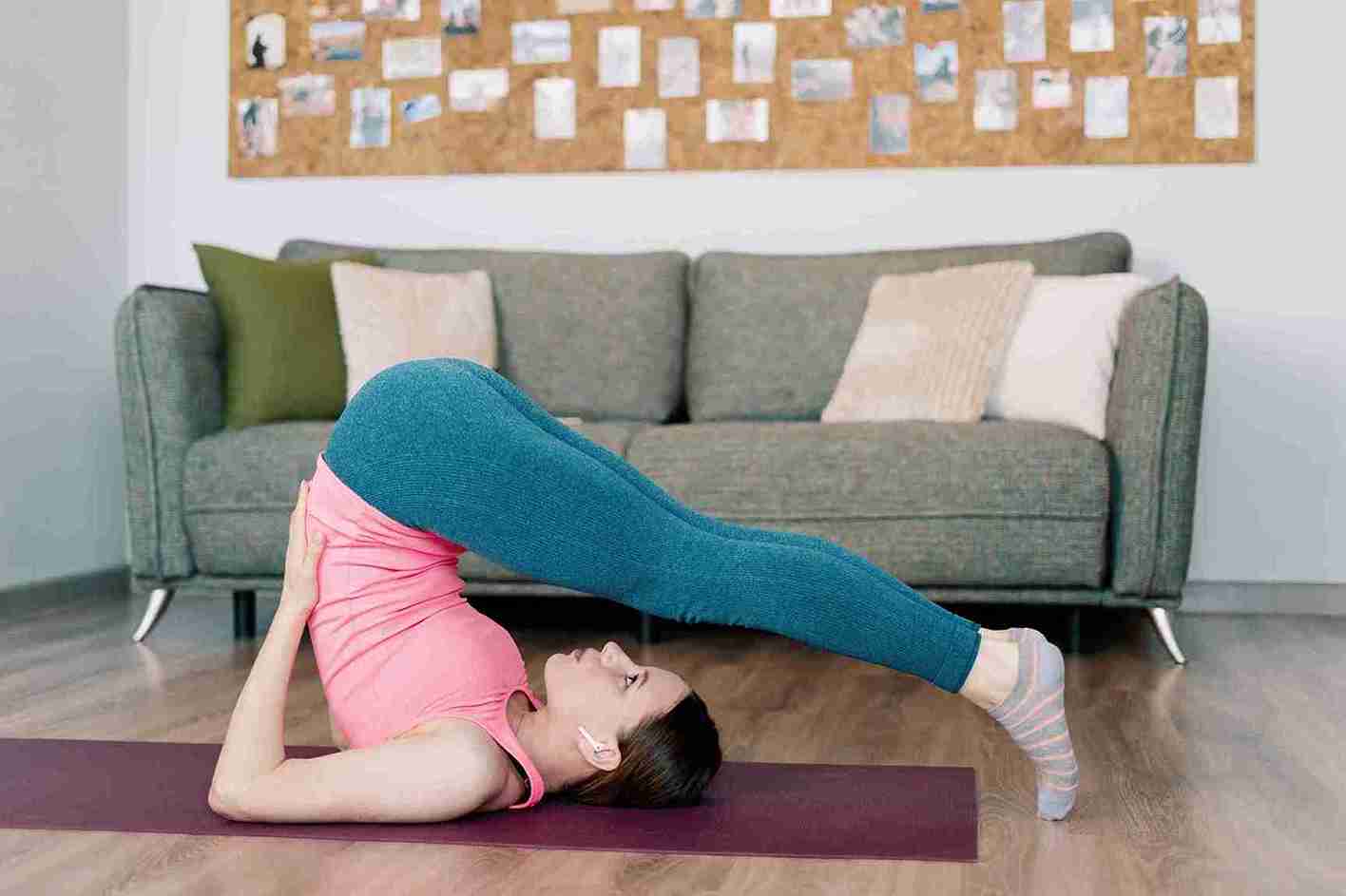
During ovarian stimulation and the two-week wait, avoid deep twists, inversions such as shoulder stand and headstand, strong core work, hot yoga and vigorous flows such as fast sun salutations. Enlarged ovaries can twist, a rare emergency called torsion. Gentle, restorative yoga remains safe at most stages; rest for a day or two after egg retrieval.
Yoga during IVF, phase by phase
This table shows how to adapt your practice at each stage of treatment, from the first injection to a positive test; follow your own clinic's advice if it differs.
Before stimulation
Your usual gentle or moderate practice
Hot yoga, very intense power flows
Ovarian stimulation
Restorative poses, seated breathing
Twists, inversions, core work, fast sun salutations
Egg retrieval and 1 to 2 days after
Rest, gentle breathing
Any physical practice
Embryo transfer and two-week wait
Restorative poses, yoga nidra
Inversions, twists, hot yoga, forceful breathing
Positive pregnancy test
Prenatal yoga with a trained teacher
Lying flat for long periods later in pregnancy, hot yoga
After transfer, bed rest is not needed; the ASRM recommends against it [11]. Gentle yoga and walking are fine. For everyday activity, see our guide to activities to avoid while trying to conceive.
Pranayama and Breathing for Fertility
Slow breathing is yoga's most useful tool for stress, and you can do it anywhere. Two practices suit fertility treatment well; one popular practice is best avoided during IVF.
Anulom Vilom (alternate nostril breathing): Slow, even breaths alternating nostrils for five minutes; safe at every stage.
Bhramari (humming bee breath): A long hum on each out-breath for five to seven rounds; it can settle racing thoughts at night.
Kapalbhati and Bhastrika (forceful breathing): Strong abdominal pumping; skip during stimulation, the two-week wait and pregnancy.
Common Myths About Yoga and Fertility
Several claims about fertility yoga are widely shared in India. These are the ones we hear most in clinic, with what the evidence says.
"Yoga can unblock fallopian tubes": No study supports this. Tubes are checked with an HSG test and, when needed, treated with surgery or IVF.
"Yoga raises AMH": The Indian PCOS trial found AMH fell with yoga [7]. AMH reflects your egg reserve, which no exercise increases [2]; read conceiving naturally with low AMH.
"Yoga reverses PCOS": Yoga improved some hormone levels in adolescents [7], but PCOS is long-term and ovulation often still needs medicine; see our PCOS and fertility guide.
"Legs up the wall after sex helps sperm reach the egg": There is no evidence that lying with legs raised changes pregnancy rates.
"Thirty days of yoga will get you pregnant": No programme can promise that, and claims like it set couples up for guilt.
How Much do Fertility Tests and Treatment Cost in India?
At Cloudnine Fertility, a first fertility consultation costs ₹800 to ₹1,500 and a tubal test (HSG) costs ₹5,000 to ₹10,000. A counselling session for stress during treatment costs ₹800 to ₹1,500 (indicative ranges). Yoga itself is low cost; the bigger expenses come from finding and treating the cause of infertility.
Cost of Tests and Treatment Discussed in This Guide
Figures are indicative Cloudnine Fertility ranges supplied for this content programme, not audited quotes. Placeholders will be replaced once pricing is confirmed.
Specialist consultation
First fertility review
Rs 800 to Rs 1,500
Fertility counselling session
Support for anxiety and stress
Rs 800 to Rs 1,500
AMH blood test
Egg reserve: the myth yoga cannot change
Rs 5,000 to Rs 6,500
Tubal test (HSG)
Checks whether tubes are open
Rs 5,000 to Rs 10,000
Laparoscopy for blocked tubes
Treats some tubal blockages
Rs. 35,000 to Rs.70,000
Ovulation induction, per cycle (medicines and scans)
First-line treatment for PCOS
Rs 3,000 to Rs 15,000
IVF cycle
When other treatment has not worked
Rs 1,50,000 to Rs 2,50,000
When Should You See a Fertility Specialist?
See a specialist after 12 months of trying if you are under 35, or six months if you are 35 or older, whether or not you practise yoga. Go sooner with irregular periods, known PCOS, a history of pelvic infection or endometriosis. Yoga can run alongside tests and treatment; it should not delay them.
When to book a fertility review
Use this table to decide when to stop waiting.
Under 35, trying 12 months
Book now
35 to 39, trying 6 months
Book now
40 or older
Book straight away
Irregular or absent periods, or PCOS
Book now
Feeling overwhelmed by stress during treatment
Ask about counselling at your next visit
Infertility puts strain on couples as well as individuals, and talking it through together often helps. Cloudnine Fertility offers fertility counselling alongside treatment. Book a consultation to plan both.
What results can you realistically expect?
With three or four sessions a week, most women notice calmer sleep and less anxiety within a few weeks; Indian data show large falls in anxiety scores [5]. Expect yoga to make treatment easier to live through. Do not expect it to change your AMH, open your tubes or replace ovulation treatment.
What to Expect From a Regular Fertility Yoga Practice
This table sets realistic expectations based on the research cited above.
Anxiety and stress
Lower within weeks
Nayak 2022 [5]; Gaitzsch 2020 [6]
Sleep and wellbeing
Better
Rao 2024 [10]
PCOS hormones
Possible improvement
Nidhi 2012 [7]
Pregnancy or live birth
Not proven
Domar 2011 [3]
AMH or tubes
No change
Nidhi 2012 [7]
Want to consult the Best Fertility in india? Please find the links below.
Find clear, trusted answers to the most common questions about IVF—designed to guide and support you every step of the way.
Which yoga is best for trying to conceive?
Gentle, restorative yoga is best: supported butterfly, reclining bound angle, child's pose, cat-cow, legs up the wall and relaxation with breathing. These lower stress safely. No style or pose has been proven to raise pregnancy rates, so choose what you enjoy, practise three or four times a week, and keep seeing your doctor.
Can yoga increase AMH level?
No. Yoga has not been shown to increase AMH, which reflects the number of eggs left in your ovaries. In an Indian trial of girls with PCOS, AMH actually fell after yoga, which fits better with hormone balance rather than more eggs. If your AMH is low, see a fertility specialist rather than relying on exercise.
Which yoga poses can improve egg quality?
No yoga pose has been shown to improve egg quality. Egg quality depends mainly on age. Yoga may help indirectly by lowering stress and improving sleep, which supports your general health during treatment. Gentle poses such as butterfly, child's pose, and supported relaxation are good choices while you and your doctor plan the rest.
Can yoga unblock fallopian tubes?
No. No evidence shows that any yoga pose or breathing practice can open blocked fallopian tubes. Blocked tubes are diagnosed with an HSG test or laparoscopy, and treated with surgery or bypassed with IVF. Yoga can help you cope with the stress of testing and treatment, but it cannot change the tubes.
Is yoga safe during IVF?
Gentle yoga is safe during IVF if you adapt it to each phase. During stimulation and the two-week wait, skip twists, inversions, strong core work, hot yoga, and forceful breathing such as kapalbhati. Restorative poses, slow breathing, and yoga nidra are safe at most stages. Rest for a day or two after egg retrieval.
Can I do yoga after embryo transfer?
Yes, gentle restorative yoga, slow breathing, and yoga nidra are fine after embryo transfer. Avoid inversions such as legs up the wall, deep twists, strong core work, and hot yoga until you get a pregnancy test. Bed rest is not recommended, so light movement is encouraged rather than discouraged.
Does yoga help with PCOS fertility?
Yoga may improve some PCOS hormones and lower anxiety, according to Indian trials in adolescents. It does not cure PCOS, and many women still need ovulation induction to conceive. Use yoga alongside weight management and medical treatment, and see a specialist if your cycles are irregular or you've been trying for six to twelve months.
How often should I do fertility yoga?
Three or four sessions a week of 15 to 30 minutes is a practical target, with a few minutes of slow breathing on other days. Studies that reduced anxiety used six- to twelve-week programmes [4][7]. Consistency matters more than intensity, so choose a routine you can keep through treatment.
Twenty quiet minutes on a mat each day can make the waiting, the scans and the injections easier to carry. Pair that practice with timely tests and treatment, and it will serve you well at every stage. Cloudnine Fertility specialists and counsellors can help with both. Book a consultation at a nearby centre.