There is no size at which an ovarian cyst automatically needs surgery. Size is one of four things a doctor weighs, alongside how the cyst looks on the scan, whether it persists, and whether you have symptoms. A large simple cyst is often less concerning than a small complex one.
The ovarian cyst size chart, and what it can and cannot tell you
The chart below is a general guide, not a decision rule. It sets out what each size band usually means in day-to-day practice, and the third column is the one to read closely, because that is where the common misreadings sit.
Your report may print a single figure or three, in centimetres or in millimetres. Ten millimetres (mm) is one centimetre (cm), and where three numbers appear, the largest is usually the one quoted. How that report is laid out and why the same cyst can measure differently on two scans are subjects in their own right.
The bands below describe simple ovarian cysts in women who have not been through menopause. After menopause, the conversation changes, and we cover that further down.
Cyst Size
What It Usually Means
What It Does Not Mean
Under 3 cm (under 30 mm)
Very commonly found, often on a scan performed for another reason. A fluid-filled sac of this size is frequently part of a normal menstrual cycle.
It does not mean that nothing needs looking at. A small cyst with an unusual appearance or one causing pain should still be assessed appropriately.
3 to 5 cm (30 to 50 mm)
A simple cyst in this range often resolves on its own over two to three menstrual cycles and may not require a routine follow-up scan when the appearance is typical and symptoms are absent.
It does not guarantee that the cyst will disappear. If symptoms continue or the cyst remains months later, reassessment may be appropriate.
5 to 7 cm (50 to 70 mm)
A simple cyst in this range may be monitored with follow-up imaging rather than treated immediately. Management depends on its appearance, symptoms, age, and clinical context.
It does not automatically mean that surgery is required. A 5 cm measurement is not, by itself, a universal surgical threshold.
7 to 10 cm (70 to 100 mm)
Further imaging or specialist assessment may be considered because a cyst of this size can be more difficult to fully characterise on a single ultrasound.
It does not mean that an operation has been decided or that the cyst is inherently dangerous.
Over 10 cm (over 100 mm)
Specialist assessment is generally appropriate, and removal may be discussed more often, particularly if the cyst persists, has concerning features, or causes pressure symptoms.
It does not automatically mean cancer or an emergency. Size alone is not sufficient to determine the nature or risk of an ovarian cyst.
Why every ovarian cyst size chart you find online says something different
If you have already searched for this, you've noticed the problem. One page sets the line at 3 cm. Another puts it at 5 cm. A third says 7 cm, a fourth says 10 cm. Each is published as the answer, and they cannot all be the answer.
The explanation is not that some of them are lying. It is that a size chart compresses four separate questions into one number, and then prints the number without saying which question it belongs to. Those four questions are: which cysts usually resolve on their own, which ones get a repeat scan, which ones are discussed with a specialist team, and which ones are usually removed. Each has its own figure attached, and the figures are different.
So 5 cm is a real number, but it answers the first two questions rather than the last one. Roughly 7 cm is a real number too, and it largely answers a practical imaging question about whether the whole cyst can be seen clearly on a scan. Neither is a removal threshold, nor does it become one by being reprinted.
The figures also shift with menopausal status, and they shift with how the cyst looks. A chart drawn for women before menopause does not carry over to women after it.
A threshold quoted without naming its question is not exactly wrong. It is unfinished. That is why your number can look alarming on one page and unremarkable on the next, and why the chart above includes a third column.
The four things that decide, and where ovarian cyst size ranks among them
Size sits inside the appearance question rather than above it. These are the factors a doctor weighs, roughly in the order they carry weight, with measurement last on purpose.
Factor
Why It Matters
How It Compares With Size
How the Cyst Looks on the Scan
Whether a cyst is simple or has more complex features is the strongest signal available from an ultrasound, and structured risk assessment is built around its appearance.
It carries more weight than the measurement. Size is one input into the overall assessment, not a separate verdict that overrides the scan appearance.
Whether It Is Still There on a Repeat Scan
A cyst that persists across several cycles is less likely to be functional, which can change what it probably is and how it should be managed.
Persistence can matter more than the number itself. A cyst that disappears was unlikely to require intervention regardless of its measured size.
Whether You Have Symptoms
Persistent pain, pressure, or bloating can shift the balance towards treatment because relief of symptoms is a legitimate reason to treat a cyst.
Symptoms are independent of size. A small cyst can cause significant symptoms, while a larger cyst may cause none.
Whether You Have Been Through Menopause
Assessment is generally more cautious after menopause, and reference points used before menopause do not necessarily carry across.
The same measurement can have different implications depending on menopausal status, so size should not be interpreted in isolation.
The Measurement Itself
Size influences how likely a cyst is to resolve, how easily it can be fully assessed on ultrasound, and how likely it is to cause pressure symptoms.
Size is relevant, but it is only one factor. It is the number most often quoted but is the least reliable factor when considered on its own.
Size also does not tell you what type of cyst it is. That comes from appearance, not from diameter.
Is a bigger ovarian cyst more dangerous than a small one?
No, not as a rule. Risk doesn't scale neatly with diameter, and treating it as though it does is the most common mistake people make with these numbers.
A 3 cm cyst that has solid components will receive more attention than an 8 cm cyst that appears simple. The reason is that the features visible on the scan carry more diagnostic information than the measurement does, so a small cyst that looks unusual raises more questions than a large one that looks straightforward.
The inverse is worth stating too, because it is the version almost nobody serves: yes, a small cyst can still be significant. That is not a reason to become anxious about small cysts generally, which are extremely common and usually uneventful. It is a reason to ask what the scan said about how the cyst looked, not just what it measured.
This is also why two women with identical measurements can receive completely different plans without either being mismanaged.
What the size of an ovarian cyst actually does change
That said, size isn't the rule, but it would be dishonest to leave you thinking it counts for nothing. Here is precisely where it does carry weight:
How likely the cyst is to resolve on its own. Smaller simple cysts resolve more reliably. This is the strongest genuine size effect.
The risk of the ovary twisting. Larger cysts increase the risk of ovarian torsion, in which the ovary rotates and its blood supply is compromised. This is uncommon, but it is a real size effect.
Pressure and bloating symptoms. A cyst has to reach a certain volume before it presses on anything, so larger cysts are more likely to be felt.
How an operation would be approached, if one is needed. Size is one factor that shapes the surgical route, separate from whether to operate at all.
How closely a repeat scan is scheduled. Larger cysts tend to be reviewed sooner and more often.
Growth is a separate question from size. A cyst that grows measurably across several scans is read as a pattern worth investigating rather than a single alarming figure. Growth rate varies by cyst type, and rescan intervals are set on a case-by-case basis, not by a universal rule.
One caution: a difference between two reports is not always growth. The same cyst can measure differently depending on the plane and where the edge was judged.
I have a 5 cm ovarian cyst. What does that mean?
A 5 cm ovarian cyst is moderate. It is neither small nor large, and on its own it does not mean surgery.
It is worth knowing why 5 cm is the figure everyone quotes, because the reason is almost the opposite of how it is used. The RCOG Green-top Guideline No. 62, Management of Suspected Ovarian Masses in Premenopausal Women (RCOG and BSGE, November 2011), describes simple ovarian cysts under 50 mm as usually resolving over two to three menstrual cycles without intervention and generally not requiring follow-up. Cysts of 50 to 70 mm are given routine ultrasound follow-up.
Read that carefully. 50 mm is the point below which a simple cyst can confidently be left alone. It is not the point above which one is removed. Those are two entirely different statements, and the internet turned the second one into the first.
The same guideline is explicit that there is no evidence-based consensus on the size above which surgical management should be considered. That is the guideline position, not a contrarian reading of it.
So a 5 cm simple cyst sits just past the point where doctors stop assuming it will vanish quietly, and well short of any figure that would decide on an operation. What happens next depends on how it looked, whether it persists, and whether it is causing you anything.
Does the size of an ovarian cyst mean it is cancer?
No, size alone does not. A cyst does not become cancerous by growing past a certain size, and that premise, which underlies a great many searches, is worth correcting directly. Cysts and ovarian cancers are different things from the outset, rather than stages of the same thing.
Risk is assessed on appearance, not on diameter. Radiologists follow a structured reporting standard for this: the American College of Radiology Ovarian-Adnexal Reporting and Data System, first published for ultrasound in 2019 and updated in 2022, which scores an adnexal finding on its features. Size appears within that scoring as one contributing feature among several, which is exactly the point: it is an input, not the assessment.
To be honest, a very large cyst is one of the things that gets weighed. It is not a factor on its own, and it does not turn a measurement into a diagnosis.
In women before menopause, the overwhelming majority of ovarian cysts are not cancer.
Can an ovarian cyst be made to shrink?
Nothing you can do will make an existing ovarian cyst shrink faster. This is the honest answer, and it is worth stating plainly, because much of what is written about shrinking cysts is not true.
Functional cysts resolve because that is what they were always going to do. They form as part of the ovulation cycle and settle on their own, typically over two to three menstrual cycles. Nothing you take or avoid in the interim changes that timeline, and a cyst that does resolve was not persuaded to.
Diet does not shrink cysts. Home and herbal remedies do not shrink cysts. Hormonal pills do not shrink an existing cyst either, although they are sometimes used for other reasons.
What does change is what happens if a cyst is still there after that window. At that point, it is reassessed rather than treated as urgent, because a persistent cyst tells the doctor something useful about what it probably is.
Ovarian cyst size and your fertility
There is no ovarian cyst measurement that by itself stops you from conceiving. Where a cyst does affect fertility, it is the type of cyst that matters rather than how many centimetres it measures.
One thing about size in fertility care that a general gynaecology page has no reason to tell you. Here the number is watched, not read once. In a baseline scan or a monitoring cycle, the same cyst is measured repeatedly over weeks, which produces a particular anxiety: watching a figure move. A cyst measured at 2.8 cm and then 3.4 cm feels like it is growing. Often, it is seen more clearly or measured on a slightly different plane.
The second thing, which only a fertility clinic will say plainly, is that a functional cyst arising during ovarian stimulation can measure large and be entirely unremarkable. Stimulation makes the ovaries more active and more closely watched, so cysts are both more likely to appear and far more likely to be spotted.
Whether a cyst needs attention before a treatment cycle is a separate clinical decision, and it is not made on the measurement alone.
Ovarian cyst size after menopause
This is the one place where the size conversation genuinely changes, so it needs to be said rather than left implied.
Ovarian cysts found after menopause are assessed more closely than the same finding before menopause, and the reference points used in the chart above do not carry over. The RCOG maintains a separate guideline for this, Green-top Guideline No. 34, The Management of Ovarian Cysts in Postmenopausal Women (July 2016, amended December 2025), precisely because the assessment differs.
The practical consequence is simple. If you have been through menopause, a figure you have read on a chart written for premenopausal women does not tell you what your measurement means, and it should not be used to reassure yourself or to alarm yourself. Ask your doctor to interpret the number against postmenopausal reference points.
When an ovarian cyst is an emergency, whatever its size
Seek urgent medical care if you have:
Sudden, severe pain on one side of the lower abdomen
Pain with fever
Pain with vomiting
Feeling faint, or actually fainting
Rapid swelling of the abdomen
These do not wait for a size threshold. A small cyst can cause every one of them, and a large cyst can cause none of them. What matters is what is happening, not what the cyst measures.
Sudden severe one-sided pain can mean a cyst has ruptured or the ovary has twisted. Both need assessment on the day, not at the next appointment.
If you are trying to work out whether one-sided pelvic pain is ovulation or a cyst, our guide to sharp pelvic pain on one side covers the distinction in more detail.
What to ask your doctor about the size of your ovarian cyst
Take your report with you and ask about your own number rather than about cysts in general:
My cyst measures [your figure]. Did it look simple, or did it have any complex features?
Given how it looks, does this measurement change anything about my plan?
When should it be rescanned, and what would you expect to see?
If it is still the same size next time, what happens then?
Is there anything about my situation that makes this measurement more significant than it would usually be?
If you have a report and no clear answer about what the number means, bring it, with any earlier scan, to a review appointment. Two reports usually say more than one. You can book a fertility consultation at a Cloudnine Fertility centre, and it helps to know what to expect at a first fertility consultation before you go.
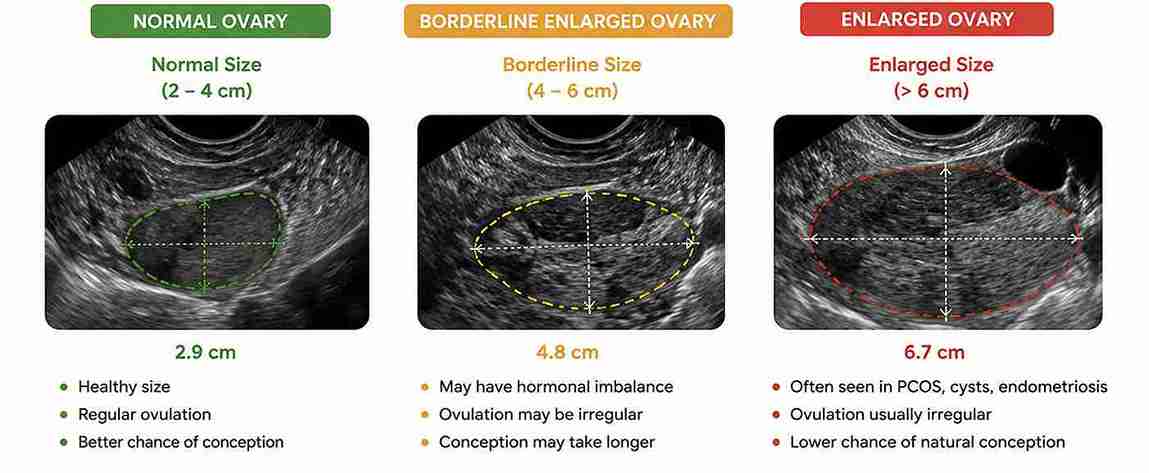
One separation worth making: the cyst and the ovary itself are different measurements with different answers. If your report commented on the ovary rather than the cyst, whether ovary size matters for getting pregnant is the question you are actually asking.
No single size makes an ovarian cyst dangerous. Concern comes from how the cyst looks on the scan, whether it is still there on a repeat scan, whether you have symptoms, and whether you have been through menopause, with the measurement as one input among those. A cyst is assessed in the context of the whole picture rather than by a number.
What size ovarian cyst needs surgery?
No size automatically requires surgery. Larger cysts are more likely to be removed because they are less likely to resolve on their own and more likely to cause pressure symptoms, not because they crossed a specific number. Whether an operation is discussed depends on appearance, persistence, and symptoms alongside the measurement.
I have a 5 cm ovarian cyst. Is that big?
A 5 cm ovarian cyst is moderate rather than large. It is the most commonly quoted figure in this topic, and it marks the point below which a simple cyst can confidently be left alone rather than the point above which one is removed. Those two things are constantly confused.
Is a bigger ovarian cyst more serious than a small one?
No. Risk tracks appearance more closely than diameter. A small cyst with solid areas within it is assessed more closely than a larger simple one, because the features seen on the scan carry more information than the measurement does.
Schedule your consultation Today!
Book your consultation with our fertility experts the first step toward your parenthood journey.