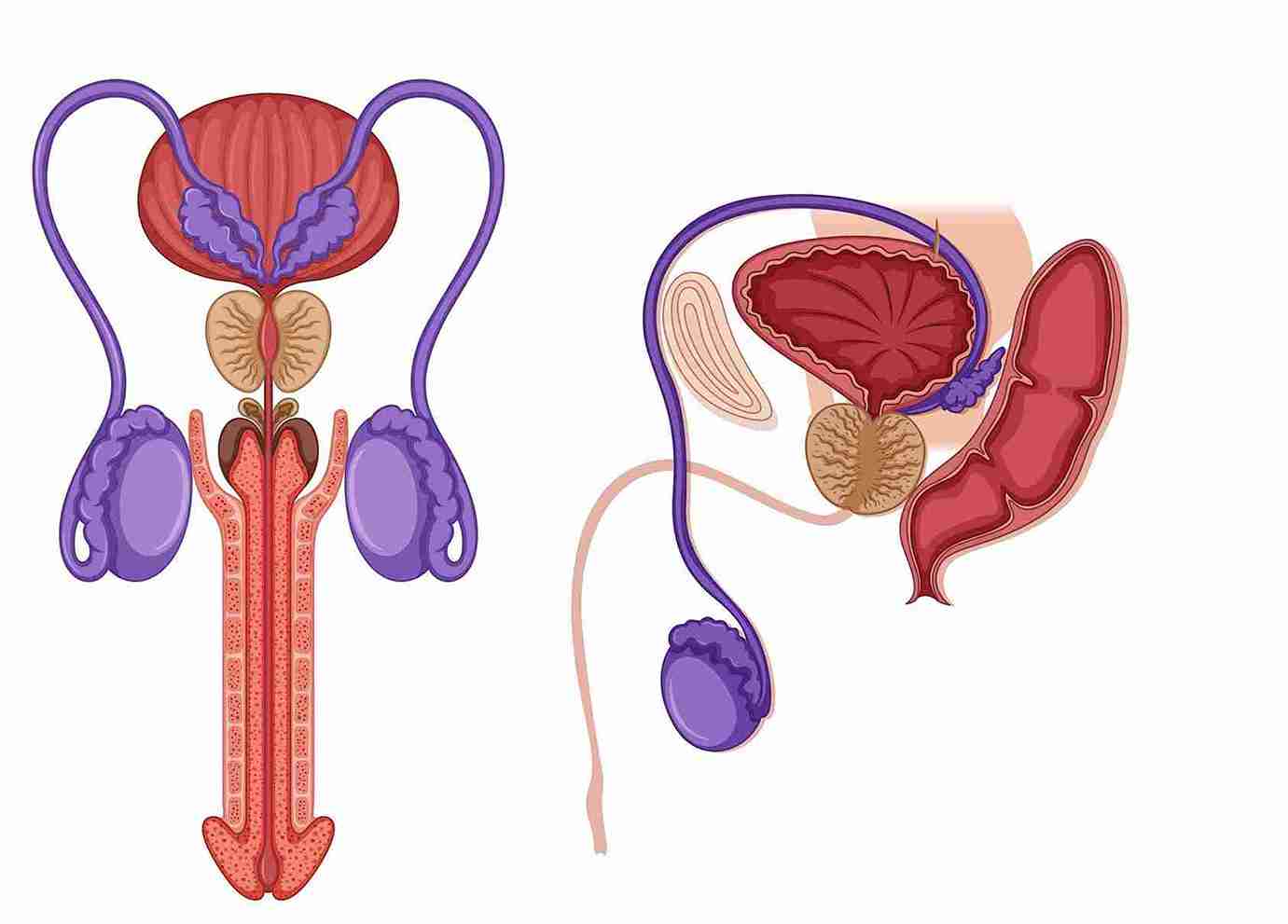
The testicles, or testes, are two oval organs in the scrotum that produce sperm and testosterone. They are rarely a matched pair. In most men, one sits a little lower than the other or is a little larger, and both findings are normal.
Most of what men notice when they check themselves turns out to be ordinary anatomy. A soft ridge that feels like a lump is usually a normal structure. A small difference between the two sides is usually the way they have always been. A few specific changes are different, and those are worth acting on quickly.
This page covers what the testicles do, what sits inside them, what normal looks and feels like, what the published size figures actually mean, and the changes that need a doctor.
What the Testicles Do
The testicles have two jobs, and they run at the same time.
The first is making sperm. This happens inside tiny coiled tubes called the seminiferous tubules, which fill most of the inside of each testicle. Sertoli cells line those tubes and support the developing sperm cells as they form. Sperm production begins at puberty and continues through adult life. How sperm are made, and how long each batch takes, is a subject in its own right and is covered in our guide to spermatogenesis.
The second is making testosterone. This happens in the Leydig cells, which sit in the tissue between the tubules rather than inside them. Testosterone drives the changes of puberty, maintains muscle and bone, supports sex drive, and is needed for sperm production to keep going.
The brain drives both jobs. The pituitary gland releases two hormones: luteinising hormone (LH), which tells the Leydig cells to make testosterone, and follicle-stimulating hormone (FSH), which works alongside testosterone to keep sperm production running. What the blood test values for those hormones mean is a separate subject and is not covered here.
Inside a Testicle: The Structures and What You Can Feel
A testicle is not a solid lump of tissue. It is a tightly packed set of tubes, wrapped in smooth coverings, with a cord running up from the top. Some of those structures can be felt through the skin of the scrotum and some cannot. Knowing which is which prevents a great deal of unnecessary worry.
The table below sets out each structure, what it does, and whether you can expect to feel it.
Structure
Where It Is
What It Does
Can You Feel It?
Scrotum
The pouch of skin and muscle below the penis.
Holds both testicles and keeps them below core body temperature.
Yes. It is the skin layer you are touching.
Tunica vaginalis and tunica albuginea
The coverings wrapped around each testicle.
Protect the testicle and give it its firm, smooth surface.
Not separately. They are why the surface feels smooth.
Seminiferous tubules
Coiled throughout the body of each testicle.
Make sperm.
No. They are the bulk you feel as the testicle itself.
Sertoli cells
Lining the seminiferous tubules.
Support and nourish sperm cells as they develop.
No.
Leydig cells
In the tissue between the tubules.
Make testosterone.
No.
Rete testis
At the back of each testicle, where the tubules meet.
Collects sperm and passes it on to the epididymis.
No.
Epididymis
A coiled tube along the back and top of each testicle.
Where sperm mature and are stored.
Yes, as a soft ridge. The structure most often mistaken for a lump.
Spermatic cord
Running up from the top of each testicle into the groin.
Carries the vas deferens, blood supply and nerves.
Yes, as a firm cord above the testicle.
Two things in that table are worth remembering.
First, most of a testicle's volume is seminiferous tubules, the tissue that makes sperm. That is why a doctor treats testicle size as a measurement worth taking, and why size comes up again further down this page.
Second, the only structures you can normally feel are the scrotum, the smooth surface of the testicle, the soft ridge of the epididymis at the back, and the firm cord above. Everything else is too small or sits too deep to feel. Our guide to the male reproductive system covers how these parts connect to the rest of the male reproductive tract.
What a Normal Testicle Looks and Feels Like
Start with what normal is, because most men have never been told.
A healthy testicle is smooth across its front and sides, firm but not hard, and roughly egg-shaped. It moves a little under the skin when you handle it rather than sitting fixed in one place. It will feel tender if squeezed, which is normal and not a sign of a problem. The two testicles should feel broadly similar in texture, even if they aren't identical in size or position.
Now the part that sends most men looking for answers. The soft, cord-like ridge you can feel at the back and top of each testicle is not a lump. It is the epididymis, the tube where sperm mature and are stored, and everyone has one on each side. It feels different from the testicle itself, softer and more irregular, which is exactly why it gets mistaken for something abnormal. Finding it on both sides, in the same place, is the strongest sign that what you are feeling is anatomy rather than a problem.
Checking yourself is straightforward. Do it after a warm shower or bath, when the scrotum is relaxed and the testicles hang lower. Take one testicle at a time. Gently roll it between the thumb and the first two fingers, covering the whole surface. You are not hunting for anything in particular. You are learning what is usual for you, so that a change stands out later.
The one finding to act on is something new on the smooth front or sides of the testicle itself: a lump, a hard patch, or an area that feels different from the rest of the surface. That isn't the epididymis, and it isn't normal variation. See a doctor rather than waiting to see if it goes away.
One Lower, One Bigger: Normal Differences Between the Two Sides
No, two testicles that aren't identical aren't a sign that something is wrong. It is the usual pattern.
Almost no man has a perfectly matched pair. One usually hangs lower than the other, and one is often slightly larger. The arrangement develops during puberty and then stays broadly the same for life.
So the question isn't whether the two sides differ. It is whether the difference is new. The table below separates the two.
What You Notice
Usually Normal When
Get It Checked When
One testicle hangs lower than the other.
It has been that way for as long as you can remember.
The way one hangs has changed recently, or the change comes with pain or swelling.
One testicle is slightly larger.
The difference is small, long-standing and unchanged.
The difference is new, or the larger side appears to still be growing.
Both sit higher in the cold and lower in the warmth.
They move together and settle back as you warm up.
One side stays drawn up and is painful.
One testicle feels different from how it used to.
Nothing else has changed, and it settles within a day or two after a knock or heat.
The change persists, or the surface feels hard or uneven.
A clear difference in size that is new or growing.
This is not assumed to be normal variation.
Always. A doctor can measure both sides properly.
The scrotum looks swollen on one side.
This is not a normal finding on its own.
Always, and the same day if there is pain or fever.
Men often ask specifically about the left side because, in most men, the left testicle sits lower. There is an anatomical reason related to the blood vessels on that side, and we cover it in our guide to varicocele. For the purposes of this page, the answer is simpler: a testicle that has always sat lower on one side is normal and, on its own, does not need investigation.
Testicle Size: What is Normal and What the Numbers Mean
If you search for a normal testicle size, you'll get several different answers, each stated with equal confidence. They are not contradicting each other by accident. Each figure comes from a different measurement method, and often from a different group of men. The method is what almost every size chart leaves out.
The table below pairs each figure with the method that produced it.
Figure in Circulation
How It Is Measured
Why It Differs
About 15 to 25 millilitres for an adult.
Bead comparison in clinic, using a set of graded ovals held against the testicle.
The bead is matched against the testicle with its coverings and skin included, so the figure reads higher than the testicle alone.
Lower averages, commonly cited at around 14 millilitres.
Ultrasound, with three measurements put through a formula.
The scan measures the testicle itself without the surrounding layers, and different formulas give different answers from the same scan.
A much wider range, roughly 17 to 55 millilitres.
One published cohort of fertile men, using a different bead set.
The men studied and the instrument both differ, and the range covers 95 out of 100 men rather than an average.
Above about 4 millilitres.
Bead comparison in a child or adolescent.
Not an adult figure at all. It is the marker that puberty has started.
So there is no single normal testicle size. Any chart that hands you one number is quoting one method, applied to one group of men, as though it were the whole answer.
The next question is usually whether bigger testicles mean more sperm. Across large groups of men, testicular volume tracks sperm production, which is why a doctor measures it. For any one man, though, it is a clue and not a result. Normal-sized testicles can produce no sperm at all in the semen, and only a semen analysis can say what is actually there.
If size needs measuring properly, a doctor does it by comparison in clinic or by scan, not by eye and not from a photograph.
Differences Some Men Are Born With
One testicle. Some men have one rather than two, either from birth or following an operation or an injury. One working testicle can do the job of two, and that alone does not make a man less fertile. Our guide to the male reproductive system covers this in full.
An undescended testicle. The testicles form inside the abdomen before birth and move down into the scrotum shortly before or after delivery. In some boys, one does not complete that journey, which is called an undescended testicle. If you were treated for one as a child, mention it at a fertility check. It is relevant history even decades later.
A testicle that comes and goes. In some boys, a testicle moves up into the groin and back down again, often when they are cold or startled. In childhood, this is normal and usually settles as they grow.
Why Testicles Move Up and Down
No, testicles that move are not a problem. That is temperature control doing its job.
A thin muscle called the cremaster muscle runs alongside the spermatic cord. In the cold, it contracts and draws the testicles up towards the body. In the warmth, it relaxes and lets them hang lower. The purpose is to keep them slightly below core body temperature, the range where sperm production works best. That is why they can look noticeably different from one day to the next, or before and after a shower.
Our guide to the male reproductive system covers why the testicles sit outside the body at all. Whether sustained heat exposure affects fertility is a separate question with its own answer.
Testicle Pain and Fertility
Fertility problems usually cause no symptoms at all, which is why they are so often found only when a couple starts trying for a baby. An ache in a testicle on its own is not a fertility result and does not tell you anything about your sperm. Which symptoms are and are not worth acting on is covered in our guide to the symptoms of infertility in men.
One exception overrides everything else on this page. Sudden, severe pain in a testicle is an emergency, as outlined in the box below.
Seek care if
Sudden, severe pain in a testicle. This can be a twisting of the testicle, called testicular torsion, and it needs same-day emergency assessment.
A new lump or a hard area on the testicle itself.
New swelling in the scrotum.
A testicle that has become noticeably smaller, or that feels heavy.
Pain in a testicle together with fever.
How Much Do Testicle Tests Cost in India?
Indicative costs are set out below.
Test or Assessment
What It Is For
Indicative Cost in India
Semen analysis
Measuring what is actually in the semen. The only test that answers the sperm question.
Rs 1,030 to 1,150 typically, within a wider band of Rs 470 to Rs 1,800 across centres.
Clinical examination with testicular volume measurement
The bead comparison a doctor performs in clinic, usually part of the consultation.
Rs 1,500 to Rs 6,000.
Scrotal ultrasound or Doppler scan
Measuring testicular volume accurately and looking at the structures inside the scrotum.
Rs 3,500 to Rs 6,500.
Hormone blood panel (FSH, LH, testosterone)
Ordered when a semen analysis is abnormal, to help show why.
Rs 1,500 to Rs 4,000.
A few points to keep in mind before comparing quotes. Cost varies by city and by centre, and a listed price is usually for the test alone rather than for the consultation that interprets it. A semen analysis is the least expensive and the most informative first step in a male fertility assessment, which is why it is almost always arranged before any imaging. A scan is added when the examination finds something that warrants a closer look, not as a routine extra.
This page covers no operation, so it lists no prices. If you have been quoted for a testicular procedure, the cost depends entirely on which procedure is recommended and why, and that belongs in a consultation rather than on a price list. For what a scan involves and where it is available, see our page on Doppler tests and urological procedures.
When to Get a Fertility Check
Have a fertility check after 12 months of trying to conceive without success. Bring that forward to 6 months if your partner is 35 or older.
Go sooner than either of those if you have a history of an undescended testicle, surgery or injury to a testicle, treatment for cancer, or a change in the size or feel of a testicle that a doctor has already noted.
Have both partners assessed at the same time. Male factors contribute to around half of all cases, and testing one partner first simply delays the answer for the couple.
Find clear, trusted answers to the most common questions about IVF—designed to guide and support you every step of the way.
What do the testicles do?
The testicles have two jobs. They make sperm inside tiny coiled tubes called the seminiferous tubules, and they make testosterone in cells that sit between those tubes. Hormones released from the pituitary gland at the base of the brain drive both jobs.
What is the lump at the back of my testicle?
It is almost certainly the epididymis, not a lump. The epididymis is a soft, coiled tube along the back and top of each testicle where sperm mature and are stored. Everyone has one on each side. A doctor should check for anything new on the smooth front or sides of the testicle.Is it normal for one testicle to hang lower than the other?
Is it normal for one testicle to hang lower than the other?
Yes. This is normal, and it is very common for the left testicle to sit a little lower than the right. On its own, it is not a sign of a problem. A change in how a testicle hangs that is new, painful or comes with swelling should be checked.
Is it normal for one testicle to be bigger than the other?
Yes, a small size difference is normal and common. What matters is change. A new difference, one that is growing, or one that comes with pain, heaviness, or swelling is a reason to see a doctor, who can measure both testicles properly.
What is a normal testicle size?
There is no single normal size because it depends on how it is measured. Bead comparison in a clinic commonly gives about 15 to 25 millilitres for an adult, ultrasound usually reads lower, and some studies of fertile men report a wider range. A doctor measures size as one clue, never as a result on its own.
Do bigger testicles mean more sperm?
You can't use it at home. Across large groups of men, testicular size tracks sperm production, which is why doctors measure it. For one man, it is only a clue. Normal-sized testicles can still produce no sperm in the semen, and only a semen analysis shows what is actually there.
Can small testicles cause infertility?
Small testicles can be a sign that sperm production is reduced, but size alone does not diagnose infertility. Some men with smaller testicles have normal fertility. If you are concerned about size, or have been trying to conceive for a year, a doctor can examine you and arrange a semen analysis.
What should a normal testicle feel like?
Smooth, firm but not hard, and roughly egg-shaped, with a little movement under the skin. It will feel tender if squeezed. A soft ridge at the back is the epididymis and is normal. A hard area, a new lump or a change from how it usually feels should be checked.