To estimate your ovulation day, subtract 14 from your cycle length. On a 28-day cycle, that gives day 14. On a 26 day cycle, day 12. On a 32-day cycle, day 18. Count from the first day of your period. That gives you an estimate rather than a date, and this page explains how close it usually is.
The Short Answers
In One Line
How do you calculate your ovulation day?
Your cycle length minus 14.
Why 14?
The second half of the cycle is steadier, usually about two weeks.
Do you count from your period or back to it?
Count back from your next expected period, not forward from your last one.
How accurate is it?
It is an estimate. In one study, the fertile window fell inside days 10 to 17 for only about 30 percent of women.
Does it work with irregular cycles?
No.
Can it be used to avoid pregnancy?
No.
How to calculate your ovulation day
Your ovulation day is your cycle length minus 14, counted from the first day of your period. Ovulation is the release of an egg from the ovary, and this page explains how to work out when it happens rather than what it is. Here is the method in three steps.
01 Work out your cycle length. Count from the first day of one period to the day before your next starts, and average your last three to six cycles.
02 Subtract 14 from that number.
03 The result is your estimated ovulation day, counted from day one of your period. On a 30-day cycle, 30 minus 14 gives day 16.
Why 14, and not half your cycle length? Because the two halves of the cycle do not behave the same way. The stretch between ovulation and the next period is the steadier part, usually around two weeks, regardless of your cycle length. The first half, between your period and ovulation, is the part that stretches or shortens. That is why ovulation moves with cycle length.
The rest of this page does what most guides leave out. It puts a number on how close this estimate usually is.
Count back from your next period, not forward from your last one
No, you should not count 14 days forward from the first day of your last period. That method only works correctly on a 28-day cycle, and most cycles aren't 28 days.
The reason sits in the structure of the cycle. The first half, from your period to ovulation, varies between women and from month to month. The second half, from ovulation to the next period, holds much steadier at around two weeks. Counting forward anchors your estimate on the part that moves. Counting back from your next expected period anchors it to the part that holds steady.
The difference is not academic. On a 32 day cycle, counting 14 days forward puts you at day 14. The estimate is day 18. You would be looking four days too early.
Patient guidance from a large academic health system puts ovulation about 12 to 14 days before the start of a new cycle, the same rule read from the other end. The table below applies it to every common cycle length.
Your ovulation day by cycle length
Each row is your cycle length minus 14, with the six fertile days around it.
Your Cycle Length
Estimated Ovulation Day
Your Six Fertile Days
What This Means for You
21 days
Day 7
Days 2 to 7
Can fall a day or two after bleeding stops.
24 days
Day 10
Days 5 to 10
Fertile days begin early, not mid-cycle.
25 days
Day 11
Days 6 to 11
Just under two weeks from day one.
26 days
Day 12
Days 7 to 12
Day 12, not day 16, a common wrong answer here.
28 days
Day 14
Days 9 to 14
The textbook cycle, and rarer than guides suggest.
30 days
Day 16
Days 11 to 16
Two days later than the day 14 rule.
32 days
Day 18
Days 13 to 18
Four days later than the day 14 rule.
35 days
Day 21
Days 16 to 21
About three weeks from day one. Upper edge of typical.
The 28-day row is the one almost every article uses, and it is the least representative. In a dataset of more than 600,000 tracked cycles, only around 13 per cent were 28 days long (Bull and colleagues, npj Digital Medicine, 2019), so day 14 is the wrong answer for most readers. The next section says how wide that estimate is.
The two middle columns differ. The ovulation day is the estimated day an egg is released. The fertile days are the days around it when sex could lead to pregnancy, because sperm survive several days. Our guide to the physical signs that you are fertile covers that window.
What if your cycles are irregular?
No, this calculation does not work if your cycle length changes by more than a few days from month to month, and no calendar method does. A calendar projects forward from a pattern. Where there is no pattern, there is nothing to project.
Two things are usable instead. First, track before you calculate. Record your cycle length for at least three months, then use your shortest and longest cycle to get a range rather than a day. A 24-day and a 31-day cycle give days 10 to 17, so you plan a week.
If your cycles are consistently shorter than 24 days or longer than 38 days, or have stopped altogether, it is worth talking to a doctor rather than trying to calculate it, because very irregular cycles can mean ovulation isn't happening reliably.
How accurate is this calculation?
It gives you an estimate, not a date, and for most women itis off by at least a day or two.
The clearest evidence comes from a study that timed ovulation by hormone testing rather than by calendar, across 696 menstrual cycles. In that study, the fertile window fell entirely within days 10 to 17, the span most guidance assumes, for only about 30 percent of women. On every day between day 6 and day 21, a woman had at least a one-in-ten chance of being in her fertile window (Wilcox and colleagues, BMJ, 2000). The authors concluded that the timing of the fertile window can be highly unpredictable, even in women with usually regular cycles.
A second source of error sits inside the sum itself. The 14 you subtract is an average, not a constant. Published patient guidance puts the gap between ovulation and the next period at about 12 to 14 days in one place and about 12 to 16 days in another. The method carries that assumption invisibly, and so does every tool built on it.
Your own ovulation day can also move from one cycle to the next. Illness, disturbed sleep, travel, stress and changes in weight can all delay it, and a calendar cannot know that.
What to do with that is simple. Treat the result as the middle of a window rather than a date, and if the timing genuinely matters, confirm ovulation rather than calculate it.
Can an app or an online tool give you your exact ovulation day?
No. A tool runs the same subtraction faster, but it works from your calendar and has no information about your body, so it cannot be more accurate than the assumption behind it. Enter a 30-day cycle, and it returns day 16, the same as the table above.
Patient guidance from an obstetrics and gynaecology professional body puts it plainly: there is no foolproof way to calculate your fertile days.
The distinction worth holding on to is between predicting and confirming. Calendar methods, online ovulation calculators and cycle apps predict. They tell you where ovulation probably falls, working only on the dates you gave them. A progesterone blood test taken in the second half of the cycle, or a follicle tracking scan, confirms. It tells you whether ovulation happened and when. Those are two different claims, and only the second is a measurement.
If the calendar is not giving you a clear answer, a Cloudnine Fertility specialist can confirm whether and when you are ovulating. Book a consultation at your nearest Cloudnine Fertility centre.
How many days after your period does ovulation happen?
It depends on your cycle length, and on a short cycle the gap is shorter than most people expect.
There is no single number, which is why published answers vary so widely. Read it off the table above. On a 21-day cycle, the estimate is day 7, about a week after your period starts and sometimes within a day or two of the bleeding stopping. On a 28-day cycle, it is day 14, about two weeks. On a 35-day cycle, it is day 21, about three weeks.
The practical read for short cycles is the opposite of the usual assumption. If your cycle is short, your fertile days begin early rather than mid-cycle. Ovulation is not a fixed number of days after a period; it is a roughly fixed number of days before the next one. Our guide to when you are most fertile covers which days matter most.
Can this be used to avoid pregnancy?
No. Working out your ovulation day is not a reliable way to avoid pregnancy, and this page should not be used that way.
The reason is the same evidence, read in reverse. In the study above, women had at least a one-in-ten chance of being in their fertile window on every day between day 6 and day 21 of the cycle (Wilcox and colleagues, BMJ, 2000). Guidance published by a national women's health office makes the same point about calculators: the result is an estimate, and it is not a guarantee of pregnancy or of birth control.
If you are trying not to conceive, talk to a doctor, who can walk you through options that are actually reliable.
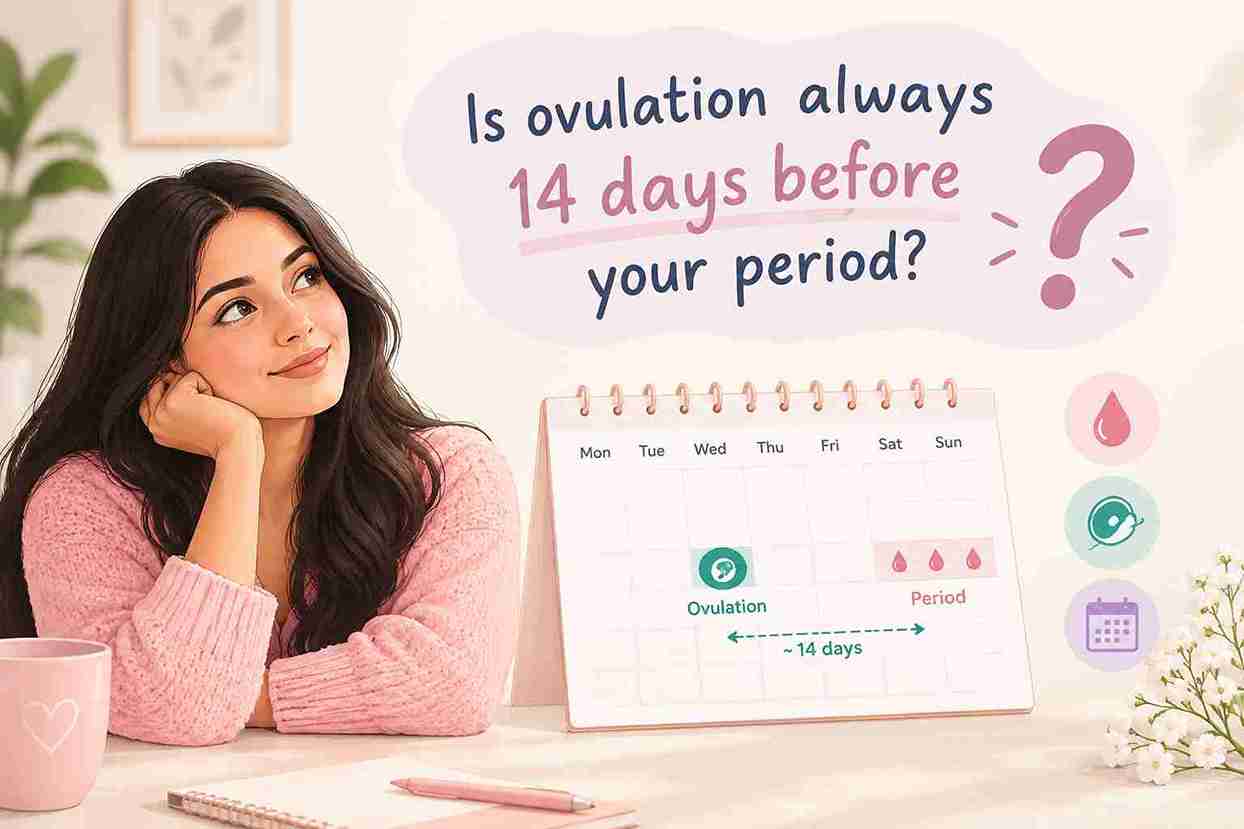
Is ovulation always 14 days before your period?
No, 14 is an average, not a fixed number.
Look at where the published guidance actually sits. One patient page from a large academic health system puts the gap between ovulation and the start of the next cycle at about 12 to 14 days. A UK pregnancy charity puts it at about 12 to 16 days. Both describe the same biology, and neither is wrong. The gap genuinely varies. Every calculator, including the sum on this page, subtracts a flat 14 anyway, because a calendar can only work with a single number.
That is what makes the subtraction a good estimate and a poor promise. For those reasons, the honest output is a window, not a date.
How much does it cost to confirm ovulation in India?
The calculation itself costs nothing. Confirming ovulation means a scan or a blood test; indicative ranges are below.
Test or Scan
What It Tells You
Indicative Cost
Pelvic or transvaginal ultrasound scan
Whether a follicle is developing at the time of the scan.
Rs 1,000 to Rs 3,500
Follicle tracking across one cycle, a series of scans
Whether and when ovulation happened in that cycle.
Rs 2,700 to Rs 6,000
Progesterone blood test, second half of the cycle
Whether ovulation is likely to have happened in that cycle.
Rs 900 to Rs 2,000
A single scan is the cheapest entry point. Follicle tracking costs more than one scan because it is several scans across the same cycle, usually three or four, timed a few days apart. A blood test is the least involved of the three and is often ordered alongside a scan rather than instead of one. None of these is a treatment cost. They are the cost of answering the one question a calendar cannot answer: whether you are ovulating at all.
When to see a fertility specialist
A specialist can confirm whether and when you are ovulating, something a calendar cannot do. Book an appointment if:
■ Your cycles are consistently shorter than 24 days or longer than 38 days.
■ Your cycle length varies so much from month to month that you cannot estimate a day at all.
■ Your periods have stopped for three months or more and you are not pregnant.
■ You have been trying to conceive for 12 months, or for 6 months if you are 35 or over.
■ You are over 40 and have started trying to conceive. Assessment is recommended straight away.
FAQs
Your questions, clearly answered
Find clear, trusted answers to the most common questions about IVF—designed to guide and support you every step of the way.
How do you calculate your ovulation day?
Subtract 14 from the length of your cycle. Your cycle length is the number of days from the first day of one period to the day before the next. On a 28-day cycle, that gives day 14; on a 26-day cycle, day 12; and on a 32-day cycle, day 18, counted from the first day of your period.
Should you count forward from your last period or back from your next one?
Count back from your next expected period. Counting 14 days forward from your last period only works on a 28-day cycle. On a 32-day cycle, it would put you at day 14 when the estimate is day 18, so you would be four days out.
How accurate is calculating your ovulation day?
It gives an estimate, not a date. In a study that timed ovulation by hormone testing across 696 cycles, the fertile window fell entirely within days 10 to 17 for only about 30 percent of women, and on every day from day 6 to day 21 a woman had at least a 1-in-10 chance of being in her fertile window.
When does ovulation happen after your period?
It depends on your cycle length. On a 21 day cycle ovulation is about a week after your period starts, which can be within a couple of days of your bleeding stopping. On a 28-day cycle, it is about two weeks, and on a 35-day cycle about three weeks.
Is ovulation always 14 days before your period?
No. Fourteen is an average, not a fixed number. Published patient guidance puts the gap between ovulation and the next period at about 12 to 14 days in one place and 12 to 16 in another, so the subtraction is a good estimate, not a reliable promise.
Can an ovulation calculator tell you your exact ovulation day?
No. A calculator runs the same subtraction faster, but it works from your calendar and has no information about your body, so it cannot be more accurate than the assumption behind it. Calendar methods and apps predict ovulation. A progesterone blood test or a follicle-tracking scan can confirm it.
What if your cycles are irregular?
This calculation will not give you a reliable answer, and no calendar method will. Track your cycle length for at least three months, then use your shortest and longest cycles to work out a range rather than a single day. If your cycles are consistently shorter than 24 days or longer than 38 days, speak to a doctor.
Can you use your ovulation day to avoid getting pregnant?
No. Working out your ovulation day is not a reliable way to avoid pregnancy. In the same study, women had at least a 1 in 10 chance of being in their fertile window every day between day 6 and day 21 of the cycle. Speak to a doctor about contraception that suits you.