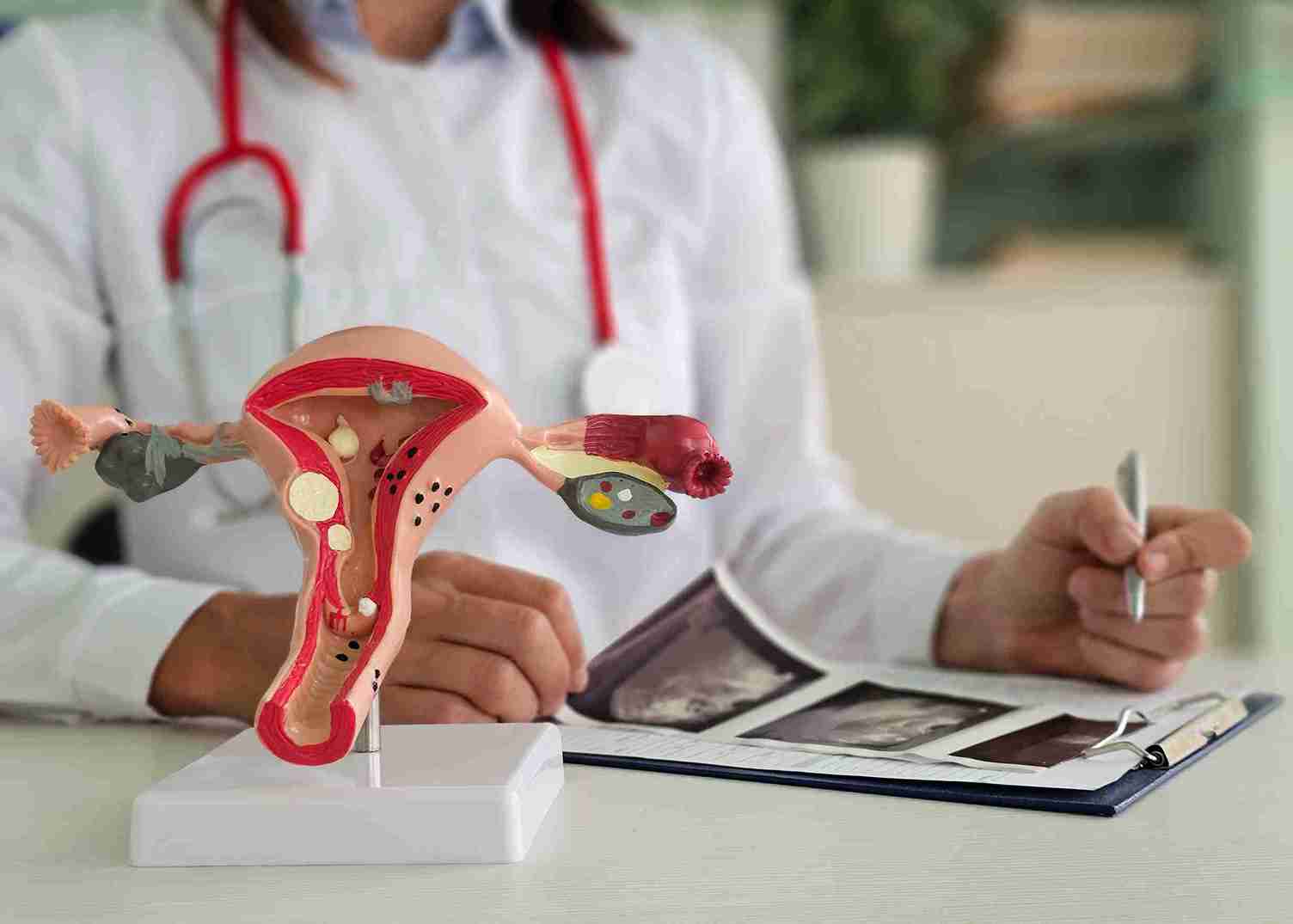
Ovarian Cysts: Types, Symptoms, Causes, Diagnosis and Treatment (Complete Guide)
September 28, 2026
Cloudnine
No items found.
Ovarian Cysts: Types, Symptoms, Causes, Diagnosis and Treatment (Complete Guide)
September 28, 2026
Cloudnine
No items found.
An ovarian cyst is a fluid-filled sac that forms on or inside an ovary. Most are functional cysts produced by the normal monthly cycle; they cause no symptoms, and they disappear on their own within two to three cycles. A small minority need investigation, and this guide explains exactly which ones.
What is an ovarian cyst?
An ovarian cyst is a fluid-filled sac that develops on or within an ovary. Most form as a by-product of ovulation, when a follicle (the small sac that holds a maturing egg) either fails to release its egg or seals over again after doing so. Ovarian cysts are one of the most common findings on a pelvic scan in women of reproductive age, and the large majority are benign.
Two numbers are worth holding on to. The Royal College of Obstetricians and Gynaecologists puts the risk of malignancy in an asymptomatic ovarian cyst in a premenopausal woman at roughly one in a thousand. The American College of Obstetricians and Gynecologists notes that functional cysts commonly resolve within six to eight weeks without treatment. Both explain why the usual first step is a repeat scan rather than surgery.
What your scan report is actually telling you
Your report describes what the cyst looks like, not what it will do. The words that matter most describe the wall, the contents and the number of compartments, because those features, far more than size, decide what happens next:
• Simple cyst: a thin-walled sac with clear fluid and nothing growing inside it. The most reassuring phrase on the report.
• Anechoic: the contents appear completely black on ultrasound, meaning pure fluid with no solid material.
• Unilocular: one compartment, no internal walls. Multilocular means several.
• Septation: a thin internal wall. A single thin one is usually benign; thick or multiple septations prompt closer review.
• Solid component or mural nodule: an area inside the cyst that is not fluid. The feature that most often triggers further investigation.
• Adnexal: located in the region of the ovary and fallopian tube. A location word, not a severity word.
• Incidental finding: the cyst was not what the scan was looking for. Most are found this way.
• Free fluid in the pouch of Douglas: a small amount of fluid low in the pelvis. A trace is normal, and often means a follicle has released.
How worried should you be?
For most women, not very. Having a cyst on an ovary is often entirely normal: a physiological cyst is the ovary doing its job, not failing at it. The overwhelming majority are benign, functional and self-limiting, and the standard response to a newly found simple cyst is a repeat scan in a few weeks rather than any intervention.
Honest reassurance means naming the minority treated differently. A cyst warrants closer attention if it has solid areas or thick internal walls, is growing quickly between scans, persists beyond a few months, causes severe pain, or is found after menopause. Those features do not mean something is wrong. They mean the cyst has earned a proper look.
Types of ovarian cysts
Ovarian cysts fall into two groups, and this split is the organising logic behind everything that follows. Functional cysts are a normal part of the menstrual cycle that did not quite finish, and they almost always resolve without treatment. Pathological cysts arise from tissue growth rather than the cycle, do not resolve on their own, and are the group that occasionally needs surgery.
Type
What it is
Typical size
Does it resolve on its own?
Risk level
Follicular cyst (functional)
A follicle that grew but never released its egg, so it kept filling with fluid
Usually 2 to 5 cm
Yes, typically within 2 to 3 cycles
Very low
Corpus luteum cyst (functional)
The structure left after ovulation seals over and fills with fluid or blood
Usually under 5 cm
Yes, usually within 2 to 3 cycles
Very low
Haemorrhagic cyst (functional)
A functional cyst that has bled into itself, which is why it looks complex on a scan
Usually 3 to 6 cm
Yes, usually within 6 to 12 weeks
Low
Chocolate cyst or endometrioma (pathological)
Old blood trapped in the ovary as a result of endometriosis, thick and dark brown in appearance
Variable, 2 to 10 cm or more
No, it persists and may enlarge
Low for cancer, but relevant to fertility and pain
Dermoid cyst or mature teratoma (pathological)
A benign growth containing tissue such as fat, hair or skin cells
Often 4 to 10 cm
No
Low, but usually removed if large or symptomatic
Cystadenoma (pathological)
A benign growth arising from the surface cells of the ovary, filled with watery or thick fluid
Can become very large
No
Low, though large ones are removed and examined
Two deserve a line of their own. A chocolate cyst, more formally an endometrioma, is caused by endometriosis depositing tissue on the ovary, and is the type most likely to matter if you are also being investigated for painful periods or difficulty conceiving. A dermoid cyst, or mature teratoma, is a benign growth from the ovary’s own germ cells, which is why it can contain unexpected tissue types.
A haemorrhagic cyst is worth reframing, because the name frightens people more than the diagnosis warrants. It is almost always an ordinary functional cyst that has bled a little into itself. The bleeding is what makes it look complicated on ultrasound, and it is the commonest reason a benign cyst gets reported as complex. Most settle on a repeat scan.
Simple versus complex: what your report means
A simple cyst is thin-walled, single-compartment, and filled with clear fluid. A complex cyst has something else going on inside it: internal walls, debris, blood, or solid areas. Complex does not mean cancerous. It means the ultrasound cannot fully characterise the cyst from its appearance alone.
The label covers a wide range. A haemorrhagic cyst is complex. An endometrioma is complex. A dermoid with fat inside is complex. All three are benign. The features that genuinely raise concern are solid nodules with blood flow through them, thick or numerous septations, and rapid growth, particularly after menopause. If your report says complex and nothing else, the usual next step is a repeat scan or a specialist review of the images, not surgery.
Symptoms of an ovarian cyst
Most ovarian cysts cause no symptoms at all. When they do, the commonest three are pelvic pain on one side, bloating or abdominal fullness, and a change in the pattern of your periods. Symptoms reflect the size and position of a cyst rather than how serious it is, which is why a large benign cyst can be uncomfortable while a small problematic one causes nothing.
• Pelvic pain on one side: usually a dull ache or heaviness low in the abdomen, on the same side as the cyst.
• Bloating or abdominal distension: a feeling of fullness or visible swelling. This is distension, not true weight gain; a cyst large enough to move the scales is uncommon, and the two are frequently confused.
• Irregular, delayed or heavier periods: a cycle disrupted by the same hormonal sequence that produced the cyst.
• Pressure symptoms: passing urine more often, or incomplete emptying, when a larger cyst presses on neighbouring structures.
• Pain during intercourse: clinically called dyspareunia, felt deep rather than at the entrance, often on one side.
• Mid-cycle pain: a sharp twinge around ovulation, more noticeable when a cyst is present.
Silent cysts: when there are no symptoms at all
Yes, you can have an ovarian cyst and feel completely well. In fact, this is the norm. The majority of ovarian cysts are picked up incidentally, during an ultrasound booked for an unrelated reason: a routine health check, an early pregnancy scan, a fertility assessment, or an investigation of abdominal pain that turns out to be something else.
Finding a cyst does not mean you missed a warning sign or ignored your body. Silent cysts are the commonest kind.
What the pain actually feels like
Ovarian cyst pain is usually one-sided, felt low in the abdomen on the same side as the affected ovary, and described as a dull ache, heaviness or pulling sensation rather than a sharp pain. It is often intermittent, more noticeable on movement or during intercourse, and can be worse in the days around ovulation or just before a period.
Sudden severe pain is a different matter and is covered in the urgent care section below. Back pain can occur as referred pain, felt in the lower back rather than where the cyst sits, but back pain on its own is rarely caused by an ovarian cyst and usually has another explanation.
Cysts and your menstrual cycle
Yes, an ovarian cyst can delay a period, and it is one of the more common reasons for an unexplained late period in a woman who is not pregnant. The usual mechanism is anovulation: the follicle that should have released an egg did not, and it became a cyst instead. Without ovulation, the hormonal signal that triggers a period is delayed or absent, so the cycle stretches.
Once the cyst resolves and ovulation resumes, cycles usually return to normal without treatment. Cysts can also make a period heavier or more painful. What they do not do is stop periods altogether over the long term; persistently absent periods point to a different cause and deserve their own assessment.
What causes ovarian cysts
Most ovarian cysts are caused by ovulation itself. Each month, a follicle grows in the ovary, matures and ruptures to release an egg. If it does not rupture, it continues filling with fluid and becomes a follicular cyst. If it does rupture but then seals over and fills again, it becomes a corpus luteum cyst. In both cases, the cyst is a normal cycle that did not complete cleanly rather than a disease process.
Pathological cysts have different origins. An endometrioma forms when endometriosis deposits tissue on the ovary that bleeds with each cycle. A dermoid arises from the ovary’s germ cells. A cystadenoma grows from its surface cells. These are growth processes, which is why they do not resolve the way functional cysts do.
You did not cause your ovarian cyst. Not through stress, not through diet, not through weight, not through anything you did or failed to do. There is no evidence that psychological stress causes ovarian cysts. Stress can disrupt ovulation, and disrupted ovulation is associated with functional cysts, but that is an indirect and unreliable link, not a cause you could have controlled.
The same applies to the other explanations commonly offered online and, sometimes, by well-meaning relatives. No specific food causes ovarian cysts. Cold drinks, curd, refined sugar and non-vegetarian food do not cause them. Late nights do not cause them. Not having children does not cause them, and neither does having them. Contraceptive pills do not cause functional cysts; if anything, they suppress the ovulation that produces them. If you are carrying guilt about this diagnosis, you can set it down.
Who is more likely to get them
Some groups do see ovarian cysts more often, though none of these factors is something you chose:
• Women of reproductive age: functional cysts require ovulation, so they are most common between the late teens and menopause.
• Women with endometriosis: endometriomas occur in a substantial proportion of women with the condition, and are often what leads to the diagnosis.
• Women undergoing fertility treatment: stimulation deliberately recruits multiple follicles, some of which persist as cysts between cycles. These are expected, monitored, and usually resolve before the next cycle.
• Women with polycystic ovary syndrome: the many small follicles seen in PCOS are not true cysts, but irregular ovulation makes functional cysts more likely.
• Pregnancy: a corpus luteum cyst is expected in the first trimester and supports the pregnancy until the placenta takes over.
Family history plays a limited role. There is no strong hereditary pattern for functional cysts, which are driven by the cycle rather than genetics. The link is stronger for endometriosis, so endometriomas are somewhat more likely if a close relative has it.
Ovarian cyst size: what the numbers mean
Size is the number everyone fixes on, and it is useful, but it is one factor among several. A 6 cm simple cyst in a 28-year-old is usually watched. A 3 cm cyst with a solid nodule in a 60-year-old is investigated promptly. Read the bands below alongside the appearance of the cyst, not instead of it.
Size band
What it usually is
What typically happens next
Under 3 cm
Almost always a normal follicle or a small functional cyst. Often not even reported as a cyst
Nothing. No follow-up needed unless there are symptoms
3 to 5 cm
Most commonly a functional or haemorrhagic cyst
Repeat scan in 6 to 12 weeks to confirm it has resolved
5 to 7 cm
Functional cysts can reach this size, but persistence at this size is more likely to be pathological
Repeat scan, often with specialist review. Surgery considered if it persists or causes symptoms
Over 7 cm
Less likely to be functional. More likely a dermoid, endometrioma or cystadenoma
Specialist assessment. Further imaging may be arranged, and surgery is more commonly discussed
Any size with complex features
Cannot be judged on size alone
Assessment is driven by the features, not the measurement
A 5 cm cyst is moderate, not large, and conservative management is still entirely standard at that size: if your report says 5 cm and simple, expect a repeat scan, not an operation.
At what size does a cyst need surgery?
There is no single size at which surgery becomes automatic. This is the honest answer, and it is different from the answer most search results give. Surgery is decided by a combination of factors: whether the cyst persists over several months, whether it has complex or suspicious features, whether it is causing significant symptoms, your age and menopausal status, and how it is behaving between scans.
Size does contribute. A simple cyst under 5 cm in a premenopausal woman is very unlikely to lead to surgery. Beyond about 5 to 7 cm, the balance shifts, partly because larger cysts are less likely to be functional and partly because torsion risk rises with size. But a persistent 4 cm endometrioma causing severe pain is far more likely to be operated on than an asymptomatic 6 cm simple cyst that is already shrinking. Size opens the conversation. It does not settle it.
Do cysts grow, and how fast?
It depends entirely on the type. Functional cysts often grow for a week or two and then shrink, which is why a scan repeated too early can be misleading. Endometriomas and dermoids tend to grow slowly, sometimes by a centimetre or so a year, and may stay stable for long periods. This is why the standard approach is serial scans at intervals of six weeks to six months rather than a single measurement.
Rapid growth between scans is the pattern that matters. A cyst that enlarges noticeably over a short interval, particularly if it is also developing solid areas, prompts specialist referral regardless of absolute size. Growth is more informative than size, and the interval scan exists precisely to reveal it.
How ovarian cysts are diagnosed
Ovarian cysts are diagnosed on ultrasound. Usually by a pelvic examination, then an ultrasound to confirm the cyst and describe its features, then a repeat scan after an interval to see what it does. Blood tests are added only when the appearance of the cyst or your age makes them useful. Most women never progress past the second scan.
Which scan is best: a transvaginal ultrasound gives significantly more detail because the probe sits closer to the ovaries, and it is the preferred first-line test where appropriate. A transabdominal scan is used where a transvaginal scan is not suitable or not acceptable, including for women who have not been sexually active, and who need a full bladder. MRI is reserved for cases ultrasound cannot characterise.
Blood tests for ovarian reserve are a separate question from cyst assessment, and worth understanding on their own terms: AMH testing and when it is useful.
CA-125: what the test does and does not tell you
A raised CA-125 does not mean cancer. This is the single most important sentence in this section. CA-125 is a protein measured in blood, and it rises in a long list of entirely benign conditions. It is not a screening test for ovarian cancer and should never be read on its own.
CA-125 is raised in endometriosis, in fibroids, in pelvic inflammatory disease, in adenomyosis, during menstruation itself, in early pregnancy, after recent pelvic surgery, and in conditions that have nothing to do with the pelvis at all, including liver disease and any cause of fluid in the abdomen or around the lungs. In premenopausal women in particular, a mildly raised result is common and frequently means nothing at all. This is precisely why the test is not used to screen healthy women.
CA-125 is useful as one component of a risk assessment, read alongside the ultrasound appearance and your menopausal status. Very high levels, around 200 units per millilitre and above, warrant specialist referral. A result a little above the reference range, in a premenopausal woman with a simple cyst, usually does not.
When in your cycle to book the scan
Where the scan is being done to assess a cyst rather than for an urgent symptom, the most informative window is roughly day 5 to day 10 of your cycle, counting day 1 as the first day of full bleeding. This is the early follicular phase, just after your period, when the ovaries are at their quietest.
The reason is practical. Later in the cycle, a dominant follicle or a fresh corpus luteum can look very much like a small cyst, so a scan done then may report a cyst that would not be there two weeks later. If you have been told to have a repeat scan in six weeks, time the appointment to fall just after a period.
If you are also having follicular monitoring as part of fertility care, your scans are already timed to the cycle, and the same logic applies.
How ovarian cysts are treated
There are three routes: watchful waiting, medical management, and surgery. The first, doing nothing beyond a repeat scan, is by a wide margin the most common, and for a simple cyst in a premenopausal woman it is the correct answer rather than a delay tactic. Medical management does not remove a cyst but helps with symptoms or prevents new ones. Surgery is reserved for cysts that persist, cause significant problems, or look suspicious.
When no treatment is needed at all
An ovarian cyst does not always need treatment, and most do not. Expectant management, which means a repeat ultrasound after an interval rather than any intervention, is the standard approach for a simple, single-compartment cyst under about 5 cm in a woman who has not reached menopause. Guidance from the Royal College of Obstetricians and Gynaecologists is explicit that such cysts usually resolve over two to three menstrual cycles without any need for intervention.
This is worth stating firmly, because much content aimed at Indian patients is written to sell an intervention. If you have been told a small simple cyst needs immediate removal, without a repeat scan and without symptoms driving the decision, a second opinion is reasonable. Where a cyst is unchanged or smaller after monitoring, the usual outcome is discharge rather than escalation.
Is there a medicine that dissolves a cyst?
No. There is no tablet, injection, syrup or supplement that dissolves an existing ovarian cyst. No medicine currently available shrinks a cyst that has already formed. Any product marketed on that claim is not supported by evidence, including prescription medicines as well as over-the-counter and traditional preparations.
Hormonal contraceptives are the source of most of the confusion here, and the distinction is simple: they can help prevent new functional cysts from forming by suppressing ovulation, but they do not shrink the one you already have. That is the entire answer. A cyst that resolves while someone is taking the pill has resolved on its own, on the timeline it was always going to follow.
Medication does have a legitimate place: simple pain relief for discomfort, and hormonal treatment to reduce pain and slow progression in endometriosis, which indirectly helps with endometriomas. Neither is the same as dissolving a cyst.
When surgery is actually considered
Surgery is considered when several factors point the same way, never on size alone. The usual triggers are:
• Persistence: a cyst unresolved across several months of monitoring, which suggests it is pathological rather than functional.
• Suspicious features: solid components with blood flow, thick or multiple septations, or rapid enlargement.
• Significant symptoms: pain affecting daily life, pressure on the bladder or bowel, or recurrent acute episodes.
• Size and torsion risk: larger cysts carry a higher risk of the ovary twisting, shifting the balance towards planned removal.
• Postmenopausal status: cysts found after menopause are held to a lower threshold for intervention.
• Fertility considerations: an endometrioma may be removed as part of a wider fertility plan, balancing benefit against the effect of surgery on ovarian reserve.
On whether it counts as major surgery: most ovarian cyst removals are laparoscopic, through several small incisions rather than an open cut, and many are day-care procedures. Recovery is measured in days to a couple of weeks. Larger or complex cases may need an open approach.
How much does ovarian cyst diagnosis and treatment cost in India?
For most women, the honest answer is that an ovarian cyst costs the price of two ultrasound scans and a consultation, and nothing more. Because most cysts are functional and resolve on their own, the usual expenditure is diagnostic rather than surgical. Surgery applies to a minority, and it is only at that point that costs rise meaningfully.
Costs vary by city, by centre and by whether a procedure is done as day-care or with an inpatient stay. The figures below are for Cloudnine Fertility centres.
Test or procedure
What it typically covers
Cost at Cloudnine Fertility
Pelvic ultrasound (transabdominal)
Initial scan to identify the cyst and measure it
₹1500 to ₹3500
Transvaginal ultrasound (TVS)
More detailed characterisation of the wall, contents and compartments
₹1000 to ₹2500
Repeat or interval scan
Follow-up scan at 6 to 12 weeks to confirm resolution or change
₹4000 to ₹5000 per scan
CA-125 blood test
Tumour marker, used only where the appearance of the cyst or your age warrants it
₹2000 to ₹3500
Specialist consultation
Review of the scan findings and a written management plan
₹1200 to ₹2000
Laparoscopic ovarian cystectomy
Keyhole removal of the cyst, usually as a day-care procedure
₹80000 to ₹200000
Histopathology
Laboratory examination of the removed tissue after surgery
₹1500 to ₹4500
Several factors move the final figure, and it is worth knowing which ones before you compare quotes:
• Whether surgery is needed at all: for most women it is not, and the cost stops at the scans.
• The type of cyst: an endometrioma or a dermoid takes longer to remove than a simple cyst, which affects theatre time.
• Keyhole versus open surgery: laparoscopic surgery usually means a shorter stay, which offsets a higher procedure cost.
• Day-care versus inpatient: an overnight or longer stay adds room, nursing and monitoring charges.
• Anaesthesia and theatre charges: usually quoted separately from the surgical fee.
• Histopathology: any removed cyst is sent for laboratory examination, which is a separate line item.
• Number of follow-up scans: a cyst that is being monitored over several months will need more than one.
On insurance, ovarian cyst surgery is generally treated as a medically indicated procedure by Indian health insurers where there is a documented clinical reason for it. Waiting periods, room-rent sub-limits and pre-existing disease clauses vary considerably between policies, and outpatient diagnostic scans are commonly not covered even where surgery is. Check your own policy wording, and ask the hospital billing desk for a written estimate before admission.
Do ovarian cysts go away on their own?
Yes. Most ovarian cysts resolve on their own within two to three menstrual cycles, without any treatment. This applies to functional cysts, which are the vast majority of ovarian cysts, and is why a repeat scan is the standard next step rather than an intervention. Pathological cysts such as endometriomas and dermoids do not resolve this way.
How long resolution usually takes
For a simple functional cyst, the usual timeframe is two to three menstrual cycles, roughly six to twelve weeks. The Royal College of Obstetricians and Gynaecologists uses the two to three cycle window for simple cysts under 50 mm, and the American College of Obstetricians and Gynecologists commonly cites six to eight weeks.
This is why a repeat scan is booked at six to twelve weeks rather than sooner: a scan repeated after two weeks often shows the cyst unchanged, causing alarm without adding information. Haemorrhagic cysts can take up to three months, because the blood inside has to be reabsorbed. A cyst still present after three to six months is reclassified as persistent and investigated as probably pathological.
What happens if a cyst ruptures
A ruptured ovarian cyst usually causes sudden, sharp, one-sided pelvic pain that eases over several hours to a few days. Most ruptures are self-limiting and need nothing more than rest and simple pain relief. Cysts rupture reasonably often, and many women have had one without ever knowing.
The honest caveat is that a minority need urgent assessment. If a cyst with a good blood supply ruptures, it can bleed into the abdomen, and the signs are pain that keeps worsening rather than settling, dizziness or fainting, a racing pulse, breathlessness, or pain spreading to the shoulder tip. Those mean go to hospital rather than wait it out. A ruptured cyst in someone who might be pregnant also needs same-day assessment, because ectopic pregnancy presents similarly.
Ovarian torsion: the one true emergency
Ovarian torsion is when the ovary twists on the ligaments that support it, cutting off its own blood supply. It is uncommon, but it is a surgical emergency, and it is the one complication of an ovarian cyst that cannot wait until morning.
It typically presents as sudden, severe, one-sided pelvic pain, often with nausea and vomiting, sometimes in waves. A cyst makes torsion more likely because the extra weight lets the ovary swing and twist, and risk rises with size. Torsion needs surgery within hours to restore blood supply, so a delay can cost the ovary itself. If you have a known cyst and develop sudden severe pain with vomiting, go to hospital immediately rather than calling for an appointment.
When to seek urgent care
Most ovarian cysts do not require emergency treatment. Any one of the following means same-day or immediate assessment:
• Sudden, severe pelvic or abdominal pain, particularly on one side and particularly if it came on abruptly.
• Pain with vomiting, which is the classic combination seen in ovarian torsion.
• Fever with pelvic pain, which may point to infection.
• Fainting, dizziness or a racing pulse, which can indicate internal bleeding.
• Breathlessness or pain at the tip of the shoulder, which can be a referred sign of blood in the abdomen.
• Pain that keeps getting worse over hours rather than settling.
• A positive pregnancy test with one-sided pain, which needs same-day review to exclude ectopic pregnancy.
• Rapid abdominal swelling with reduced appetite or a persistent feeling of fullness.
• Any new pelvic mass or cyst found after menopause, which is not an emergency but does need prompt, not deferred, specialist assessment.
Ovarian cysts and cancer: the honest answer
An ovarian cyst does not turn into cancer. The vast majority of ovarian cysts are benign, and malignant transformation of a simple functional cyst is not something that happens. The Royal College of Obstetricians and Gynaecologists puts the incidence of malignancy in asymptomatic ovarian cysts at approximately one in a thousand in premenopausal women, and around three in a thousand in women over fifty.
Ovarian cancer, where it occurs, generally presents as a mass that was malignant from the outset rather than a benign cyst that changed its nature. That is why follow-up focuses on characterising what a cyst is. Two exceptions are worth naming honestly: certain long-standing endometriomas and some borderline tumours carry a small increased risk, which is why persistent cysts are followed up properly.
How the distinction is actually made
Clinicians do not guess. The assessment combines several strands, and understanding the process removes much of the anxiety:
• Ultrasound appearance: simple, thin-walled and anechoic suggests a benign cyst. Solid areas with blood flow, thick septations and irregular walls point the other way.
• Change over time: resolution or stability is reassuring. Rapid enlargement is not.
• Menopausal status: the same cyst carries a different risk profile before and after menopause.
• CA-125 in context: useful as part of a risk index, particularly after menopause, and unreliable on its own before it.
• Symptoms: persistent bloating, early satiety, appetite changes or unexplained weight loss may warrant further evaluation, particularly when several symptoms occur together.
• Family history: a first-degree relative with breast or ovarian cancer lowers the referral threshold.
Cysts after menopause
Yes, cysts found after menopause are taken more seriously, and it is fair to know why rather than to be reassured vaguely. After menopause, the ovaries are no longer ovulating, so functional cysts should not be forming. A new cyst therefore cannot be explained away as part of the cycle, which removes the most common benign explanation.
This does not mean postmenopausal cysts are usually cancerous. They are not. Simple cysts are found in a meaningful proportion of postmenopausal women, and most are benign. What changes is the threshold: a scan and a CA-125 are arranged promptly, follow-up intervals are shorter, and the bar for referral is lower. That is appropriate caution, not a signal that something is wrong.
What does not work, honestly
No home remedy shrinks an ovarian cyst. There is no diet, drink, oil, compress, massage, detox, seed cycling protocol or supplement that dissolves a cyst that has already formed. This is not a cautious hedge; it is the clear position of the clinical evidence, and it is worth stating plainly because a great deal of content promises otherwise.
What genuinely helps is far less dramatic: an accurate description of the cyst on a good-quality scan, a properly timed repeat scan, pain relief while you wait, and a clinician who will explain the report. For functional cysts, the effective treatment is time, and the reason natural remedies appear to work is that the cyst was going to resolve regardless.
Exercise and yoga are the same case: neither gets rid of a cyst, and no posture or movement sequence shrinks one. Both are good for general wellbeing, but they are not treatments. With a large cyst, sudden vigorous twisting is worth avoiding, because it can contribute to torsion risk.
Ayurveda, homoeopathy and herbal remedies
There is no reliable clinical evidence that ayurvedic, homoeopathic or herbal preparations dissolve ovarian cysts. This is stated without dismissiveness: many women in India use these systems thoughtfully, often alongside conventional care. The evidence position is simply that no preparation from these systems has been shown in adequate trials to shrink an established cyst.
The practical risk is not the remedy itself but what it can displace. If a course of treatment is used instead of a repeat scan, a persistent or complex cyst can go uncharacterised for months. Keep the scan appointments, and tell your treating doctor about anything else you are taking, since some herbal preparations interact with prescribed medication.
Does diet make any difference?
No diet dissolves an ovarian cyst, and there is no list of foods you must avoid because you have one. You do not need to give up curd, rice, cold water, non-vegetarian food or anything else on the basis of a cyst diagnosis, and restrictive eating advice given for this reason is not evidence-based.
The honest nuance is that dietary quality matters for the conditions around cysts rather than for the cysts themselves. In polycystic ovary syndrome, a balanced diet supporting insulin sensitivity genuinely helps ovulation and symptoms. In endometriosis, some women find dietary changes ease pain, though the evidence is inconsistent. Neither is the same as shrinking a cyst.
Ovarian cyst versus PCOS versus fibroid
These three are confused constantly, and the confusion causes real anxiety. The clearest way to separate them is by organ and structure: an ovarian cyst is a single fluid-filled sac in the ovary, PCOS is a hormonal condition affecting the whole body, and a fibroid is a solid muscle growth in the uterus, not the ovary.
Ovarian Cyst, PCOS and Fibroids: How They Differ
Ovarian cyst
PCOS
Uterine fibroid
What it is
A single fluid-filled sac
A hormonal and metabolic syndrome, not a cyst
A solid, benign growth of muscle and fibrous tissue
Where it forms
On or inside the ovary
Affects both ovaries and the whole hormonal system
In the wall of the uterus, not the ovary
Typical symptoms
Often none. One-sided pelvic ache, bloating
Irregular or absent periods, acne, excess hair growth, weight changes
Heavy or prolonged periods, pelvic pressure, frequent urination
How it is diagnosed
Pelvic ultrasound
Combination of cycle history, clinical signs, hormone tests and ultrasound
Pelvic ultrasound
Usual treatment
Watchful waiting for most. Surgery for a minority
Long-term management of ovulation, metabolic health and symptoms
Watchful waiting, medical management, or surgical removal if symptomatic
Effect on fertility
Most do not affect fertility. Endometriomas are the main exception
A common and treatable cause of difficulty conceiving
Depends on size and position. Those distorting the cavity matter most
One further distinction: a cyst is a fluid-filled sac, while a tumour is a solid mass of tissue growth, and the word does not mean cancer. The great majority of ovarian tumours, including dermoids and cystadenomas, are benign.
Why PCOS is a misleading name
PCOS does not mean you have ovarian cysts. The name is a genuine misnomer, and it has caused decades of unnecessary confusion. What is seen on a scan in polycystic ovary syndrome is a larger-than-usual number of small, immature follicles arranged around the edge of the ovary. Follicles are normal structures. They are not cysts, and they do not need removing, monitoring or treating as cysts.
The distinction is more than semantic. PCOS is a hormonal and metabolic condition affecting ovulation, cycle regularity, insulin handling and often skin and hair, managed over the long term. An ovarian cyst is a single structure in one ovary that will usually resolve by itself. You can have PCOS without a single true cyst, and a cyst without PCOS. If a report says polycystic ovarian morphology, it describes that follicle pattern, not a set of cysts.
For how the condition is actually diagnosed and managed, see our full guide to PCOS and fertility.
Ovarian cysts, fertility and pregnancy
Most ovarian cysts do not affect fertility. Functional cysts come and go with the cycle and have no lasting effect on your ability to conceive. The main exception is the endometrioma, which is linked to endometriosis and can reduce ovarian reserve, both through the condition itself and through surgery to remove it.
Yes, you can get pregnant with an ovarian cyst, and many women do so without ever knowing one was present. If a cyst is found during pregnancy, it is usually a corpus luteum cyst, which is an expected finding in the first trimester and supports the pregnancy until the placenta takes over. These almost always resolve by the second trimester.
Most are not. The overwhelming majority of ovarian cysts are benign and resolve without treatment. A minority need closer attention: those with solid areas or thick internal walls, those growing rapidly, those persisting beyond a few months, and any cyst found after menopause. Sudden severe pain is always assessed urgently.
Can you have an ovarian cyst without any symptoms?
Yes, and this is the norm. Most ovarian cysts cause no symptoms at all and are found incidentally during a scan booked for another reason. A silent cyst is not a warning sign you missed. The absence of symptoms is reassuring rather than concerning, and does not mean a cyst has been growing unnoticed.
What size ovarian cyst needs surgery?
There is no single size that requires surgery. The decision combines persistence over several months, complex or suspicious features, symptom severity, your age and menopausal status, and how the cyst changes between scans. Simple cysts under 5 cm in premenopausal women rarely lead to surgery. Size opens the discussion rather than settling it.
Is there a tablet to dissolve an ovarian cyst?
No. No tablet, injection or supplement dissolves an existing ovarian cyst. Hormonal contraceptives can help prevent new functional cysts by suppressing ovulation, but they do not shrink one that has already formed. Pain relief helps with symptoms. A cyst that clears while on medication has resolved on its own timeline.
Schedule your consultation Today!
Book your consultation with our fertility experts the first step toward your parenthood journey.