Simple vs Complex Ovarian Cyst: What the Two Words Mean on Your Scan Report
October 5, 2026
Cloudnine
No items found.
Simple vs Complex Ovarian Cyst: What the Two Words Mean on Your Scan Report
October 5, 2026
Cloudnine
No items found.
Simple and complex describe how an ovarian cyst looks on ultrasound, not what it is. A simple ovarian cyst holds clear fluid and nothing else. A complex ovarian cyst holds something more, such as blood, a dividing wall or solid tissue. Neither word is a diagnosis, and complex does not mean cancer.
Simple vs complex ovarian cyst: the difference at a glance
Both words come from the sonographer's description of what the scan showed. They sort the cyst by appearance so that the right next step can be chosen. They do not tell you the cause, and they do not tell you the outcome.
Feature
Simple Ovarian Cyst
Complex Ovarian Cyst
Contents
Clear fluid only.
May contain blood, thick fluid, debris, or solid-appearing tissue.
Appearance on Screen
Uniformly black (anechoic).
May contain grey or bright areas inside.
Wall
Thin and smooth throughout.
May be thickened or irregular.
Internal Echoes
None.
Often present.
Septations
None.
May have one or more dividing walls.
Solid Areas
None.
May be present.
Blood Flow Inside Contents
Absent.
May be seen within solid areas.
Commonest Underlying Cause
A normal ovarian follicle that continued filling with fluid.
Several causes are possible, including bleeding into a functional cyst, endometrioma, dermoid cyst, or other ovarian lesions.
Typical Risk Band
Usually benign when it has a typical simple appearance.
Often benign, but risk is assessed from the specific ultrasound features rather than the word "complex" alone.
Does It Usually Resolve?
Yes. Many functional cysts clear within two or three cycles.
Depends on the type. Some resolve spontaneously, while others persist.
Usual Next Step
Often no further action, or an interval scan when clinically appropriate.
Further characterisation and/or repeat imaging may be recommended depending on the appearance, size, symptoms, and clinical context.
Does It Affect Fertility?
Usually not.
Depends on the underlying type and other factors rather than the word "complex" itself.
What makes an ovarian cyst simple
A simple ovarian cyst is defined by a fixed checklist, not by a doctor's impression. Under the reporting lexicon used by the International Ovarian Tumour Analysis group and the American College of Radiology, a cyst is called simple only when every one of the following is true.
Anechoic: uniformly dark on screen, with no internal echoes.
Unilocular: a single compartment, with no complete dividing wall inside it.
Thin, smooth wall: no thickening, no bumps, no irregular edge.
No solid component: no tissue growing into the cavity.
No internal blood flow: nothing lights up inside on Doppler imaging.
Posterior acoustic enhancement: a bright band behind the cyst, which pure fluid produces.
All of the criteria must be met. That is why a single small finding, such as a fleck of debris, flips the report from simple to complex without anything about the cyst having worsened. In Hindi-speaking consultations, you may hear it described as a saral gaanth in the andashay, but the report itself will carry the English term.
What makes an ovarian cyst complex
Complex simply means the checklist above was not met. Four findings trigger it: internal echoes, a septation, a solid component, or a thickened or irregular wall. Any one of them is enough. Because the word covers everything from a resolving bleed to a genuine tumour, it carries no fixed meaning on its own, which is why the report will describe the specific features alongside it. For the full report glossary, including phrases such as cannot exclude neoplasm, see what a complex ovarian cyst report actually means.
Is a complex ovarian cyst more serious than a simple one?
Not automatically. Risk is graded rather than binary. Radiologists in India increasingly score adnexal findings using O-RADS, a system that places each cyst into a risk band based on its features. Several appearances that read as complex to a patient sit in the almost certainly benign band, with under a one per cent chance of malignancy, including a classic bleeding cyst, a typical endometrioma and a typical dermoid. The features decide the band, not the word.
The honest reverse is also true: simple does not mean harmless. A large simple ovarian cyst can still twist on its blood supply, and a simple cyst that appears after menopause is still reviewed rather than assumed to be nothing. Size alone does not settle either case, because a small cyst with a solid area carrying blood flow matters more than a large, entirely clear one. For how the scoring bands themselves work, see the O-RADS classification for ovarian cysts.
Can a simple ovarian cyst become complex, or a complex ovarian cyst be re-reported as simple?
Yes, in both directions. This is exactly why repeat scans are booked rather than treatment being started straight away, and it is the single most common reason two reports on the same ovary read differently.
A simple ovarian cyst that bleeds into itself
The commonest crossover. A normal ovulation cyst bleeds internally, the clear fluid fills with fine strands and specks, and the next scan describes it as complex or as a haemorrhagic ovarian cyst. The cyst has not become more dangerous. It has changed appearance, and it will usually settle on its own.
A complex ovarian cyst whose contents clear
Blood and debris inside a cyst are gradually reabsorbed. Once they have gone, the contents look clear again, and a repeat scan may describe the same cyst as simple or find that it has resolved entirely. Nothing was treated. The body cleared it.
Why two radiologists can describe the same ovary differently
Three practical reasons. Timing in the cycle matters, because a cyst scanned just after ovulation looks different from the same cyst two weeks later. The route matters, because a transvaginal scan resolves fine internal detail that a transabdominal scan can miss. Machine quality and operator experience matter too. A change in wording is often a change in the scan, not a change in the cyst.
Which ovarian cyst types are simple and which are complex
The label maps onto type fairly predictably. This table shows only which side of the line each type falls on.
Cyst Type
Usual Appearance
Why
Follicular Cyst
Simple
A follicle that did not release its egg and continued filling with clear fluid.
Corpus Luteum Cyst
Either
May look clear when uncomplicated, or complex when it bleeds or develops a thicker wall.
Haemorrhagic Cyst
Complex
Blood inside the cyst can produce a fine, lace-like or reticular pattern of internal echoes.
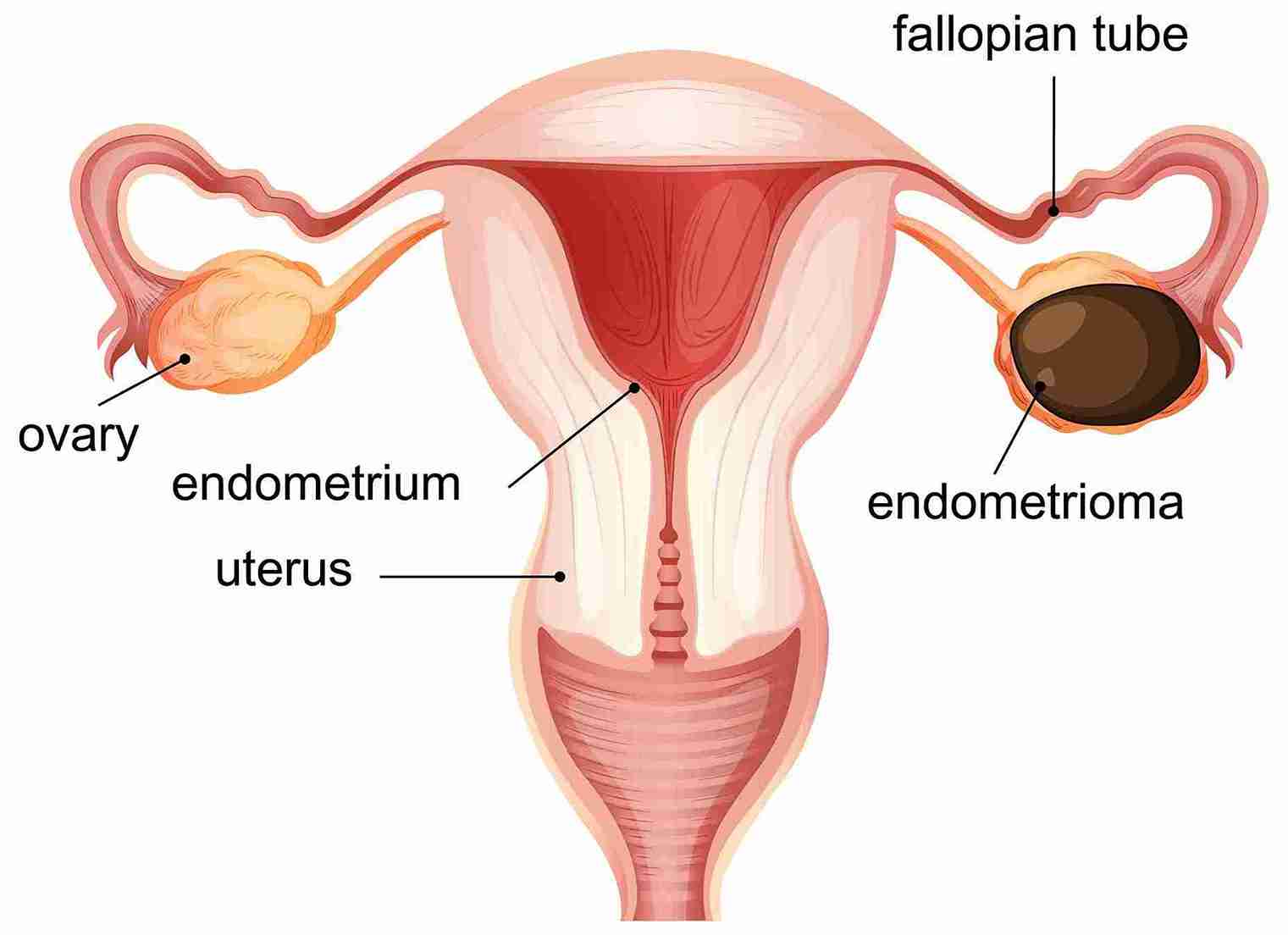
Endometrioma
Complex
Old blood associated with endometriosis produces a relatively uniform "ground-glass" appearance.
Dermoid Cyst
Complex
May contain fat, hair, or calcium, which can produce bright or solid-appearing areas on ultrasound.
Cystadenoma
Complex
May contain one or more septations and can become large.
Tubo-Ovarian Abscess
Complex
Infected fluid, thickened walls, and surrounding inflammation can create a complex appearance.
Corpus Luteum of Pregnancy
Either
A normal structure in early pregnancy that may appear clear or complex, particularly when there is internal bleeding.
Does PCOS produce simple or complex ovarian cysts?
Neither. Despite the name, polycystic ovary syndrome does not produce cysts at all. The many small structures seen on the scan are immature follicles, typically around two to nine millimetres across, and they are a normal part of ovarian tissue rather than fluid-filled sacs. PCOS is diagnosed on cycle pattern, hormone levels, and ovarian appearance together, never on a single scan finding. More on what a normal scan looks like in normal ovary size to get pregnant.
Does the label change what happens next for an ovarian cyst?
It changes the pathway, not the verdict. What follows is the usual route, not a rule, and your own history will shift it.
Situation
Usual Next Step
Why
Small simple cyst before menopause
Usually nothing further.
It is commonly a functional cyst related to ovulation and often clears on its own.
Large simple cyst
Often an interval scan to confirm that it is stable or resolving.
Larger cysts can have a higher risk of complications such as ovarian torsion, so follow-up may be advised.
Complex cyst with reassuring features
Repeat imaging after the next cycle or two, when appropriate.
Some complex appearances, such as those caused by bleeding, can change or resolve as the cyst clears.
Complex cyst with a solid area carrying blood flow
Specialist review, with further imaging and/or blood tests as appropriate.
A vascular solid component requires careful characterisation alongside the other scan findings.
Any new cyst after menopause
Medical review and appropriate assessment rather than assuming it is a normal functional cyst.
Ovulation has stopped, so a new ovarian cyst is not explained by the normal menstrual cycle.
Blood tests such as tumour markers are read alongside the scan rather than on their own, and are covered in the CA 125 test and ovarian cysts. A complex label does not mean surgery is coming. Where an operation is genuinely being considered, ovarian cyst surgery covers what that involves.
Can a medicine or the contraceptive pill turn a complex ovarian cyst into a simple one?
No. No medicine changes what is already inside a cyst. Combined hormonal contraception can reduce how often new functional cysts form by suppressing ovulation, which is a different thing from shrinking one that already exists. The same applies to the home remedies commonly suggested in India, including castor oil packs, apple cider vinegar and various herbal preparations. None has been shown to change a cyst's contents or its appearance on a scan.
What a simple or complex ovarian cyst means for fertility
Neither label decides fertility on its own. Simple functional cysts do not usually stop ovulation or prevent conception, and most clear without any effect on a cycle. Among complex cysts, the endometrioma is the exception that matters, because it is associated with reduced ovarian reserve, and surgery to remove one can reduce it further. That is why the underlying cause is worth far more attention than the word on the report. If reserve is the concern, AMH levels by age explain what the test does and does not tell you, and whether AMH testing is necessary when it changes a decision. A simple cyst rarely delays treatment, and where preserving options is the priority, the egg freezing process in India sets out the pathway.
When to seek care for an ovarian cyst
Seek same-day medical care if you develop any of the following:
Sudden, severe pain on one side of the lower abdomen
Persistent vomiting alongside that pain
Fever with pelvic tenderness
Dizziness, fainting or a racing pulse
Rapidly increasing abdominal swelling
These can indicate ovarian torsion (the ovary twisting on its blood supply), cyst rupture, or pelvic infection. All three are time-sensitive and none of them waits for a scheduled appointment.
Want to consult the Best Fertility in india? Please find the links below.
Find clear, trusted answers to the most common questions about IVF—designed to guide and support you every step of the way.
What is the difference between a simple and a complex ovarian cyst?
A simple ovarian cyst contains clear fluid only, with a thin smooth wall and nothing inside it. A complex ovarian cyst contains something more, such as internal echoes, a dividing wall or an area of solid tissue. Both words describe the ultrasound appearance, not the diagnosis.
Is a complex ovarian cyst more dangerous than a simple one?
Not automatically. Complex cysts are assessed more carefully because they need to be characterised, but most found on routine scans are benign. A large simple cyst can still twist, and a new simple cyst after menopause is still reviewed. The features matter more than the label.
Can a simple ovarian cyst turn into a complex one?
Yes, and it usually means something harmless. The commonest reason is bleeding into a normal ovulation cyst, which fills clear fluid with internal echoes and changes the report wording. The cyst has not become more dangerous. It has changed appearance and will often settle on its own.
Can a complex ovarian cyst be reported as simple later?
Yes. Once blood or debris inside a cyst is reabsorbed, the contents can look clear again and a repeat scan may describe the same cyst as simple, or find it has gone. This is one reason a repeat scan is booked rather than immediate treatment.