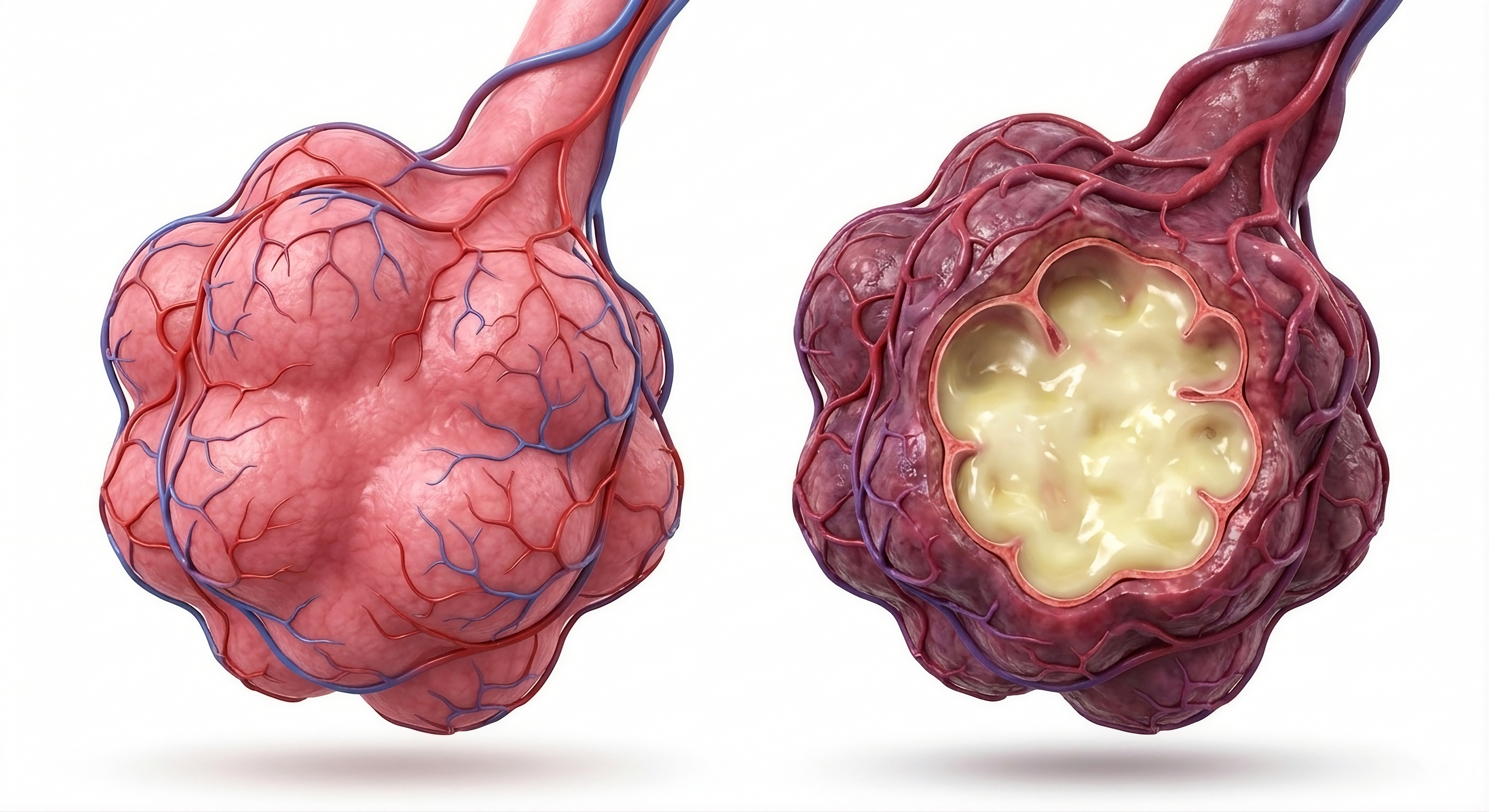
Yes, most ovarian cysts go away on their own. Functional cysts, the commonest type, usually resolve within one to three menstrual cycles without any treatment. But some cysts never resolve, no matter how long you wait. Endometriomas, dermoid cysts, and cystadenomas do not resolve on their own. Which group yours falls into is the only question that matters.
That split is the whole answer, and most pages give you only half of it. This page gives you both halves: how long the majority take to clear, why they clear at all, which types never will, and what your specialist is really testing when she asks you back for a repeat scan.
Will an ovarian cyst go away without surgery?
For most women, yes. The great majority of ovarian cysts picked up on a routine scan are functional cysts, which form as an ordinary part of ovulation and clear without anyone doing anything to them. Surgery is the exception on this pathway, not the default setting.
What it depends on is which type of cyst you have, and that is not something you can judge from how it feels. It is read off the ultrasound. The table below outlines what each type does over time.
Cyst Type
Does It Resolve on Its Own?
Typical Timeline
What Happens If It Does Not
Where to Read More
Follicular Cyst (Functional)
Yes, usually.
One to three menstrual cycles.
Reassessed as probably not functional; the focus shifts to identifying the type.
Functional Ovarian Cyst Guide (URL pending build)
Corpus Luteum Cyst (Functional)
Yes, usually.
One to three menstrual cycles.
Reassessed; persistence beyond this is uncommon.
Functional Ovarian Cyst Guide (URL pending build)
Haemorrhagic Cyst (Bleeding Into a Functional Cyst)
Yes, usually.
Six to twelve weeks.
Repeat imaging to confirm what it is.
Haemorrhagic Cyst Guide (URL pending build)
Endometrioma (Chocolate Cyst)
No.
Does not resolve.
Monitored or removed depending on symptoms and fertility plans.
Endometriosis and Fertility
Dermoid Cyst (Mature Teratoma)
No.
Does not resolve.
Monitored or removed surgically.
Dermoid Cyst Guide (URL pending build)
Cystadenoma
No.
Does not resolve.
Monitored or removed surgically.
Cystadenoma Guide (URL pending build)
One column in that table does all the work: the yes or the no. Everything else follows from it. If your cyst is functional, time is the treatment. If it is not functional, time changes nothing, and the plan has to come from elsewhere.
Why functional ovarian cysts clear on their own
A functional cyst is not a growth. It is a normal structure of the menstrual cycle that has stayed fluid-filled for longer than it should have.
Every cycle, your ovary grows a follicle, which is a small fluid-filled sac holding a developing egg. At ovulation, the follicle ruptures and releases the egg, then collapses into a temporary hormone-producing body called the corpus luteum, which breaks down before your next period. Two things can interrupt that sequence. If the follicle never ruptures, it keeps filling and becomes a follicular cyst. If the corpus luteum seals over instead of breaking down, fluid or blood collects inside it, forming a corpus luteum cyst.
In both cases, the ovary is not doing anything abnormal. It has run a normal process and simply not finished it. These cysts clear because the next cycle resets the ovary. Hormone levels fall at the end of the cycle; the cyst wall loses the signal that was keeping it going; the fluid is gradually reabsorbed, and the structure collapses. Nothing removes it. Your body just stops maintaining it.
That mechanism is also why the timeline is counted in cycles rather than in weeks. It is ovulation that drives the reset, not the calendar.
It follows that a cyst still present after two or three cycles is unlikely to be functional. It has been offered a reset several times and has not responded. That is a diagnostic signal, not a sign of slow healing. A fuller explanation of how functional cysts are classified belongs on our functional ovarian cyst guide. This section covers the mechanism only.
How long does an ovarian cyst take to go away?
One to three menstrual cycles is the honest answer for a functional cyst. The Royal College of Obstetricians and Gynaecologists, in Green-top Guideline No. 62 (November 2011), states that simple or functional ovarian cysts usually resolve over two to three menstrual cycles without any intervention. The American College of Obstetricians and Gynecologists puts the same point in weeks, describing functional cysts as often clearing within six to eight weeks, with many gone after one or two cycles.
Why the clock runs on cycles, not weeks
Six to eight weeks and two to three cycles sound like different answers. They are the same answer expressed two ways, and they only line up if your cycles are regular. The reabsorption of a functional cyst is driven by the hormonal fall at the end of each cycle. If you ovulate every 28 days, three cycles is roughly twelve weeks. If you do not ovulate on that schedule, the weeks keep passing, but the resets do not happen on time.
What an irregular cycle does to the timeline
Longer or unpredictable cycles stretch the timeline in real time without changing it in cycle terms. A woman with 45-day cycles may take four or five months to complete three cycles. She is not taking longer to heal. She is simply getting fewer resets per calendar month. This matters when someone tells you a cyst should be gone in two months, and yours is not, because the deadline you were given was measured in the wrong unit.
Why the repeat scan is booked when it is
Your specialist will usually ask for the repeat scan in the early part of a cycle, shortly after a period. That is deliberate. Early in the cycle, the ovary is at its quietest, so a new follicle developing for that month is far less likely to be mistaken for the original cyst still sitting there. Scanning at the wrong point can produce a false alarm about something that is simply this month's normal follicle. If you want to understand how ovarian findings are read on a pelvic scan more generally, our guide to how ovary size is read on a pelvic ultrasound covers the same territory.
Which ovarian cysts do not go away on their own?
Some ovarian cysts will never resolve on their own, no matter how long you wait. This is the half of the answer that most pages leave out, and it is the half that changes what you should do next. Waiting on these types is not conservative management. It is delay.
Endometriomas, also called chocolate cysts. These form when endometriosis tissue becomes established on the ovary. They are not part of the ovulation cycle, so a cycle reset does nothing to them. Reports of spontaneous disappearance exist but are uncommon enough that no plan should be built on them.
Dermoid cysts, also called mature teratomas. These contain ordinary body tissue, such as skin, fat, and hair, and can remain for years without symptoms. They tend to grow slowly rather than shrink. There is no mechanism by which they clear.
Cystadenomas. These are benign growths arising from the surface of the ovary. Some stay small indefinitely, and some become large. Neither behaviour includes resolving.
Persistent complex cysts. A cyst that looks complex on the scan, meaning it has solid areas, thick walls or internal divisions rather than clear fluid, is unlikely to be functional and is not expected to clear on the functional timeline.
If you have been told you have one of these, the useful question is no longer how long to wait. It is what the plan is, and whether that plan is monitoring or removal. For endometriomas in particular, that decision is tied closely to whether you are trying to conceive, which our guide to how endometriosis affects fertility sets out in detail. The type-specific pages for dermoid cysts and cystadenomas cover the rest.
What does not speed up an ovarian cyst?
Nothing you do makes a cyst go away faster. There is no diet, supplement, exercise routine, heat treatment, cleanse or medication that has been shown to shorten how long a functional cyst takes to resolve. It clears on its own schedule, or it was never going to clear at all.
Diet and supplements. No dietary pattern or supplement has been shown to shorten resolution time.
Exercise. Useful for general and hormonal health, but it does not act on an existing cyst.
Heat packs and home remedies. These may ease discomfort. They do not change the cyst itself.
Hormonal medication. Medication that stops ovulation can reduce the chance of forming new functional cysts. It does not clear one that is already there.
Here is the thing almost no page tells you. A cyst that has not gone away after three cycles is not taking its time. It is being reclassified. The repeat scan is not a waiting exercise that runs until the news improves. It is a test, and the thing being tested is the original assumption that the cyst was functional.
What your specialist compares between the two scans
The comparison is the cyst against itself, not the cyst against a threshold. Has it gone, shrunk, stayed the same, or grown? Has its appearance changed, from clear fluid towards something more solid or more divided? Is it still in the same place, on the same ovary? A single scan describes a cyst. Two scans, spaced across cycles, describe its behaviour, and behaviour is what classifies it.
What a stable or growing cyst changes
A cyst that is unchanged has failed the functional test. It has been through the reset and did not respond, which moves it out of the functional group and into the group that needs to be identified. A cyst that has grown moves faster in the same direction. Neither finding is automatically alarming, and neither means surgery. What both mean is that the question changes from how long to wait to what this is.
What the Repeat Scan Shows
What It Tells Your Specialist
What Usually Follows
Cyst Has Gone
It behaved as a functional cyst.
No further scanning for this cyst.
Cyst Is Smaller
Consistent with a resolving functional cyst.
Often one further scan to confirm it has cleared.
Cyst Is Unchanged
Unlikely to be functional; the type has not yet been established.
Further assessment to identify what it is.
Cyst Has Grown or Looks More Complex
Not functional; the appearance now carries more weight than size.
Specialist assessment and a decision made with you.
Size is part of that picture, but it does not decide anything on its own, and no single measurement is a trigger. How the cyst looks matters more than how big it is. The numbers themselves belong on ourovarian cyst size guide, and the treatment decision belongs on our ovarian cyst treatment guide.
Gone is not the same as cured
A clear scan means this cyst has gone. It does not mean you will never form another one. Functional cysts form because you ovulate, and you will keep ovulating, so forming another one at some point is entirely ordinary.
This catches people out, because a resolved cyst feels like a closed chapter and a new one six months later feels like a relapse or a treatment failure. It is neither. The first cyst was not treated badly, and your body has not gone wrong. An ovary that makes the occasional functional cyst is an ovary that is ovulating, which is the outcome you actually want if you are trying to conceive.
What would change the framing is a pattern: cysts forming repeatedly, cycle after cycle, or forming alongside pain, irregular periods or difficulty conceiving. That is a different question with different drivers, and it belongs on our recurrent ovarian cysts guide. A single recurrence, months apart, is not that pattern. It is ovulation working.
Waiting when you are trying to conceive
Watchful waiting costs almost nothing when you are not trying to get pregnant. It costs something specific when you are, because you are counting cycles too, and the same three cycles that are a reasonable observation period for the cyst are three attempts you did not get to make with a clear plan.
For most functional cysts, this is not a real conflict. A small functional cyst does not usually stop you from ovulating, does not usually need you to pause, and will very likely have cleared by the time anything else would have started. Waiting and trying can happen at the same time.
Where waiting genuinely costs you time is with the types that were never going to resolve. An endometrioma sitting on an ovary is not going to disappear over three cycles, and three cycles spent waiting for it to is time removed from a plan that may already be tight, particularly if ovarian reserve is a question. If that applies to you, our guides to how endometriosis affects fertility and what low AMH means for natural conception are the right next reads.
There is also a practical point about treatment cycles. A cyst noted at a baseline scan can lead a fertility cycle to be deferred to the following month, which is a normal and sensible decision rather than a setback, as our walkthrough of how a frozen embryo transfer cycle is planned explains. If you are timing intercourse rather than in treatment, our guide to physical signs that you are ovulating will help you keep trying while the cyst is being watched.
What does it cost to monitor an ovarian cyst in India?
Monitoring an ovarian cyst is mostly the cost of scans and consultations rather than the cost of a procedure. The figures below are indicative ranges for Cloudnine Fertility centres and vary by city and centre.
Item
Indicative Cost
Specialist Consultation
₹1,000 to ₹1,800
Pelvic or Transvaginal Ultrasound Scan, Per Scan
₹1,000 to ₹3,500
Repeat Scan at Six to Eight Weeks
₹1,000 to ₹3,500
Pelvic MRI, Where the Ultrasound Is Unclear
₹12,000 to ₹19,000
Tumour Marker Blood Panel, Where Indicated
₹2,000 to ₹5,000
AMH Blood Test, Where Ovarian Reserve Is Being Assessed
₹5,000 to ₹6,500
Laparoscopic Cyst Removal, If Surgery Is Needed
₹60,000 to ₹1,20,000+
What moves the total is how many scans you need and whether anything beyond ultrasound is required. A single functional cyst that resolves on the first repeat scan is the cheapest and most common version of this pathway. Costs rise when the cyst persists and needs identifying rather than simply watching, or when a surgical route is being considered, in which case day care versus admission, anaesthesia and the extent of the work-up all matter. Our guide to what a diagnostic laparoscopy involves covers that route.
When to seek care immediately
Watchful waiting assumes a stable situation. Some symptoms mean you should be seen now rather than at your scheduled scan.
Symptom
What to Do
Sudden, Severe Pelvic or Lower Abdominal Pain
Go to the nearest emergency department now.
Pain With Fever or Vomiting
Go to the nearest emergency department now.
Faintness, Dizziness or a Racing Heartbeat With Pain
Go to the nearest emergency department now.
Pain That Is Steadily Worsening Rather Than Settling
Contact your specialist the same day.
New or Rapidly Increasing Abdominal Swelling
Contact your specialist the same day.
These are triage signals, not a diagnosis, and they are uncommon. If you are trying to work out whether one-sided pain is ovulation or a cyst in the first place, our guide to telling ovulation pain from cyst pain is the better starting point.
How Cloudnine Fertility handles the waiting period
At Cloudnine Fertility, monitoring is an active clinical decision, not a way of putting you off. When a cyst is being watched, you should leave the consultation knowing three things: what type of cyst your specialist thinks it is, when the repeat scan is and why it is booked at that point in your cycle, and which symptoms mean you come back sooner. If you are trying to conceive, you should also know whether the cyst changes your plan for the next few cycles or leaves it alone. A waiting period with those four answers in it is a plan. Without them, it is just a wait.
Want to consult the Best Fertility in india? Please find the links below.
Find clear, trusted answers to the most common questions about IVF—designed to guide and support you every step of the way.
Do ovarian cysts go away on their own?
Most do. Functional cysts, the most common type, usually resolve on their own within 1 to 3 menstrual cycles without treatment. Some other types never resolve. Endometriomas, dermoid cysts, and cystadenomas do not clear by themselves, so the type of cyst matters far more than how long you wait.
How long does an ovarian cyst take to go away?
Usually one to three menstrual cycles. The clock runs on your cycle rather than on calendar weeks, so an irregular cycle lengthens the timeline in real time without changing it in cycle terms. If you ovulate roughly every 28 days, three cycles is about twelve weeks.
Which ovarian cysts do not go away on their own?
Endometriomas, dermoid cysts and cystadenomas do not resolve on their own. These are not functional cysts, and waiting will not clear them. Persistent complex cysts, meaning those with solid areas or internal divisions on the scan, also sit outside the functional group and are not expected to disappear.
Can I make my ovarian cyst go away faster?
No. No diet, supplement, exercise, or home remedy has been shown to shorten how long a cyst takes to resolve. A functional cyst clears on its own schedule. Hormonal medication can reduce the chance of forming new functional cysts, but it does not clear one that is already there.